Trump asks Supreme Court to let him build ballroom, citing national security needs and architectural values

Daftar Isi
Supreme Court Petition Seeks to Unblock White House Ballroom Construction
Earthguardiansonline.com – The White House is seeking emergency intervention from the nation’s highest court to proceed with a controversial $400 million ballroom project, arguing that congressional approval is unnecessary given national security imperatives and the president’s constitutional authority. The petition, filed Friday, represents the first time one of President Trump’s signature initiatives has reached the Supreme Court’s doorstep.
Solicitor General John Sauer’s filing emphasizes that the former East Wing site has become critical infrastructure for presidential protection. The document notes that multiple assassination attempts against Trump in recent years have elevated the ballroom from architectural ambition to security necessity. Sauer characterized the lower courts’ injunction as exceeding judicial boundaries, writing that the president serves as “the sole, elected head of the Executive Branch” rather than a mere occupant of the building.
Legal Battle Over Executive Authority
The legal dispute centers on whether the president can unilaterally transform the White House grounds or must seek legislative consent. The DC Circuit Court of Appeals delivered a 2-1 ruling on August 7, siding with a federal judge who ordered construction halted on above-ground portions of the ballroom. The appeals court concluded that Congress retains ultimate decision-making power over such transformative changes to the historic property.
Whether or not a massive ballroom should be constructed is for Congress to decide and is not a matter for Executive self-help.
The appeals court granted a 14-day reprieve to allow Trump’s legal team to petition the Supreme Court, creating the current window for emergency review. During this period, construction of an underground security bunker beneath the ballroom has continued uninterrupted, as both lower courts permitted this portion of the project to proceed.
Architectural Vision Takes Shape
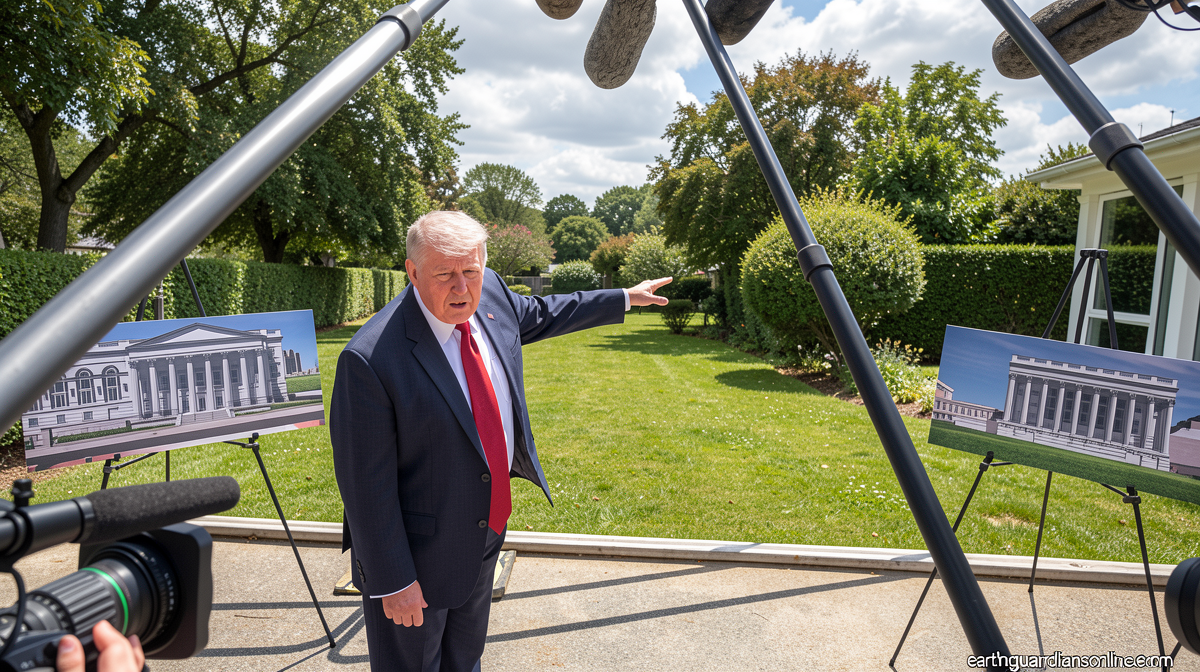
New renderings included in the Supreme Court filing reveal design modifications to the ballroom, most notably the addition of at least two large presidential seals rendered in gold on the exterior facade. The structure, designed by lead architect Shalom Baranes, spans approximately 89,000 square feet—substantially larger than the 55,000-square-foot Executive Mansion that serves as the president’s primary residence.
Construction progress has been visible since spring, with photographs showing multiple levels of concrete support columns, extensive metal rebar networks, and heavy machinery including a tower crane operating on the site. President Trump has maintained direct oversight of design elements ranging from floor plans to marble selections for interior surfaces.
Historic Preservation Concerns
The legal challenge originated last year when the National Trust for Historic Preservation, America’s premier heritage organization, filed suit against the administration. The preservation group argued that Congress never surrendered comprehensive authority to redesign the White House according to individual presidential preferences.
The National Trust has shown, compellingly, that Congress has not ceded unfettered authority to the Executive Branch to dramatically redesign, reshape, and reconstruct the White House – the People’s House – to fit a particular President’s desires.
The organization has until noon on Tuesday to submit its response to the Supreme Court petition. The administration contends that the partial injunction allowing only bunker construction remains insufficient, warning that halting above-ground work threatens both current and future presidential safety.
Security Infrastructure and Timeline
Sauer’s filing emphasizes that the ballroom’s design incorporates protective functions beyond ceremonial purposes. The entire structure serves as a shield for the military installation positioned beneath it, with the administration arguing that incomplete construction creates vulnerability during the building phase.
The project carries an expedited completion target of summer 2028, positioning the ballroom to open months before Trump’s anticipated departure from office. This accelerated schedule reflects the administration’s position that security considerations justify bypassing traditional congressional oversight mechanisms for White House renovations—a precedent that previous presidents have utilized without exception, according to the filing.
As the Supreme Court considers whether to grant certiorari, the case represents more than a dispute over construction permits. It raises fundamental questions about executive power, judicial restraint, and the balance between preserving America’s most iconic building while allowing it to evolve to meet contemporary security demands.
Related Reading
Frequently Asked Questions
What is Trump asks Supreme Court to let him?
Trump asks Supreme Court to let him is the main topic of this guide. The article explains the context, practical details, and next steps readers should understand.
Why does Trump asks Supreme Court to let him matter?
Trump asks Supreme Court to let him matters because readers are looking for a useful answer, not just a short summary. Good content should match search intent and help them decide what to do next.