How a celebrity cat inspired the construction of the world’s largest wildlife corridor

Daftar Isi
A Hollywood-Era Cougar Helped Turn an Urban Wildlife Crisis Into a Landmark Crossing
Earthguardiansonline.com – Los Angeles is preparing to open a major new passage for wildlife above one of its busiest roads, a project shaped in part by the remarkable life of a mountain lion that became an unlikely local celebrity. The Wallis Annenberg Wildlife Crossing, spanning the 10-lane Highway 101, is designed to reconnect habitat separated by traffic and development.
The 165-foot-wide overpass links the Santa Monica Mountains with the Sierra Madre Range, restoring a route between two important natural areas. Its planned opening date is December 2, and the crossing is intended to allow animals to move across the landscape without entering the highway below.
The mountain lion who captured Los Angeles
The project gained powerful public momentum through P-22, a California mountain lion that made Griffith Park his home after crossing two of the busiest freeways in the United States. The park is surrounded by dense urban development, yet the cougar carved out a territory within its boundaries and nearby neighborhoods.
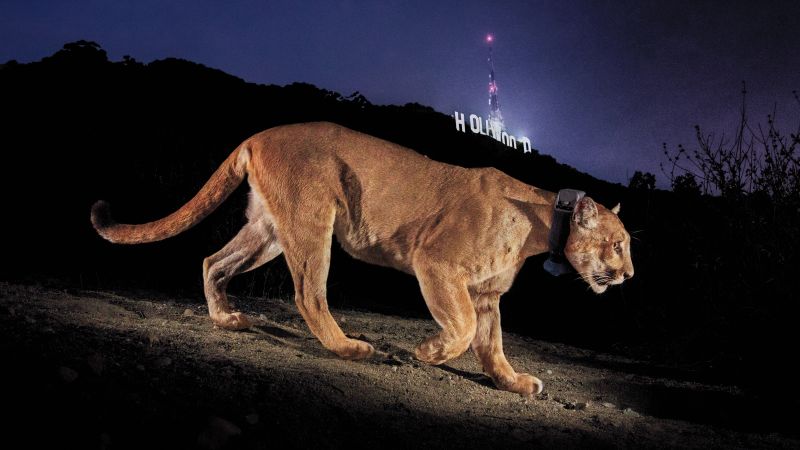
Wildlife photojournalist Steve Winter helped turn P-22 into an international symbol when one of his remote cameras photographed the animal beneath the glowing Hollywood sign in 2013. The image placed a solitary wild cat at the heart of one of the world’s most recognizable cities.
“People fell in love with this cat, he was a celebrity in the land of celebrities,” Winter said. “It was like a movie.”
P-22 was later spotted resting in residential yards and feeding on garden plants, appearances recorded through camera traps and household security cameras. His visibility made him an unusually familiar wild resident for many Angelenos. But his circumstances also revealed the danger of a life confined by roads.
His range in Griffith Park covered only 6.7 square miles. With limited space and few safe paths beyond the park, P-22’s movements increasingly brought him into urban areas. He was euthanized in 2022 after suffering severe injuries in a vehicle collision along with illness.
When habitat becomes an island
P-22’s death drew attention to a wider challenge confronting large predators around the world. Big cats are losing territory, and some species have already lost more than 90% of the areas they once occupied. The threat is not limited to outright habitat destruction. Remaining land is often broken into disconnected fragments by roads, cities and other barriers.
“It’s not only that animals are losing habitat, but remaining habitat is becoming really fragmented, with areas often cut by roads that are nearly impossible to cross,” environmental journalist Sharon Guynup said.
For animals that need broad territories, fragmentation can restrict access to food, mates and new habitat. It can also make a population more vulnerable when individuals are trapped in small, isolated areas. Wildlife crossings address one part of that problem by providing safer movement routes where roads have divided a landscape.
“They’re prisoners in these areas,” Winter said, “so we need to find a way to give animals the opportunity to cross these roads that have them hemmed in.”
The Los Angeles crossing has therefore become more than a piece of infrastructure. It represents an effort to make a heavily developed region more navigable for wildlife while reducing the risks created when animals attempt to cross traffic lanes.
Stories intended to protect big cats
Winter and Guynup have spent decades documenting big cat species in different parts of the world. Their work combines photography and reporting, and their National Geographic book, Big Cats, focuses on conservation stories with practical consequences rather than simply presenting celebrated images.
“We didn’t want to make this a greatest hits photo book; we wanted to focus on stories that had tangible impact,” Guynup said.
Their reporting explores efforts ranging from confronting illegal wildlife trade to encouraging conservation policy. Behind each story is a broader argument: protecting large predators can help sustain the ecosystems around them.
“We need the entire spectrum of life to keep ecosystems healthy, and big cats have an outsized role in that process,” Guynup said.
Changing the story of jaguars in Brazil
One of Winter’s earliest encounters with a jaguar came in 1997, while he was traveling through the waters of Corixo Negro in Brazil’s Pantanal. The Pantanal, the planet’s largest tropical wetland, supports one of the world’s largest concentrations of jaguars.
At the time, many local ranchers believed jaguars were responsible for cattle losses. Retaliatory hunting followed, while jaguar fur was also sold for profit. Winter described the prevailing view bluntly:
“So they thought the only good jaguar was a dead jaguar,” he said.
His work with biologist Sandra Cavalcanti helped challenge that perception. Using GPS collars, Cavalcanti found that cattle account for less than one-third of jaguars’ diet. Jaguars may feed on as many as 85 different animal species, while disease and malnutrition were responsible for more cattle deaths than jaguars.
The combination of scientific evidence and widely seen photography helped shift public understanding of the animals from feared predators to wildlife with ecological and economic value. The Pantanal’s importance as a destination for jaguar sightings also demonstrated that living jaguars could support local economic interests.
From the wetlands of Brazil to the highways of Southern California, the underlying lesson is similar: coexistence depends on making room for wildlife. P-22 could not survive the constraints of an isolated urban park, but the crossing inspired by his story offers a chance for other animals to move through the region more safely.
Related Reading
Frequently Asked Questions
What is How a celebrity cat inspired the construction?
How a celebrity cat inspired the construction is the main topic of this guide. The article explains the context, practical details, and next steps readers should understand.
Why does How a celebrity cat inspired the construction matter?
How a celebrity cat inspired the construction matters because readers are looking for a useful answer, not just a short summary. Good content should match search intent and help them decide what to do next.