Tesla unveils what it says is a flying car

Daftar Isi
Tesla Displays Roadster Prototype With Dramatic Air-Jet Stunts
Earthguardiansonline.com – Tesla CEO Elon Musk introduced a new version of the Roadster on Thursday with a demonstration designed to make an extraordinary claim: the two-seat sports car could eventually do more than deliver extreme speed on pavement. At a SpaceX test site in Texas, Musk presented the vehicle as a car capable of lifting itself and performing short aerial maneuvers through a system of high-pressure air jets.
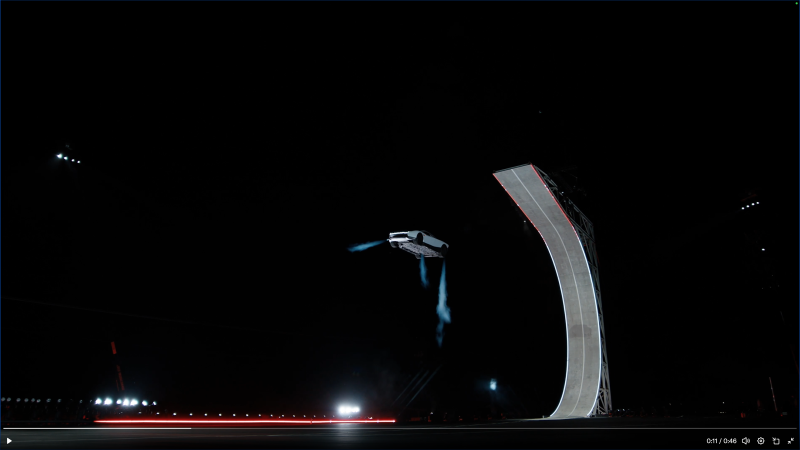
The event featured a sequence of carefully staged demonstrations rather than a conventional road test. The Roadster accelerated up a sharply inclined ramp, using suction beneath the vehicle to remain attached as it climbed and briefly hung inverted. It then left the ramp, rotated in the air, and used its jets to return to the ground.
No person was inside the car for that portion of the presentation. Musk said the decision was made for safety.
“Success is not guaranteed,” Musk told the audience. “I mean that. It’ll probably work, but if it doesn’t work, we’re at a safe distance.”
Later, the Roadster jumped over a row of existing Tesla vehicles parked alongside one another. It also used rear-mounted jets to reach 60 mph in less than one second, a performance figure Musk described as a record. The company says the car’s propulsion system uses 10 nozzles and “ultra high-pressure air tanks” to provide both rapid acceleration on the ground and lift during aerial movement.
Musk characterized the project as the result of combining Tesla’s vehicle engineering with SpaceX’s rocket expertise.
“The results of what happens when you have a collaboration with the world’s best car company and the world’s best rocket company,” Musk said.
A Spectacle With Major Questions Still Unanswered
The display showed that the Roadster can perform brief hops and controlled stunt-like movements. It did not establish that the vehicle can conduct sustained, long-distance flight or function as an aircraft owners could routinely use to travel through the air.
That distinction is central to evaluating the announcement. A car that can rise, leap or maneuver briefly with thrust is very different from a road-legal vehicle capable of safely taking off, transitioning into forward flight, navigating airspace and landing in varied conditions. The Texas event offered no demonstration of that broader capability.
Musk told an enthusiastic crowd that the live audience was important because people needed to see the demonstration directly.
“We need an audience to prove that it’s not AI or SI. So you guys can tell people you saw it with your eyes, because what you see with your eyes, you will not believe.”
Tesla expects the Roadster to enter production in 2028. The company and Musk have previously announced ambitious product schedules that were later delayed by years, making the production target uncertain. The engineering challenge may be especially demanding here because the project combines the requirements of a high-performance road car with some characteristics associated with vertical-flight aircraft.
Why a Genuine Flying Car Is Hard to Build
Interest in electric vertical takeoff and landing aircraft, commonly called eVTOLs, has grown in recent years. Working prototypes exist, but they face difficult technical and operational hurdles. These include managing weight, maintaining lift, ensuring stability, developing safety systems and meeting the requirements that apply to both road travel and aviation.
Roger Connor, curator for vertical flight at the Smithsonian’s National Air and Space Museum, noted before the Tesla event that aircraft and cars are built around competing priorities. Aircraft benefit from keeping weight as low as possible, while passenger vehicles are expected to include protective structures such as bumpers and crumple zones.
“Aircraft are extremely sensitive to weight, whereas with ground vehicles you want them to have bumpers and crumple zones and all that,” Connor said. “Inevitably, something that is a hybrid between the two is going to be a poor performing aircraft and a poor performing vehicle, and also quite expensive.”
That tradeoff helps explain why a visually impressive jump is not the same as practical flight. A vehicle needs enough energy and lift to remain airborne, adequate control when moving forward, and a dependable way to deal with changing conditions. It must also carry people safely while remaining useful on ordinary roads.
California startup Alef is developing another vehicle intended to become airborne. Its design uses eight propellers, split between the front and rear of the vehicle. But the prototype weighs 254 pounds, far less than a Tesla Roadster, and is designed to carry only one person whose weight must remain below that of the vehicle.
Alef CEO Jim Dukhovny said before Tesla’s event that getting the Roadster off the ground would be plausible, but he emphasized that lift alone does not solve the most difficult part of the challenge.
“It absolutely is 100% feasible,” Dukhovny said. “That being said, the hardest part on all eVTOLs, and for us, it’s a transition from (rising) vertical to (moving) forward. It needs to be extremely careful, making sure you do not lose lift, and making sure it’s very stable.”
From Hopping to Sustained Flight
Connor questioned whether a street-legal car such as the Roadster could deliver the kind of airborne travel many people associate with a flying car. He drew a clear line between a short burst of lift and a vehicle that can operate as a true aircraft.
“We’re not talking about sustained flight,” Connor said. “We are literally talking about hopping.”
Tesla’s demonstration nevertheless points to an unusual direction for the Roadster: a sports car designed to use compressed-air thrust for acceleration and brief aerial movement. If the company can translate the concept into a production vehicle, it could create a new category of extreme-performance automobile. For now, however, the public display showed short-range maneuvers rather than evidence of routine, practical flight.
Related Reading
Frequently Asked Questions
What is Tesla unveils what it says is?
Tesla unveils what it says is is the main topic of this guide. The article explains the context, practical details, and next steps readers should understand.
Why does Tesla unveils what it says is matter?
Tesla unveils what it says is matters because readers are looking for a useful answer, not just a short summary. Good content should match search intent and help them decide what to do next.