
Protests and defeat: Chelsea fans run out of patience with club’s billionaire American owners
Protests and defeat: Chelsea fans run out of patience with club’s billionaire American owners
Protests and defeat – Four years after US billionaire Todd Boehly assumed control of Chelsea, the once-revered football club finds itself at a crossroads. The BlueCo consortium, backed by Boehly’s financial empire, promised transformative change, vowing to elevate the team to unprecedented heights. Yet, as the final whistle echoed across Wembley Stadium on Saturday, the season’s culmination left fans disillusioned. A protest erupted before the FA Cup final, signaling a growing rift between the supporters and the board that now governs the storied London outfit.
From Ambition to Uncertainty
Boehly’s arrival in May 2022 was marked by grandiose aspirations. “We’re all in – 100%,” he declared, emphasizing his commitment to reshaping Chelsea’s future. The BlueCo group, however, has faced mounting criticism for its approach. Despite a multi-billion-dollar investment, the club’s performance has faltered, with fans now questioning whether the owners have prioritized financial splendor over tactical and structural clarity.
A Season of Disappointment
Chelsea’s struggles this season have been palpable. After a dismal run of form, the team secured a surprising FA Cup final berth, a rare bright spot in an otherwise bleak campaign. Yet, the victory was hollow. A 1-0 loss to Manchester City on Saturday extinguished any lingering hope, leaving supporters in despair. The match day was a microcosm of the broader issues plaguing the club: a bloated squad, a lack of direction, and an apparent disconnect between the owners and the fans.
The dejection was universal, both on and off the pitch. As players trudged off the field, fans stood in silence, their disappointment etched in every face. The stadium, once a fortress of tradition and triumph, now felt like a stage for a theatrical downfall. Even the most optimistic supporters admitted that their faith had been shaken. “I think we’re going to get smashed,” one fan muttered on the tube, three hours before the game. His friend, echoing the sentiment, replied, “I think you’re probably right.” The exchange, though lighthearted, underscored the fatigue that has settled over the Chelsea faithful.
Fractured Unity and Growing Frustration
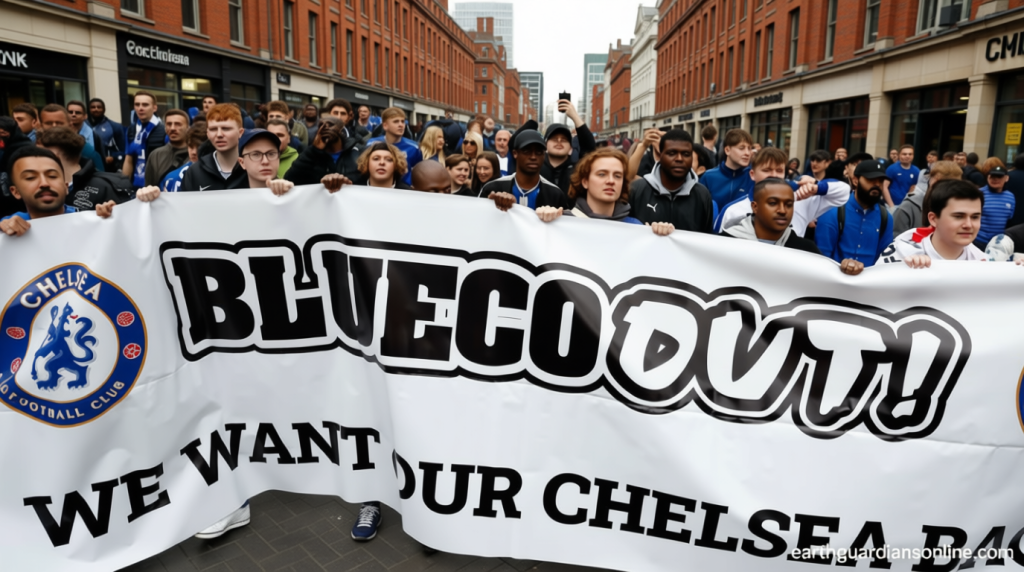
Chelsea’s fanbase, long accustomed to success, now demands consistency. The owners’ strategies have not met these expectations, leading to a palpable sense of alienation. A protest on Wembley Way before the FA Cup final was a stark reminder of this frustration. Fans marched behind a banner that read: “BlueCo out! We want our Chelsea back.” The chant, once a symbol of unity, now carried an air of resignation.
Inside the stadium, however, the atmosphere shifted. Supporters rallied behind their team, singing familiar anthems that had once defined the club’s identity. The players responded with a spirited effort, showcasing moments of brilliance in their clash against Manchester City. Still, the lack of decisive quality proved costly. The final result was a cruel indictment of the club’s investment, raising questions about the effectiveness of their recruitment strategy.
Management Changes and Leadership Vacuum
The turmoil extends beyond the playing field. Calum McFarlane, appointed as interim manager for the FA Cup final, managed the team with a temporary resolve, but his tenure highlighted the instability at the helm. Over the past year, Chelsea has seen a revolving door of coaches, each leaving behind a trail of challenges. Liam Rosenior, the latest casualty, was dismissed in April after being lured from Strasbourg, a club also under the ownership of Chelsea’s hierarchy. Before him, Enzo Maresca, who had led the team to the FIFA Club World Cup, resigned in January, citing an inability to thrive under the current system. These departures underscore a lack of long-term vision and support for the coaching staff.
The club’s next step came on Sunday with the announcement of Xabi Alonso as the permanent manager. The former Bayer Leverkusen and Real Madrid tactician will take charge on July 1, tasked with revitalizing a squad that has become a target for criticism. Alonso’s appointment signals a shift toward stability, but it also raises concerns about the owners’ ability to adapt to the mounting pressure from fans.
The Billion-Dollar Gamble
Chelsea’s financial commitment to its squad has been staggering. Over $1 billion has been spent on player transfers since Boehly’s takeover, yet the returns have been underwhelming. The strategy of signing young talent to long-term contracts in hopes of future profits has created a squad that is both deep and disjointed. While the club boasts a vast roster, it lacks the experienced leadership that is crucial for sustained success. Young players, often high-profile signings, have not yet translated into on-field cohesion or dominance.
“The squad is too big,” one analyst noted, adding that the infusion of young talent has diluted the team’s quality. The FA Cup run, though a brief reprieve, revealed the club’s inability to maintain consistency. Fans now see the owners’ spending as a double-edged sword—while it has brought in star names, it has also left them questioning whether the money is being used wisely. The pressure on the new management is immense, with the expectation that they will right the ship before the next season.
Future Outlook and Fan Sentiment
As Chelsea prepares for its next chapter under Alonso, the fanbase remains divided. Some see this as a chance to restore the club’s former glory, while others are skeptical. The recent loss to Manchester City has become a turning point, forcing the owners to confront the reality of their stewardship. With the league standings still precarious and the Champions League qualification at risk, the time for optimism is running out.
The path forward will depend on how quickly the new management can implement changes. Will Alonso’s tactical acumen and leadership bring clarity? Or will the same patterns of mismanagement persist? For now, the BlueCo group’s legacy is defined by its ambition and the unmet expectations of a fanbase that once thrived on success. The protests, the empty chants, and the stark scoreboard at Wembley serve as a reminder that patience has its limits—and the clock is ticking.
