
National Mall prayer event sparks concern about Trump administration eroding the wall between church and state
Trump Administration’s National Mall Prayer Event Draws Controversy Over Church-State Boundaries
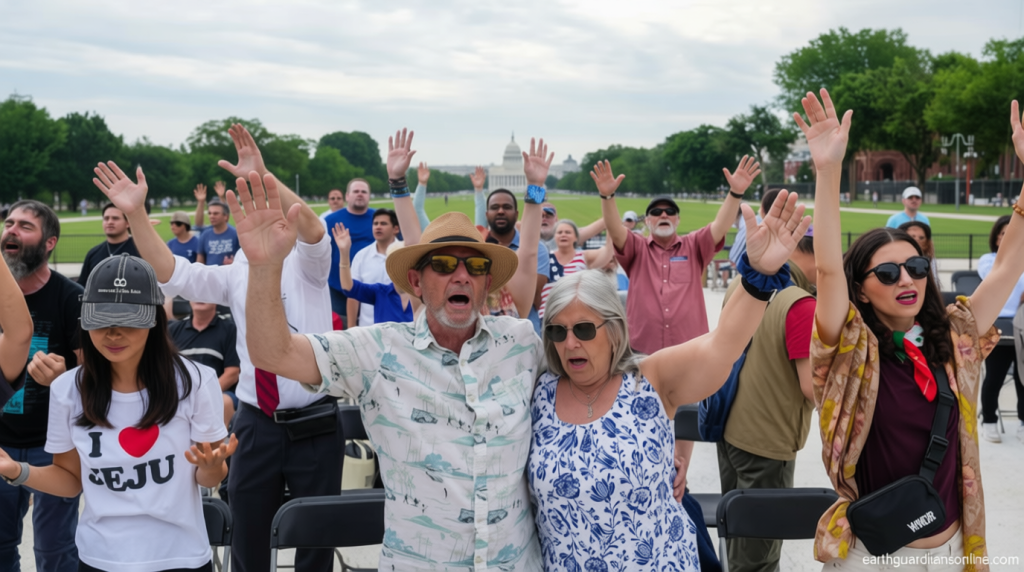
National Mall prayer event sparks concern – Sunday’s extended prayer gathering on the National Mall, underwritten by a combination of public funds and private contributions, has ignited fresh debates about the Trump administration’s influence on the separation of church and state. The event, branded “Rededicate 250: A National Jubilee of Prayer, Praise & Thanksgiving,” is part of a broader celebration marking the 250th anniversary of American independence. Organized by the nonprofit Freedom 250, which operates as a subsidiary of the National Park Foundation, it aims to unite religious figures, government officials, and musicians in a moment of reflection and communal worship.
Event Details and Organizational Context
The ceremony will feature video addresses from President Donald Trump and his Cabinet, alongside speeches from House Speaker Mike Johnson, a prominent Christian leader. While the organizers claim inclusivity, the majority of faith representatives attending are evangelical Christians, with only one Orthodox rabbi and two conservative Catholic bishops present. This composition has sparked discussions about the event’s representation of American religious diversity.
Freedom 250, a group under the National Park Service’s fundraising arm, has framed the event as a chance to “recommit ourselves to the ideals that define us” and “look toward the future with renewed hope and purpose.” Danielle Alvarez, a senior adviser with the organization, emphasized its symbolic significance. “Rededicate 250 will be a powerful moment to reflect on where we have been, recommit ourselves to the ideals that define us, and look toward the future with renewed hope and purpose,” she stated.
Legal Perspectives on the Event
Experts questioned whether the event adheres to constitutional standards. Andrew Koppelman, a constitutional law professor at Northwestern University, noted that the gathering is permissible since no court has issued a restraining order. However, he argued it contradicts the Constitution’s foundational goal of maintaining a clear distinction between religious institutions and governmental authority. “This kind of divisive embrace of a particular religion and trying to associate the incumbent administration with that religion is bad for religion, bad for government, and bad for America,” Koppelman said.
Contrasting this view, Douglas Laycock, a law professor specializing in religion and law at the University of Texas, deemed the event “flagrantly unconstitutional.” He cited its explicit promotion of a specific religious tradition, stating, “It is unconstitutional because it is explicit government promotion of religion, and not just religion in general, but of a fairly specific version of one particular religion.” Meanwhile, Michael Moreland of Villanova University’s Charles Widger School of Law offered a more moderate stance, asserting that religious faith and public life can coexist without violating constitutional principles. “I think that it’s kind of overemphasizing that idea of separation to think that an event like this raises any constitutional problems,” Moreland remarked, adding, “It’s too strong a separationist view of what the First Amendment requires.”
Administrative Defense and Historical Claims
Mike Johnson, a devout Christian, defended the event during an appearance on Fox News. He framed the gathering as an acknowledgment of the nation’s “religious and moral tradition,” accusing opponents of attempting to “erase the history of America and pretend as if we’re not a nation that was dedicated originally to God.” Johnson’s comments echoed the administration’s broader narrative that the United States was founded as a Christian nation, a perspective repeatedly championed by Trump’s team.
White House spokesperson Taylor Rogers echoed this sentiment in a statement to CNN. “Rededicate 250 will be a beautiful and unifying moment to reflect on America’s history that has been shaped by ‘great men and women of faith,’” she said. Rogers also highlighted the event’s role in celebrating “freedom of religion for all people of faith,” positioning it as a cornerstone of the Constitution’s sacred principles. “Americans will come together on the National Mall to rededicate this country as ‘one nation under God,’” she added.
Critics Highlight Concerns About Christian Nationalism
Opponents argue the event is part of a larger effort by the Trump administration to promote Christian nationalism—the ideology that the United States was established as a Christian nation and should be guided by Christian values. Rabbi Jonah Dov Pesner, director of the Religious Action Center of Reform Judaism, criticized the use of the term “Judeo-Christian” to describe the event, noting its frequent adoption by the administration. He suggested this framing may obscure the nation’s more pluralistic religious roots, potentially privileging one tradition over others.
The controversy reflects a longstanding tension between religious expression and governmental neutrality. While some see the event as a natural extension of America’s historical ties to faith, others warn it could set a precedent for institutional favoritism. The National Mall, historically a site for political and cultural events, now hosts a ceremony that blends celebration with theological emphasis, raising questions about the balance between tradition and constitutional principles.
Supporters of the event contend that the inclusion of religious elements is consistent with the nation’s heritage. They point to the Constitution’s references to “the Lord” and the phrase “one nation under God” in the Pledge of Allegiance as evidence of the government’s historical engagement with religion. However, critics counter that such references do not justify modern efforts to align public policy with a specific faith, particularly when those efforts are perceived as politically motivated.
As the event unfolds, its impact on public perception of the separation of church and state will be closely watched. The administration’s ability to frame the gathering as both a celebration of American identity and a constitutional exercise may depend on how it navigates the fine line between tradition and overt religious influence. Whether viewed as a unifying moment or a divisive act, the National Mall prayer event underscores the ongoing debate over the role of religion in shaping national policy and cultural values.
The broader implications of the event extend beyond its immediate purpose. It serves as a case study in the Trump administration’s strategy of intertwining religious identity with political messaging. By leveraging the 250th anniversary as a platform, the administration aims to reinforce its vision of America as a nation rooted in Christian principles, a narrative that has been central to its campaign and governance. Yet, the event also highlights the challenges of maintaining religious neutrality in an increasingly polarized political climate.
With the nation’s founding anniversary approaching, the prayer event becomes a focal point for discussions about the role of faith in public life. It invites Americans to reflect on the historical connection between religion and governance while testing the boundaries of constitutional guarantees. As the day progresses, the event’s legacy will likely depend on how it is received by both supporters and detractors, shaping the discourse on the future of religious expression in the United States.
