
Cave diving is fraught with danger, but the reward is sights like nothing else on Earth
Cave Diving: A High-Stakes Journey into Earth’s Hidden Depths
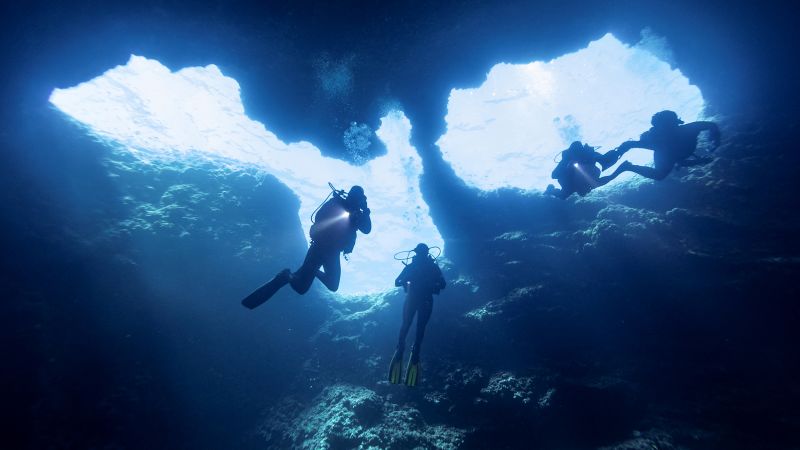
Cave diving is fraught with danger – When divers venture into the labyrinthine caves of the Maldives, they leave behind the familiar world of sunlight and open water. The transition is abrupt, as the light from the surface fades and the only illumination comes from the beams of their flashlights. These beams carve through the darkness, revealing an alien ecosystem teeming with unseen life. Stalagmites and stalactites rise like frozen pillars, while bioluminescent organisms flicker in the gloom. It is a realm where human presence feels both insignificant and extraordinary, a place where the boundaries of the known world dissolve into the unknown.
Cave diving is more than an adventure—it is a discipline that demands precision, resilience, and an intimate understanding of risk. The underwater systems of the Maldives, though rare, offer a unique glimpse into Earth’s geological and biological secrets. Spanning hundreds of miles, these submerged corridors form intricate networks that defy conventional navigation. Divers rely on a delicate balance of equipment, training, and instinct to traverse them, often venturing into conditions that are as hostile as they are mesmerizing.
The Cost of Exploration
For those who embrace this perilous craft, the dangers are ever-present. A 2024 documentary titled “Diving Into the Darkness” captured the essence of this risk, with veteran Canadian diver Jill Heinerth recounting the grim reality of her profession. “I’ve swum through the graves of my friends countless times,” she said, noting that the list of those who have perished in these depths exceeds a hundred. The recent tragedy in the Vaavu Atoll caves underscores the relentless nature of these hazards. On May 14, five Italian divers lost their lives during a descent, and Maldivian military diver Sgt. Mohamed Mahudhee also succumbed while recovering their bodies.
The incident has raised questions about the conditions that led to the divers’ disappearance. Local authorities confirmed that the group had permission to explore beyond the typical 30-meter limit of recreational diving. Yet, the exact cause of their mishap remains under investigation. Were they overwhelmed by the depth? Did their equipment fail? Or did they encounter an unforeseen challenge in the depths of the cave? As the probe continues, the focus remains on the human element of the dive—the judgment, preparation, and courage that define this unique form of exploration.
Life in the Abyss
Despite the risks, cave divers are drawn to these environments by the sheer magnitude of the experience. Heinerth, who has logged over 8,000 dives, describes the act as “swimming through the veins of Mother Earth.” This metaphor captures the feeling of entering a world that is both ancient and alien. The caves are not just geological formations; they are living systems, filled with creatures adapted to perpetual darkness and unique ecosystems. For Heinerth, the underwater world is akin to space—a place where the overview effect is felt in a different way. “Astronauts talk about the overview effect, that moment when they see Earth from above and understand its fragility,” she explained. “I have a similar experience when I’m inside the planet itself. I’m literally within the lifeblood of Earth, the water that sustains all of humanity and the planet’s natural rhythms.”
Before every dive, Heinerth meticulously reviews the potential for disaster. “I rehearse every scenario that could kill me,” she said. This includes imagining the worst-case situations—equipment failure, guideline breakage, or sudden loss of visibility. The stakes are higher than in surface dives, as divers cannot simply ascend to safety. They must rely on their own expertise and their partner’s support to navigate the labyrinth. “It’s a deep self-assessment,” she added. “Am I ready for self-rescue today? Can I handle a buddy rescue if something goes wrong?” These questions anchor her preparation, ensuring she is mentally and physically prepared for the unknown.
The Fragility of Human Ingenuity
While the Maldives’ caves are a marvel of natural engineering, their complexity also makes them unpredictable. Vladimir Tochilov, a technical diving instructor with prior experience in the system, emphasized their rarity. “These caves are a unique feature of the Maldives,” he told CNN. “They’re not just deep—some of them stretch for 200 meters, a distance that requires extraordinary skill and endurance.” Even with such preparation, accidents can happen. The recent loss of life serves as a stark reminder that no amount of training can fully eliminate the risks.
As divers squeeze through narrow tunnels and navigate turbulent currents, they face physical challenges that test their limits. “Sometimes, my shoulders are scraping the ceiling and my belly is on the floor,” Heinerth recalled. “Visibility can drop to less than a meter, and sand and silt blast me in the face like a storm.” These conditions force divers to rely on their senses and instincts, creating a tension between the awe of discovery and the threat of catastrophe.
The allure of cave diving lies in its ability to reveal the planet’s hidden wonders. Yet, for every breathtaking moment, there is a shadow of peril. The recent tragedy in the Maldives has sparked renewed discussions about the importance of rigorous training and the need for continuous evaluation of risks. As Heinerth noted, the dive is not just a physical journey—it is a mental one, requiring divers to leave their emotions on the surface and enter a state of pragmatic focus. “You have to be ready for anything,” she said. “That’s the beauty and the terror of it.”
