
Four killed as Belgian school bus hit by train after appearing to plow through barrier
Four Killed in Collision Involving School Bus and Train in Northern Belgium
Four killed as Belgian school bus hit – On Tuesday morning, a tragic incident occurred in Buggenhout, a town in northern Belgium, where a school minibus was struck by a train, resulting in the deaths of four individuals. Authorities confirmed the accident involved a serious collision at a level crossing, with at least two of the victims being students. The event unfolded around 8 a.m. local time, sending shockwaves through the community as emergency services scrambled to respond.
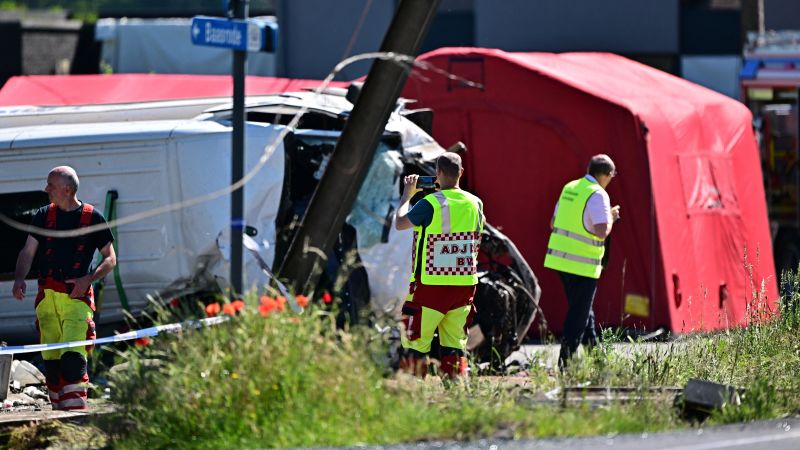
Photographic evidence from the scene revealed the minibus, a small school vehicle, had been overturned and lay partially along the railway tracks. The wreckage showed significant damage, with the bus’s frame crushed and windows shattered. Witnesses described the chaotic aftermath, with rescuers working under challenging conditions to stabilize the injured. The high temperatures in the region during the early hours reportedly added to the complexity of the rescue efforts.
Victims and Their Backgrounds
The casualties included two children, ages 12 and 15, along with an attendant and the bus driver. According to Lisa De Wilde, a spokesperson for the Public Prosecution Service, the driver, a 49-year-old with no prior criminal record, was among those who lost their lives. The attendant, a 27-year-old, also perished in the crash, while five other children sustained serious injuries. All five are currently in stable condition at the hospital, as per De Wilde’s update.
Local media sources indicated that the minibus was transporting students from a nearby special education school, highlighting the severity of the impact on the community. The school, which serves children with specific needs, had sent its students to the crossing area, possibly for a routine outing or pickup. The incident has raised questions about safety protocols and the adequacy of measures in place at the location.
Investigation and Initial Findings
As the investigation into the accident began, officials emphasized that the barriers at the level crossing were closed and the red warning signal was operational at the time of the collision. Thomas Baeken, representing Infrabel, the Belgian rail infrastructure operator, told Flemish public news channel VRT, “Footage shows that the barriers were down and the traffic lights were red.” This detail suggests the crossing was properly signaled, yet the collision still happened.
“We do not know how the accident could have happened,” Baeken added, underscoring the mystery surrounding the incident. He noted that the train had braked, but the driver was unable to stop in time. “The operator activated the emergency brake, but the vehicle could not be halted,” Baeken explained. The train emerged from the collision with minimal damage, and none of its passengers were injured, according to officials.
The train driver, who had tested negative for drugs and alcohol, was not at fault in the immediate aftermath. However, the cause of the accident remains under scrutiny. Belgian authorities have appointed a traffic expert to analyze the situation, and a forensic laboratory is conducting on-site tests to gather more evidence. These steps aim to determine whether mechanical failure, human error, or a combination of factors led to the tragedy.
Statements from Political Leaders
Belgian Prime Minister Bart De Wever expressed deep sorrow over the incident, stating in a post on X that he was “deeply moved by the horrific accident.” He extended his condolences to the families of the victims, emphasizing the emotional toll of the event. Similarly, Flemish Education Minister Zuhal Demir conveyed her sympathy, writing, “What heartbreaking news from Buggenhout.” She followed this with gratitude toward the emergency services for their swift response.
“My deepest condolences go out to the victims’ families and their loved ones,” Demir added in her message, acknowledging the impact of the tragedy on the community. Ursula von der Leyen, President of the European Commission, also shared her condolences, calling the incident “heartbreaking.” She expressed her sorrow in a statement, highlighting the shared grief across the region.
The collision has sparked discussions about the safety of level crossings and the potential risks faced by pedestrians and vehicles. While the barriers were functioning as intended, the timing of the accident raises concerns about whether the crossing’s design adequately protected users. Local officials are reviewing the incident to assess if improvements are needed to prevent similar occurrences in the future.
Community members have expressed shock and sadness, with many calling for stricter safety measures at the site. Some local residents described the crossing as a common route for school buses, raising questions about its suitability for regular use. The tragedy has also prompted a renewed focus on the importance of traffic signals and barriers in preventing accidents.
Broader Implications and Ongoing Efforts
As the investigation continues, authorities are working to piece together the sequence of events leading to the collision. The absence of prior convictions for the bus driver suggests that the incident may have been an accident rather than a deliberate act. However, the exact cause remains unclear, and further analysis is required.
Emergency services have already begun recovery operations, with teams ensuring that the injured received prompt medical attention. The efforts of these professionals have been praised, though the emotional weight of the event is evident in the reactions of officials and the public. The school’s community, in particular, is grappling with the loss of its students, adding a personal dimension to the tragedy.
Authorities have also initiated a review of the incident’s circumstances, including the train’s speed, the visibility at the crossing, and any potential lapses in communication. The presence of the red warning light and closed barriers indicates that the system was in place, but the collision suggests a failure in either the driver’s reaction time or the vehicle’s stopping distance.
With the investigation ongoing, more details about the accident’s cause are expected. The school bus driver’s body will be examined in an autopsy to determine if any pre-existing conditions contributed to the incident. Meanwhile, the train operator’s actions are under scrutiny, and officials are looking into whether the barriers malfunctioned or if there was a delay in their activation.
The event has not only affected the immediate victims but also left a lasting impression on the local community. Residents are calling for increased safety awareness and possibly changes to the level crossing’s design. The tragedy serves as a reminder of the vulnerabilities of transportation systems and the
