
A violent volcanic eruption may have revealed a new weapon to tackle a potent planet-heating gas
A Violent Volcanic Eruption May Have Uncovered a Novel Method to Combat Methane Emissions
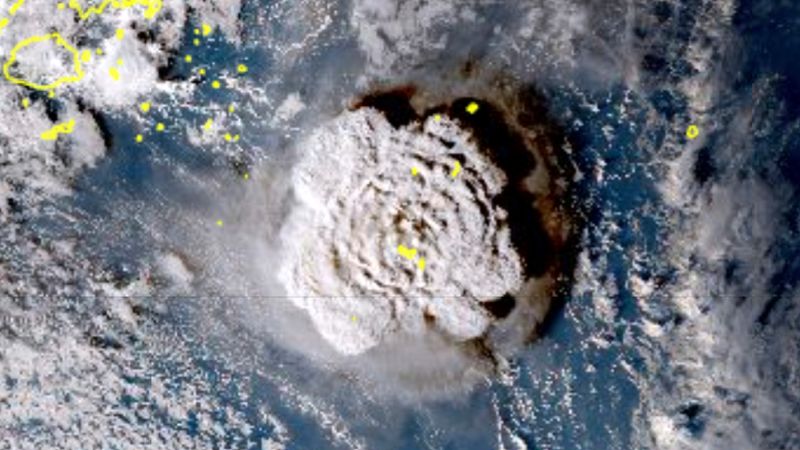
A violent volcanic eruption may have – In January 2022, an explosive underwater volcanic event in the South Pacific sparked global attention. The eruption of the Hunga Tonga-Hunga Ha’apai volcano unleashed a towering plume of ash, steam, and gases that soared nearly 40 miles into the Earth’s atmosphere. This powerful display of nature’s force was not only one of the most intense volcanic eruptions in recent history but may have also unveiled a previously unknown process for mitigating a key driver of climate change: methane.
The Eruption’s Unprecedented Scale
The volcanic explosion, which occurred in January 2022, released energy equivalent to hundreds of Hiroshima-sized nuclear bombs. Its force generated a tsunami that traveled across the Pacific and a sonic boom that encircled the globe twice. Such extreme power was rare, and scientists were caught off guard by the unexpected aftermath. The study published in Nature Communications on Thursday suggests that the eruption did more than destroy the environment—it may have actively reduced some of the pollution it created.
Researchers analyzed satellite data to uncover this phenomenon. The results revealed a massive cloud of formaldehyde, a compound typically not associated with volcanic activity. This discovery led to a critical insight: the eruption might have initiated a process that breaks down methane, a gas with a far greater warming potential than carbon dioxide.
Methane’s Role in Climate Change
Methane is a critical component of Earth’s climate system. Over a 20-year span, it is approximately 80 times more effective at trapping heat than CO2, making it a formidable challenge in the fight against global warming. Currently, methane accounts for about a third of the planet’s total warming effect, and its concentrations have more than doubled in the last two centuries. While reducing carbon dioxide emissions remains a top priority, methane has been considered a more accessible target for short-term climate mitigation due to its relatively brief atmospheric lifespan.
The team behind the study hypothesizes that the volcanic plume created conditions for a chemical reaction known to occur in other regions. In the Atlantic, Saharan dust mixed with saltwater spray to form iron-rich particles. When sunlight interacted with these particles, they catalyzed the release of chlorine atoms, which then broke down methane in the air. This same mechanism, now observed in the stratosphere, could offer a new way to tackle greenhouse gases.
The Unexpected Methane Breakdown
Van Herpen, a physicist and executive director at Acacia Impact Innovation, explained the findings: “We found a huge cloud of formaldehyde that should normally not be there.” This cloud, he noted, indicated that the volcanic eruption’s plume had undergone a transformation. The mixture of ash and saltwater vapor produced by the event created an environment where methane could be decomposed. This process, though familiar in the Atlantic, had never before been documented at such high altitudes.
The researchers estimate that the eruption emitted roughly 330,000 tons of methane into the atmosphere. However, the plume’s unique composition allowed for the continuous breakdown of these emissions. Over 10 days, they tracked the formaldehyde cloud, a marker of the chemical activity. Since formaldehyde dissipates rapidly, its persistence suggested that the plume was actively destroying methane for more than a week. “Because formaldehyde only exists for a few hours, this showed that the cloud must have been destroying methane continuously for more than a week,” van Herpen added.
According to the study, the volcanic plume contained enough saltwater vapor to fill approximately 58,000 Olympic-size swimming pools. This quantity, combined with ash, created a complex mixture capable of initiating the chlorine-driven reaction. The process effectively reversed some of the methane emissions generated by the eruption, a finding that challenges traditional views on how volcanic activity affects the climate.
Implications for Climate Solutions
Van Herpen and his colleagues suggest that this natural process could be harnessed as a tool for reducing methane emissions. By mimicking the conditions formed during the eruption, such as injecting iron-based particles into the atmosphere, scientists might develop a method to neutralize methane at its source. This approach could complement existing strategies, including capturing emissions from landfills or livestock.
Matthew Johnson, a chemistry professor at the University of Copenhagen and co-author of the study, emphasized the significance of the discovery. “It’s new—and completely surprising—that the same process observed in the Atlantic has now been identified in a volcanic plume high above the stratosphere,” he said. The findings open the door to geoengineering techniques, where artificial interventions are used to counteract climate change. For instance, iron particles could be dispersed over oceans to replicate the chemical reaction seen in the eruption, potentially reducing methane levels.
Challenges and Skepticism
Despite the promising results, some experts caution against overinterpreting the data. Pete Edwards, an atmospheric chemist at the University of York not involved in the research, called the study “interesting but very difficult to confirm.” He highlighted uncertainties in relying solely on formaldehyde observations to infer the methane-decomposition mechanism. “The use of only formaldehyde observations to infer a mechanism, although novel, does not help address the known uncertainties within our current understanding of atmospheric chemistry,” Edwards told CNN.
Edwards also pointed out that the study’s findings are based on stratospheric conditions, while the proposed methane-removal strategy would need to operate in the troposphere. This distinction is crucial, as the two layers of the atmosphere behave differently. The troposphere, where most human activity occurs, is more dynamic and complex. Applying the same process there could lead to unpredictable outcomes, potentially affecting climate patterns, air quality, or ecosystem health.
Emily Dowd, a climate scientist at the University of Leeds, echoed Edwards’ concerns. She noted that while the study offers valuable insights, further research is needed to validate the mechanism. “The volcanic plume created an environment where methane could be decomposed, but scaling this process to a global level requires more evidence,” Dowd said. Scientists are now exploring how to replicate the conditions of the eruption in controlled experiments to ensure the findings hold up under scrutiny.
A New Frontier in Climate Science
The discovery could reshape how we approach methane reduction. Unlike traditional methods that focus on limiting emissions at the source, this process leverages natural chemistry to actively break down pollutants. It highlights the potential for Earth’s own systems to provide solutions to climate challenges. However, the transition from observation to application remains a hurdle. Researchers must determine whether the process is stable, repeatable, and scalable.
For now, the study serves as a reminder of the interconnectedness of natural and human-driven climate factors. The eruption’s impact on methane levels demonstrates that even extreme events can have unintended environmental benefits. As scientists continue to analyze the data, the findings may inspire new approaches to combating climate change. Whether this volcanic plume’s secret can be replicated in the troposphere or used as a model for future strategies, the discovery underscores the importance of interdisciplinary research in addressing global warming.
In the coming years, the team plans to conduct additional studies to refine their understanding of the process. They aim to explore how factors like wind patterns, temperature variations, and particle concentration affect methane breakdown. Such efforts could lead to practical applications, from geoengineering projects to more targeted emission-reduction policies. The study not only adds to the scientific toolkit for tackling climate change but also reinforces the idea that nature may hold answers to some of humanity’s greatest environmental challenges.
