
Curfew established around Newark ICE facility after days of protests
Curfew Established Around Newark ICE Facility After Days of Protests
Curfew established around Newark ICE facility – Newark authorities have implemented a nightly curfew surrounding Delaney Hall, a federal immigration detention center in the city, following sustained demonstrations over alleged mistreatment of detainees. The measure, effective at 12 a.m. on Sunday, will remain in place until further notice, restricting movement between 9 p.m. and 6 a.m. each night. This decision comes as tensions escalate between protesters and law enforcement, prompting officials to prioritize public safety in the wake of recent clashes.
Mayor Calls for Immediate Action
In a statement released early Sunday, Newark Mayor Ras J. Baraka emphasized the urgency of the situation. “The growing unrest at Delaney Hall and the heightened presence of armed individuals have necessitated swift measures to safeguard the community,” he said. The mayor noted that multiple arrests had occurred during the protests, with some participants reportedly carrying weapons, which he described as a clear indication of the potential for violence.
“Multiple individuals have already been arrested and found in possession of weapons, underscoring the seriousness of the threat,” said Baraka.
The curfew follows a volatile confrontation between demonstrators and police on Saturday night, which left the area tense and unpredictable. Protesters have been gathering outside the 1,000-bed facility for days, drawing attention to claims of deplorable conditions for those detained there. The latest incident marks a continuation of the unrest that has gripped the neighborhood, with law enforcement being forced to intervene increasingly.
Family Visitation Restored, But Conditions Remain Controversial
Separately, New Jersey Governor Mikie Sherrill announced that the Department of Homeland Security (DHS) had agreed to her request to reinstate family visitation at Delaney Hall. Limited visitation hours will resume at noon on Sunday, with full access to be restored on Monday, she said. However, Sherrill also highlighted ongoing concerns about the facility’s conditions, stating that the recent protests were a direct response to alleged inhumane treatment of detainees.
“These actions put both peaceful protestors and law enforcement in danger,” said Sherrill.
The protests have drawn a wide range of participants, including local activists, legal representatives, and even national extremist groups, according to the governor. While she did not specify which organizations were involved, the presence of these groups has intensified the conflict, with some individuals reportedly engaging in aggressive behavior during the demonstrations.
Protesters Highlight Food and Living Conditions
Legal advocates representing detainees at Delaney Hall have pointed to the Memorial Day weekend as the catalyst for the escalating tensions. During that period, hundreds of residents reportedly went on a hunger strike to protest spoiled food and substandard living conditions. However, the Department of Homeland Security has denied the existence of a hunger strike, attributing the unrest to what they describe as “a handful of individuals refusing to eat for ethnic reasons.”
“There was only a small group of detainees who chose to skip meals because they wanted their ethnic group or their ethnic-right food,” said Homeland Security Secretary Markwayne Mullin during a cabinet meeting on Wednesday. This claim has been challenged by attorneys, such as Alex Minogue of Nova Law Group, who argue that the denial ignores the clear evidence of dissatisfaction with the food provided. “They just don’t want to eat worms,” Minogue said, referring to the presence of worms in detainees’ meals as reported by some.
Law Enforcement and Community Tensions
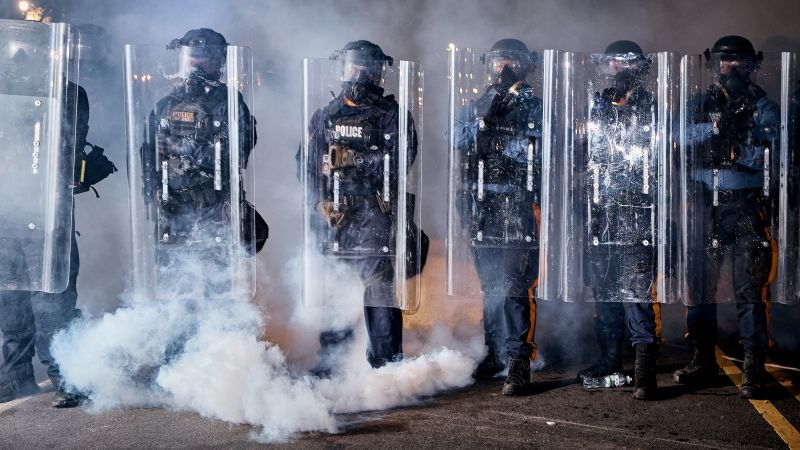
Video footage from Saturday night’s demonstration showed a chaotic scene as protesters and police exchanged blows. Mounted officers advanced into the crowd, while tear gas blanketed the air, creating a tense atmosphere. Some demonstrators used chairs and other debris to ignite fires in the streets, further complicating the situation. Despite the violence, state police Lt. Col. David Sierotowicz stated that the protest remained orderly, though the presence of a SWAT team in full riot gear added to the sense of urgency.
The clash on Saturday night was preceded by a confrontation between supporters of the Immigration and Customs Enforcement (ICE) agency and opponents of its policies. This divide has become a recurring feature of the protests, with each side accusing the other of inciting unrest. Sherrill, who has been vocal about the need for accountability, reiterated that the recent incidents were a result of “dangerous actions” by a minority of protesters who targeted law enforcement.
“I refuse to let these dangerous actions detract from New Jersey’s dedication to ensuring public safety, keeping people safe from ICE, and that the people detained inside Delaney Hall are treated with dignity,” said Sherrill.
Meanwhile, political figures have continued to weigh in on the situation. House Minority Leader Hakeem Jeffries visited the facility on Sunday morning and described the conditions as unsanitary, with inadequate medical care and unhealthy meals. “I learned of unsanitary living conditions, lack of adequate medical care, and unhealthy food,” Jeffries said in his statement, vowing to maintain congressional oversight to ensure detainees are treated humanely.
Delaney Hall as a Symbol of Controversy
Delaney Hall has become a focal point of debate, with critics accusing DHS of prioritizing efficiency over compassion. Acting Assistant Secretary Lauren Bis of DHS defended the facility, asserting that “sanctuary politicians are spreading categorically false smears about ICE’s Delaney Hall.” She claimed that these smears had incited violent riots outside the center, despite the agency’s efforts to provide detainees with proper care and due process.
“No lawbreakers in the history of human civilization have been better treated than illegal aliens,” Bis added, highlighting the three meals a day, medical services, and legal protections available to those held at the facility. However, this rhetoric has not quelled the anger of local advocates, who argue that the conditions are far from ideal and that the facility’s management has failed to address systemic issues.
New Jersey Representative Rob Menendez has also voiced his concerns, stating that he has witnessed firsthand the struggles faced by detainees. While the exact details of his observations were not disclosed, his comments align with the broader criticism that Delaney Hall is a symbol of the challenges within the U.S. immigration system. The protests have drawn national attention, with the situation in Newark serving as a microcosm of the larger debate over immigration policy and detainee rights.
Legacy of the Protests and Future Outlook
As the curfew continues and the facility remains under scrutiny, the focus has shifted to long-term solutions. Advocates are calling for reforms to improve conditions, while officials are working to balance security with the rights of detainees. The events in Newark underscore the growing divide between those who support ICE and those who criticize its practices, with the Delaney Hall protests becoming a flashpoint for this national conversation.
The ongoing demonstrations reflect a broader movement against immigration policies perceived as harsh and inhumane. With the facility at the center of these efforts, the city of Newark now faces the challenge of maintaining order while addressing the demands of its residents. As the situation evolves, the impact of the protests on both the facility and the wider immigration debate will continue to be a topic of discussion among lawmakers, activists, and the public.
