Switzerland’s ‘Brexit moment’: Vote on a population cap sets up potential collision with EU

Switzerland’s Population Cap Referendum: A Potential Clash with the EU
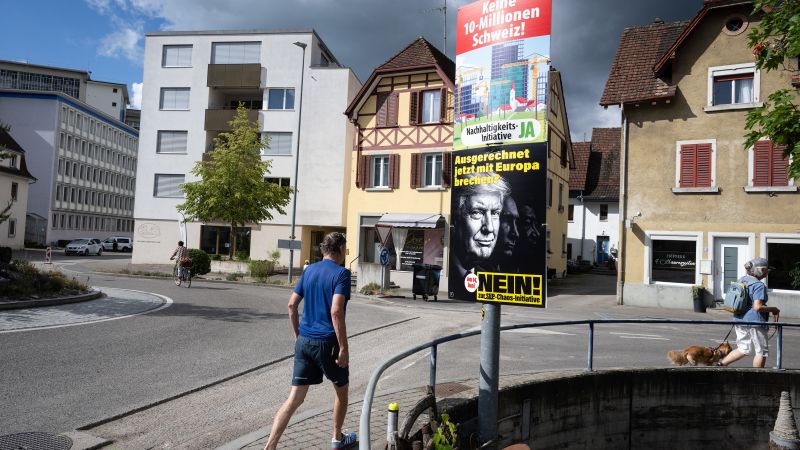
Switzerland s Brexit moment – Sunday’s referendum in Switzerland marks a pivotal moment for the nation, as voters will decide whether to impose a cap on the country’s population. This initiative, championed by the right-wing Swiss People’s Party (SVP), has ignited fierce debate over immigration’s role in shaping the country’s future. If the measure passes, Switzerland could become the first European nation to legally limit its population, a decision that may strain its relationship with the European Union (EU) and challenge the delicate balance of its economic and social systems.
A Political Divide Over Immigration
The proposal to cap the population at 10 million stems from growing tensions around immigration, which have fractured Swiss society. The SVP, the nation’s largest political group, has framed the issue as a matter of “sustainability,” arguing that unchecked immigration threatens to overwhelm resources and erode national identity. Their campaign website highlights concerns about overcrowding, housing shortages, and the strain on public services, asserting that “uncontrolled immigration is causing Switzerland to grow far too quickly” and that “negative consequences are noticeable in all areas of life.”
However, the referendum’s outcome remains uncertain, with recent polls indicating a narrow margin between supporters and opponents. At the start of May, a survey suggested the two sides were evenly matched, but more recent data from gfs.bern shows that those against the cap now lead by 52% to 48%. This close race underscores the deepening divide in Swiss public opinion, as the country grapples with its role as a hub for European migration.
The Growing Swiss Population
Switzerland’s population has surged dramatically in recent decades, reaching just over 9 million in 2024—nearly a quarter more than a decade ago. According to government figures, over 27% of its residents are foreign-born, with a significant portion hailing from the European Union. This influx has been driven by the country’s strong economy, stable political environment, and its strategic location at the heart of Europe. Yet, the rapid growth has also sparked worries about the long-term viability of these trends.
The SVP’s initiative is not just a response to demographic changes but also a reflection of broader anxieties about cultural preservation. They argue that the nation’s quality of life is at risk, citing examples like crowded housing markets and overburdened infrastructure. Jürg Müller, a director at the Swiss think-tank Avenir Suisse, has echoed these concerns, noting that recent population increases have created “tensions on housing markets, infrastructure, and access to lakes.” He explained, “It feels for many people too crowded,” adding that the SVP has turned these sentiments into a political platform.
“You see the tensions on housing markets, infrastructure… access to lakes… it feels for many people too crowded.”
Müller emphasized that the proposal is rooted in the idea that Switzerland’s growth is outpacing its capacity to manage the associated challenges. He described the SVP’s initiative as a way to address these issues, though he also pointed out that the party’s rhetoric may be amplifying fears beyond the data. “The SVP have taken this feeling and transformed it into this initiative,” he said, suggesting that the debate is as much about perception as it is about reality.
Economic Implications of a Population Cap
Opponents of the cap, including business leaders, warn that limiting population could have severe economic consequences. They argue that Switzerland’s economic strength is tied to its ability to attract skilled workers from the EU and other regions. Avenir Suisse’s Müller highlighted that the country’s recent economic boom has attracted migrants, creating a demand for labor in sectors like healthcare, education, and technology. “The economy is running well,” he said, “and Switzerland has been historically doing quite a few things right in terms of economic policies.”
Yet, this economic success has come with trade-offs. As the population grows, so do the pressures on housing, transportation, and public services. Müller noted that while the country’s living standards remain high, “life in France and Germany has changed over the last decades,” and Switzerland’s appeal as a place to live is due in part to its quality of life. He stressed that the cap proposal is not purely about xenophobia but about managing growth in a way that preserves the nation’s long-term stability.
Switzerland’s EU Relations and Migration Dynamics
Switzerland’s position as a non-EU member has not prevented it from experiencing high levels of migration, thanks to its free-movement agreement with the EU since 2002. This pact allows EU citizens to live and work in Switzerland without the need for additional visas, making the country a popular destination for migrants seeking employment. Furthermore, its membership in the Schengen area facilitates borderless travel across much of Europe, reinforcing its role as a transit point for movement within the continent.
While the SVP’s campaign focuses on domestic concerns, the broader context of Swiss-EU relations cannot be ignored. The nation’s economic ties to the EU, particularly with Germany and France, have historically contributed to its attractiveness as a place to live. However, the SVP argues that this dependency has led to an imbalance, with Switzerland absorbing too many immigrants from its neighbors. “Three hours you’re in Paris, three hours to Milan—[Switzerland] is just a nice spot to live,” Müller said, illustrating how proximity to major cities enhances the country’s appeal.
Anti-Muslim Rhetoric in the Campaign
Despite the SVP’s claims of sustainability, the pro-cap campaign has also leaned into cultural and social concerns, particularly around immigration from Muslim-majority countries. Their website features sections that highlight “problems with asylum seekers from Muslim countries,” citing studies suggesting certain migrant groups are “many times more criminal than the rest of the population.” Another page uses imagery to depict the “loss of culture and identity,” with a photograph of a woman wearing a headscarf holding a Swiss passport. The caption reads, “Loss of culture and identity,” implying that foreign influence is eroding traditional Swiss values.
The campaign also includes claims about “creeping Islamization” and incidents of harassment at Swiss swimming pools, allegedly carried out by French nationals of North African origin. These arguments, while not universally accepted, have resonated with voters who feel the pace of change is too rapid. However, critics argue that the rhetoric may be misleading, using specific examples to generalize broader trends in immigration.
Referendum Process and Public Sentiment
Switzerland’s referendum system allows citizens to vote on proposed laws if they gather at least 100,000 signatures from eligible voters within 18 months. The population cap initiative met this threshold, prompting the national vote. Recent opinion polls suggest the outcome will be tightly contested, with the anti-cap faction appearing to hold a slight edge. This reflects a growing concern among the public about the consequences of unchecked migration, even as economic and social leaders urge caution.
The referendum’s significance extends beyond its immediate outcome. It represents a turning point for Switzerland’s identity, as the country balances its historical economic policies with modern challenges. The SVP’s proposal, while backed by a portion of the population, has also drawn criticism for its potential to deepen divisions. Delphine Klopfenstein, a Green Party member, described the campaign as “utterly xenophobic,” arguing that it scapegoats foreigners for societal issues. “It is dangerous because it is deceitful,” she said, highlighting the risk of using immigration as a political tool to address complex economic and cultural shifts.
As the vote approaches, the debate over population limits continues to shape Switzerland’s future. Whether the cap is implemented or not, the referendum has already sparked a national conversation about the role of immigration in defining the country’s character and prosperity. The outcome may set a precedent for other European nations facing similar demographic challenges, while also testing Switzerland’s ability to maintain unity amid growing polarization.