
The smell of death lingers in Venezuela’s ruined streets as overwhelmed hospitals race to save lives
The Smell of Death Lingers in Venezuela’s Ruined Streets as Overwhelmed Hospitals Race to Save Lives
The smell of death lingers in Venezuela – Long before the recent earthquakes, Venezuela’s infrastructure was already strained to its limits. The twin tremors that struck last Wednesday left the nation in ruins, but the damage was not unexpected. Decades of government mismanagement and economic sanctions have eroded the country’s ability to respond effectively to crises. At Dr. José Manuel de Los Ríos Children’s Hospital in Caracas, the situation is dire. Dr. Huníades Urbina-Medina, who oversees the facility, can only attend to four children in the intensive care unit at a time. “We once had the capacity to treat up to ten patients,” he explained. “However, for at least a decade, we’ve lacked sufficient personnel, medicine, and mechanical ventilators.”
The impact of these shortages is evident. A 12-year-old girl, trapped beneath collapsed structures, is currently receiving care in the ICU. She suffers from multiple life-threatening injuries, her condition a stark reminder of the earthquakes’ devastation. While the hospital has treated around 100 children since the disaster, the number of injured individuals in the region is far higher. The government has released updated casualty figures, but many believe the numbers are significantly low. As of now, over 1,900 deaths and more than 10,000 injuries have been reported. However, the US Geological Survey suggests the actual toll could be tens of thousands, with the true count remaining uncertain.
“No hospital in Venezuela is prepared for the day-by-day,” said Dr. Urbina-Medina. “But with this catastrophe, it’s worse because we don’t have enough medicines, personnel, equipment here in Venezuela.”
The tragedy of La Guaira in 1999 offers a grim precedent. At that time, the government failed to release an official death toll, a pattern that continues today. On Monday, Ecuadorian rescuers announced the recovery of a 12-year-old boy from rubble, but the window for survival after an earthquake is narrowing. The “golden window,” a critical period for saving lives, is now closing, leaving fewer options for those still buried. As the search efforts intensify, the chances of finding survivors diminish.
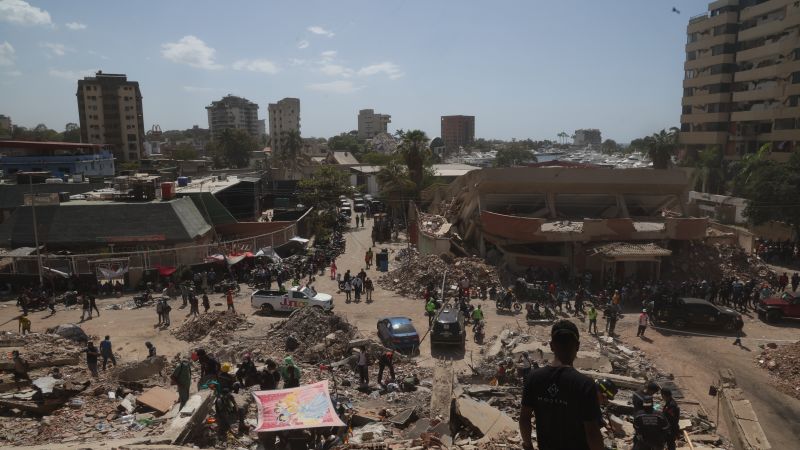
Disaster response has also been complicated by the government’s decision to extend school closures. Preliminary reports indicate that 432 schools in Caracas alone have been damaged, forcing some to be repurposed as temporary shelters for displaced families. The city’s streets are now filled with the unmistakable odor of decay, a lingering presence from the collapsed buildings. Despite the stench, families of the trapped continue to gather near the rubble, hoping for news of their loved ones. Mirella Herrera, one such parent, has spent days outside the ruins waiting for any sign of her relatives.
The State of Healthcare
Before the earthquakes, the Venezuelan government often touted its health system as resilient. Officials attributed challenges to the economic sanctions imposed by the United States, claiming they hindered the nation’s ability to provide adequate care. However, the reality on the ground tells a different story. Dr. Andrés Cortiz, a volunteer with Healing Venezuela, a British charity, noted that eight hospitals in Caracas have been forced to shut down. The remaining institutions are overwhelmed, lacking even basic supplies like bleach and disinfectant. “The hospitals are in chaos,” Cortiz said, describing the situation as a struggle to maintain order amid the influx of patients.
Dr. Urbina-Medina added that the healthcare system’s weaknesses have been compounded by the brain drain of medical professionals. Over the past decade, as Venezuela’s economic and political situation deteriorated, many qualified staff left for better opportunities abroad. This exodus has left the country with a critical shortage of skilled personnel. “We’ve lost so many doctors and nurses,” he said, emphasizing the systemic collapse. The same trend has affected education, with severe teacher shortages reported before the earthquakes. Now, schools are not only damaged but also serving as emergency housing for those displaced.
The Human Toll and Global Concerns
International organizations have raised alarms about the healthcare crisis. The World Health Organization (WHO) stated that hospitals are under “significant strain,” with overcrowding and disorganization creating a dangerous environment for patients. Christian Lindmeier, a WHO spokesperson, noted that at least three health centers are critically damaged, while six others are either partially functional or require urgent repairs. “The situation is chaotic,” Lindmeier said, highlighting the need for immediate support.
While the government continues to manage the crisis, experts and citizens alike doubt the accuracy of its reported casualties. The USGS estimates that the magnitude 7.2 and 7.5 quakes may have killed tens of thousands, but the official count remains at over 1,900 deaths. This discrepancy has sparked fears that the government is underreporting the scale of the disaster. The lack of transparency is not new; in 1999, the same pattern emerged in La Guaira, where no official death toll was released despite widespread destruction.
As the search for survivors continues, the focus shifts to the broader implications of the disaster. The earthquakes have exposed vulnerabilities in Venezuela’s infrastructure and emergency response systems. With limited resources and a growing population of displaced individuals, the path to recovery is uncertain. For families like Herrera’s, the wait for answers is endless, and the scent of death remains a constant reminder of the catastrophe that has shaken the nation. The resilience of the people, however, endures. Even in the face of overwhelming odds, they remain determined to rebuild and find hope in the ruins.
Drone footage captured the devastation in La Guaira, where entire neighborhoods were reduced to piles of rubble. The images serve as a visual testament to the scale of the damage, with buildings collapsed and streets littered with debris. In the days following the quakes, the focus has turned to restoring basic services, but the road ahead is long. For now, the hospitals continue their desperate efforts, each day bringing new challenges and an unrelenting fight to save as many lives as possible.
