
Why does Trump keep talking about ‘communism’?
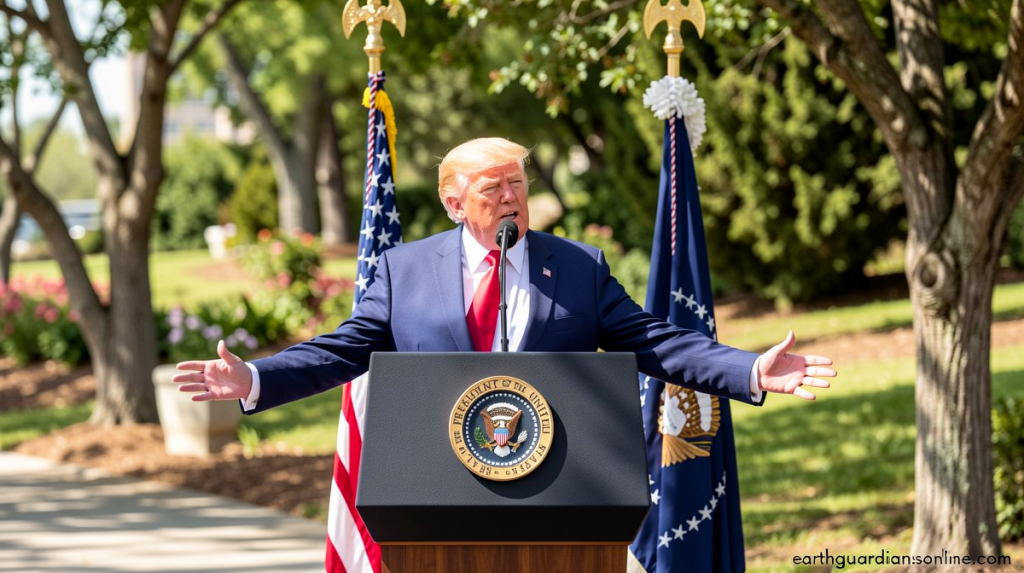
Trump’s Communist Counterattack: A Modern Red-Baiting Strategy
Why does Trump keep talking about – As the nation celebrates its semiquincentennial, President Donald Trump has resurrected a classic American political weapon. During a July 3 ceremony at Mount Rushmore marking 250 years of American independence, the president declared that communism represents an existential danger to American freedom. He went further, positioning this ideology as surpassing even the most devastating moments in American history—World War I, World War II, the attack on Pearl Harbor, and the September 11 terrorist attacks.
The speech, lasting half an hour, contained fourteen separate references to communism or communist. Trump continued this theme the following day during a Fourth of July gathering on the National Mall, where he pledged to a supportive audience that the United States would never transform into a communist nation.
Political Context and Rhetorical Strategy
This pattern of labeling political adversaries as communists is emerging as Trump’s preferred defensive maneuver heading into the midterm elections. Democratic socialist successes in various congressional and municipal primary races have invigorated progressive factions while creating unease among more centrist party officials. In response, the president and his Republican coalition have embraced the traditional practice of red-baiting.
“This is not your granddaddy’s Democrat Party,” White House press secretary Karoline Leavitt stated during a recent Fox News interview. “These are communists.”
House Speaker Mike Johnson echoed similar sentiments on Sunday, telling Fox News that communism and socialism represent departures from American values. He emphasized the historical toll of communist regimes, noting that tens of millions of innocent people perished under communist rule during the twentieth century alone. “We have to fight this,” Johnson declared.
Historical Roots of the Term
CNN’s Word of the Week segment provides context for this frequently deployed term. The word communism entered the English language approximately 1840, derived from the French word “communisme.” This occurred eight years prior to Karl Marx and Friedrich Engels releasing their influential Communist Manifesto. The concept broadly encompasses a political vision of a society without classes, money, or a centralized state, where property and production means belong collectively.
During the early twentieth century, communism acquired negative connotations within American political and business circles. Labor activists, many of whom were immigrants from Eastern and Southern Europe, introduced Marxist principles into the often violent conflicts between employers and employees. The Russian Revolution of 1917 intensified American fears of domestic upheaval, while nativist elements perceived incoming immigrants as potential security threats.
From Red Scare to Modern Politics
This collective anxiety produced the first Red Scare, characterized by the Palmer raids that targeted suspected radicals, anarchists, and foreign nationals. Over subsequent decades, as communist nations evolved into authoritarian states rather than egalitarian societies, Cold War Americans associated communism with the leadership of Joseph Stalin, Mao Zedong, and Fidel Castro. The era also brought memories of civil defense drills conducted under the constant threat of Soviet nuclear destruction.
“You can be loyal to Karl Marx or you can be loyal to America,” Trump asserted during his July 3 address. “You can be a communist or you can be a patriot. You cannot be both.”
Austin Sarat, a professor of jurisprudence and political science at Amherst College, explains that Trump employs “communism” differently than its technical definition. Rather than addressing specific ideological positions of democratic socialist candidates, the president uses the term as shorthand for “un-American.” Sarat notes that this signals to Trump’s supporters that their traditional way of life faces endangerment.
“It’s a kind of broad-brush way of saying, ‘These people are not like us; these people threaten our way of life,'” Sarat observed.
This accusatory approach traces back through American political history. Senator Joseph McCarthy gained national prominence in the 1940s and 1950s by claiming communist infiltrators had compromised American institutions. McCarthy’s chief counsel, Roy Cohn, would later serve as a mentor and attorney to a young Donald Trump. Similarly, warnings about pink sympathies contributed to Richard Nixon’s successful 1950 Senate campaign.
The communist label has consistently functioned as a tool to undermine political opponents and civil rights movements throughout American history, making Trump’s current deployment of the term both familiar and strategically calculated.
