
Finding the art in the beautiful game
Where Fine Art Meets Athletic Glory
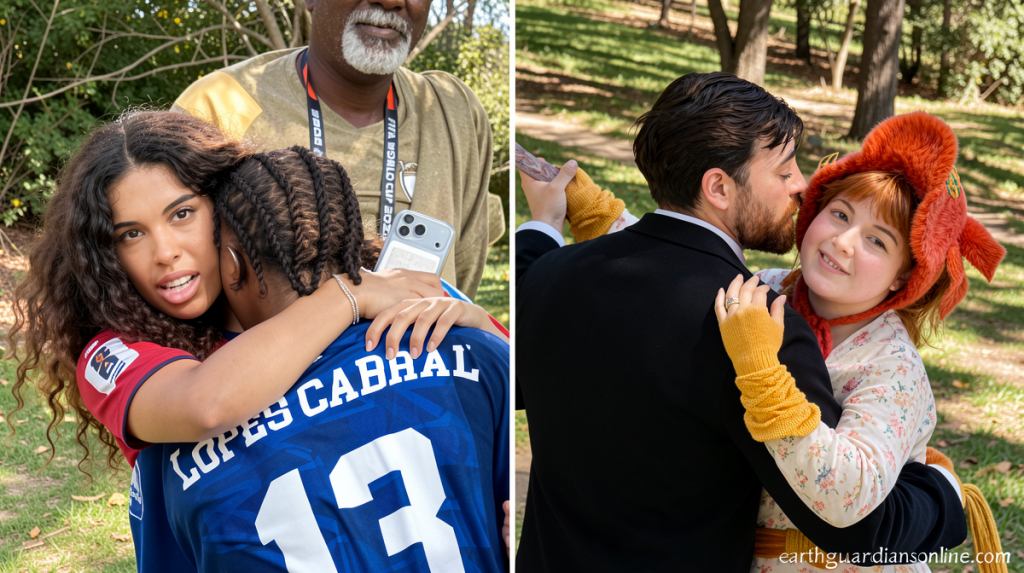
Finding the art in the beautiful – During the 102nd minute of an unforgettable World Cup clash between Cape Verde and Argentina, a moment unfolded that would captivate audiences worldwide. Sidny Lopes Cabral, the Cape Verdean fullback, unleashed a magnificent strike that curved gracefully into the Argentine goal. After scoring, he dashed toward the stands to embrace his girlfriend, Jayley da Cruz. This tender moment of celebration quickly spread across social media platforms, catching the attention of LJ Rader, who immediately recognized its potential for his artistic project.
“Regardless of whether or not Cape Verde was going to win that match, that was the image that would summarize that game,” Rader explained. The creative mind behind the beloved “Art But Make It Sports” accounts, Rader specializes in pairing dynamic sports photographs with classical artworks. His social media presence has grown tremendously, showcasing how athletic moments can echo centuries-old artistic compositions.
A Growing Artistic Mission
Earlier this year, Rader published a collection featuring some of his most celebrated pairings. One standout comparison juxtaposed a 1999 photograph of Brandi Chastain celebrating shirtless after scoring for the US Women’s National Team alongside a twelfth-century sculpture of a kneeling female deity housed in the Metropolitan Museum of Art.
During the FIFA World Cup, Rader has been working tirelessly. Social media users tag him in hundreds of images from various matches, and he races to discover the perfect artistic counterparts. Some connections appear instantly, while others require careful consideration. When English midfielder Jude Bellingham scored with a header, Rader immediately recognized his resemblance to a Sibylle Bergemann photograph capturing a statue of Friedrich Engels being positioned in East Berlin.
“I had just been waiting for the day where a player went completely horizontal to use it,” Rader said of the Bellingham comparison.
Navigating the Beautiful Game
The World Cup presents unique challenges and opportunities for Rader’s creative process. Soccer differs from other sports in several ways. Players cannot use their hands, limiting positional variety. Football involves more bodies and movement, making facial recognition difficult, yet this complexity ultimately balances out. Basketball proves perhaps the most straightforward, with players constantly leaping and contending, creating abundant visual diversity.
However, the World Cup unites everyone around a single global event. Photographers from numerous countries contribute images, and Rader’s community continuously shares discoveries. This abundance of material makes the process increasingly manageable.
On a day-to-day level, soccer tends to be harder just because there are only so many positions they can be, since can’t use their hands. Football is hard because you can’t see faces, but there are more people and more movement, so it kind of balances out and ends up becoming easier. Basketball is probably the easiest, just because players are always jumping and fighting, all the limbs are moving around, and there tends to be a lot of image variety.
Rader noted that summer typically brings quieter periods for most sports, aside from the WNBA, baseball, and Wimbledon. Yet the World Cup transforms the season entirely.
Yeah, the summer is usually quiet across other sports. You’ve got the WNBA and baseball, and there’s Wimbledon. But the tournament draws so much attention that it just becomes World Cup season for everybody. I’m a big WNBA fan, and even my attention is definitely focused on the World Cup.
The Search for Perfect Pairings
When Rader receives a sports photograph, his approach varies depending on the situation. He prefers actual photographs over screenshots, seeking the finest possible artwork to complement each athletic moment. His drafts folder contains numerous attempts that fell short of his personal standards.
During major tournaments, Rader often envisions capturing the frame just before or after a key moment. He occasionally communicates directly with photographers to access additional angles. This collaborative approach rarely occurs outside of significant sporting events.
Each scenario is unique, but they all fit within the same framework. The ideal is getting a sports photo, rather than a screenshot, and pairing it with the best possible artwork.
One memorable example involved a Spain-Portugal match in Dallas featuring Rodri and Bernardo Silva. The former teammates were captured taunting each other from behind, but Rader wanted a frontal view where facial expressions would enhance the connection. Though he didn’t secure the perfect angle, the process exemplified his dedication to finding meaningful artistic parallels in the beautiful game.
