
A once-obscure chip maker has landed the largest US listing by a foreign company
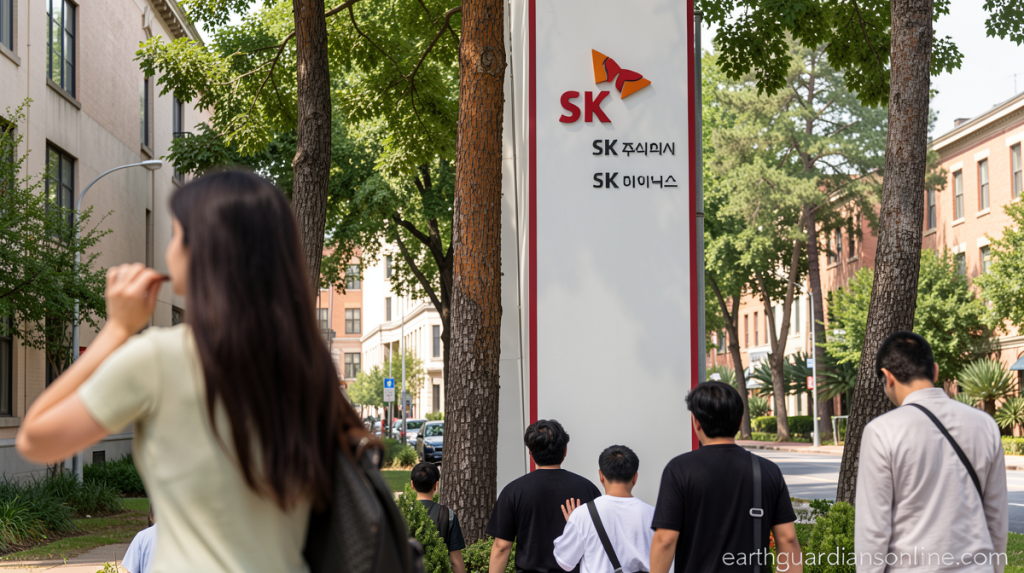
SK Hynix Makes History with Record-Breaking American Market Debut
A Groundbreaking Financial Milestone
A once obscure chip maker has landed – Investors who may have been unfamiliar with SK Hynix just twelve months ago now have unprecedented access to one of the most sought-after opportunities in global markets. The South Korean semiconductor manufacturer officially commenced trading on Friday at a price point of $149 per share, successfully securing approximately $26.5 billion in capital through its American listing. This achievement surpasses the previous benchmark established by Alibaba, the Chinese e-commerce powerhouse, which raised $25 billion during its landmark initial public offering in 2014.
The remarkable accomplishment highlights the extraordinary enthusiasm that has propelled technology equities to unprecedented heights throughout the current year. American market participants can now directly participate in what has become one of the most compelling investment narratives of the decade.
The AI Revolution Fuels Market Transformation
A tremendous expansion of data center infrastructure designed to support artificial intelligence applications has dramatically increased global demand for memory chips, the primary products manufactured by SK Hynix. This surge in requirements has triggered an unprecedented rush among investors to acquire shares in both SK Hynix and Samsung Electronics, which collectively represent the world’s dominant memory chip producers.
The investment fervor has fundamentally reshaped South Korea’s financial landscape, elevating its stock market to become the seventh-largest globally after surpassing Canada’s market capitalization in May. Both corporations, which together account for roughly half of Seoul’s Kospi index, have achieved $1 trillion valuation milestones within recent months, marking a historic transformation for the Asian economy.
“The strong demand for the offering suggests global appetite for AI infrastructure remains intact, despite recent volatility,” explained Jung In Yun, chief executive officer at Fibonacci Asset Management Global.
Nevertheless, the intense desire to capitalize on artificial intelligence growth, particularly among individual retail investors, has simultaneously amplified dramatic market fluctuations. Multiple instances of sharp sell-offs in South Korean equities have already prompted temporary trading suspensions throughout the current year.
Strategic Investments and Government Support
SK Hynix and Samsung have reported record-breaking profits this year as artificial intelligence applications have consumed the world’s memory chip supply and generated unprecedented demand. Anticipations of extended shortages have motivated these corporations to commit substantial resources toward expanding manufacturing capabilities, with encouragement from their national government providing additional confidence.
Earlier this month, South Korean authorities unveiled ambitious plans to allocate more than $500 billion toward constructing new semiconductor fabrication facilities across the country’s southwestern region. President Lee Jae Myung has emphasized rapid execution of these initiatives, prioritizing the acquisition of land, water resources, and electrical power to preserve the nation’s competitive advantage in advanced technological manufacturing.
“This pivotal $26.5 billion U.S. listing gives them the firepower to out-scale Samsung, close the valuation gap with U.S. rivals such as Micron, and secure the elite talent with attractive compensation and boost corporate morale,” stated MS Hwang, research director at Counterpoint Research, who specializes in memory semiconductors.
In official regulatory documentation, SK Hynix indicated that the capital raised through its American market debut will facilitate the construction of additional production facilities within Korea, strengthening its position in the global semiconductor industry.
Emerging Risks and Future Outlook
Despite the optimistic trajectory, the accelerated expansion undertaken by memory chip manufacturers, combined with the proliferation of leveraged investment positions in these companies, has generated concerns regarding potential market corrections. The semiconductor sector’s inherently cyclical characteristics suggest that current growth patterns may not persist indefinitely.
According to statistics compiled by the Korea Financial Investment Association, borrowing by retail investors within the Kospi market has reached unprecedented levels during the current year. Several South Korean legislators have cautioned about the financial vulnerabilities associated with purchasing leveraged exchange-traded funds, which track individual stocks like SK Hynix and can magnify both gains and losses exponentially.
“The danger is that if earnings disappoint expectations, which is what we kind of think is likely, that share prices especially at the tech companies do start to fall towards the backend of 2027 and you see a slowdown in US business investment,” warned Gareth Leather, senior Asia economist at Capital Economics, during a recent briefing.
Technology equities across both South Korea and the United States have demonstrated susceptibility to sentiment shifts regarding artificial intelligence, particularly when evidence emerges suggesting the technology fails to deliver the projected returns on investment or transformative changes that were initially anticipated. Should these concerns materialize, the current boom in Asian exports could potentially transition into a significant downturn, affecting global markets worldwide.
