
These ‘invisible buildings’ are hidden in the desert
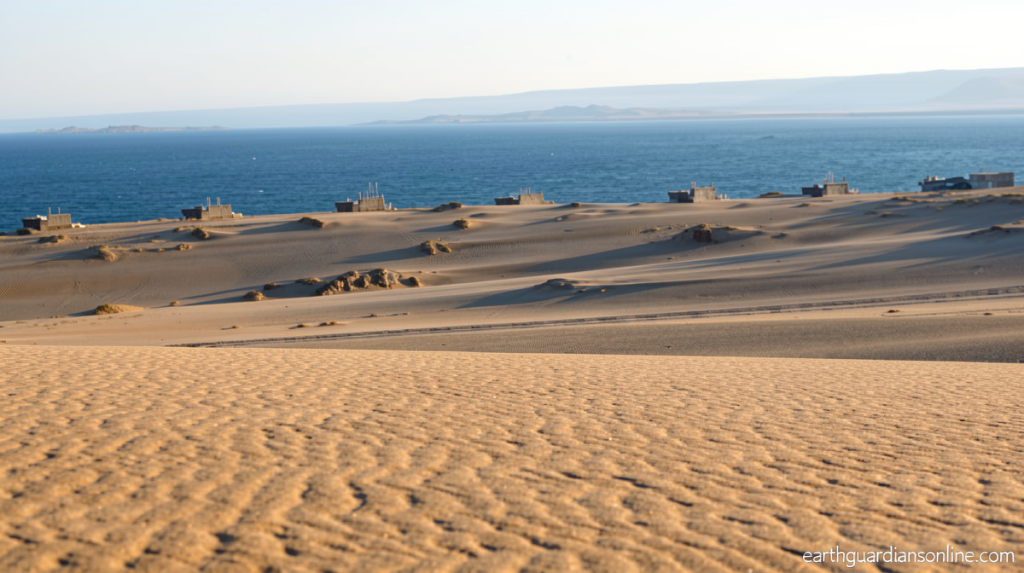
These invisible buildings are hidden – From towering converted castles to Olympic-sized infinity pools perched nearly 1,000 feet above the ground, luxury resorts are often, by design, hard to miss. Yet in Namibia, some high-end havens are being built in pursuit of a seemingly counterproductive aim: to be as difficult to find as possible. Invisible architecture, as it’s known, is on the rise across the southern African country, as upscale retreats bid to offer an elusive brand of exclusivity by blending seamlessly into some of the region’s most remote environments.
Few locations anywhere on the planet are more isolated than Namibia’s Skeleton Coast, an ends-of-the-Earth 310-mile-long sandy expanse where 100-meter dunes spill into shores littered with shipwrecks. As lions, elephants and sharks drift between the abandoned vessels, the rusting corpses are effectively the only signs of humanity to be found within “The Gates of Hell.” That is until you peer a little closer through the Atlantic fog at 10 of the beached structures in Skeleton Coast National Park. Doing so reveals Shipwreck Lodge, an assortment of luxury cabins designed to mimic the beached boats from which — in addition to the bleached bones of whales and seals washed ashore during the whaling era — the region takes its name.
Opened in 2018, they are the brainchild of prominent Namibian architect Nina Maritz, who set out to recreate the desperate feeling of searching for shelter that scores of stranded sailors experienced there centuries ago. “When you get there, there is a really strong sense of remoteness, of being really in the middle of nowhere, the farthest away from anywhere you can get on the planet,” Maritz told CNN. “There’s something that happens when you go inside a building and it goes quiet around you and out of the wind.
It’s like a catharsis, which I think very few people experience anymore — we’re not in tune with our senses. “So when I designed the building, I wanted to kind of recreate that feeling so that people can go there and they can get that feeling of, ‘I’m exhausted. I’ve been in the sun and the sand and the wind all day and now I have refuge.’ It’s this contrast between the scale and the immensity of the landscape and how much bigger it is than we are.” Ghostly shot of hyena wins Wildlife Photographer of the Year award Equipped with king-size beds, private bathrooms and Wi-Fi, the cabins offer weary travelers far silkier sanctuaries than those which mariners could have fashioned from the remains of their broken ships.
Yet the decision to imitate the rudimental designs that castaways could have lashed together was just one aspect of a more complex visual approach. In Maritz’s eyes, buildings placed in nature should always come second to the surrounding environment. As such, the cabins are built with weathered timber — simple enough to remove if the resort’s concession from the Namibian government one day ends — and positioned intentionally to have no impact on the skyline.
“The whole experience of a place like the Skeleton Coast is that we are not here to dominate. We are subordinate, so it is very important that we place it in some way that we don’t see it,” Maritz explained. “Now, unfortunately, architecture has become kind of embroiled in an aesthetic pursuit that ignores all the other aspects of buildings.
And for me, aesthetics is one of the many functions that buildings have … I’m more interested in making eternal, long-serving architecture than making fashion statements.” Head inland to the rocky desert plains of Damaraland, and another luxury escape is doing its very best not to be found. In the case of Onduli Enclave, though, the natural landscape does not hide the architecture so much as it is the architecture. Built high into a granite outcrop that overlooks Brandberg Mountain, Namibia’s highest peak, the enclave is a private villa promising all the perks of a glamorous resort amid the arid 1,540-square-mile confines of the Doro Nawas Conservancy — home to an estimated mere 1,500 people but a teeming array of wildlife, from black rhinos to leopards and cheetahs.
Growing grapes in the desert: This award-winning wine is made in one of the world’s harshest climates “Floating” on stilts with reddish-tinted roofs that blend with the surrounding rock, the villa comprises a series of interconnected canopied rooms, with stairs leading up to an outdoor pizza oven, campfire circle and pool. Inside, three climate-controlled suites fitted with frameless glass stacking doors offer panoramic views of the surrounding landscape, skirted by a decking that props up wood-fire hot tubs and loungers. After a swim in the pool, guests can unwind by scoping out the nearby waterhole with pairs of Swarovski binoculars, provided by a staff that includes a chef and butler.
Among the team is Berwald Awiseb, one of the retreat’s private guides whose responsibilities include black rhino tracking tours and — most importantly of all — helping travelers find the villa to begin with. “Sometimes I would get funny questions like, ‘How far are we? Is it there?’” Awiseb recalled.
“Once we are approaching, if they start to see the building, they are amazed. Especially when they start to see it looking like it’s literally falling off a mountain.” It’s an approach intentionally choreographed by designer Trevor Nott, who — long before the site hosted its first residents in 2024 — envisioned a herd of metal giraffes, protruding from a granite boulder, signaling the end of the travelers’ search for their lodging. “It’s extremely important that you don’t see this thing when you travel up towards it,” Nott explained.
“You walk up and then this thing opens up … suddenly the whole world is open to you. The Brandberg in the background and these little granite inselbergs (isolated boulders) are dotted all over. You just have to stand there and get tears in your eyes.” Formerly an ecologist at Etosha National Park, Nott is a self-taught designer who has kept his nature-focused roots.
Translating to giraffe in the local language, Onduli was built “organically” from the ground up, said Nott. Much of the villa’s biodegradable materials were sourced locally, be it calcrete (limestone soil and gravel) sourced from nearby pits or logs from dead trees in local woodlands. “The way you do it is with what’s around you,” Notts said.
“You pick up whatever there is around you and then you grow this thing organically.”
