
Oil prices fall as Trump floats possible sanctions relief
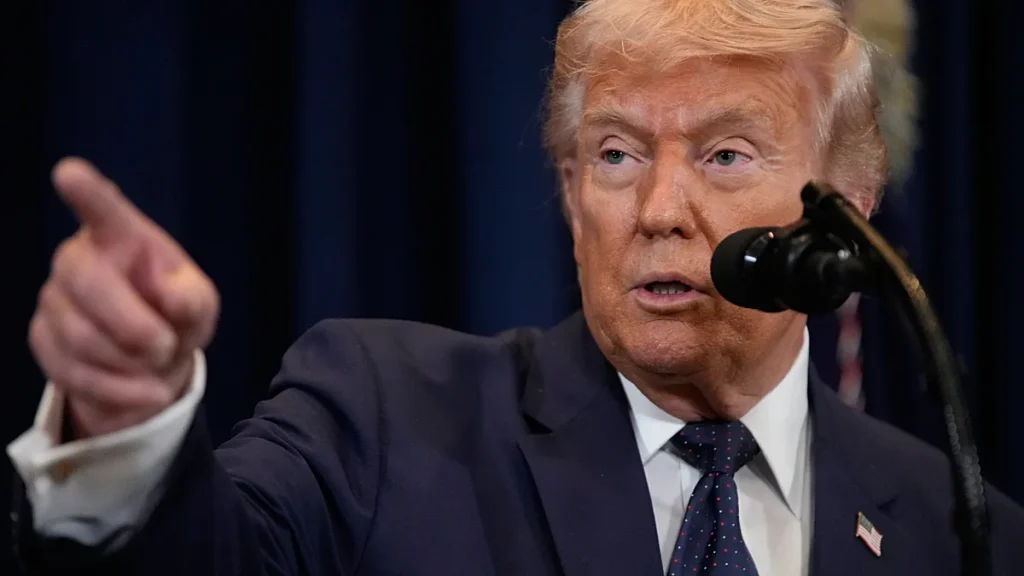
Crude Market Decline Amid Trump’s Consideration of Sanctions Relief
Following remarks by US President Donald Trump, global oil prices experienced a notable decline. Trump hinted at potential easing of sanctions on certain nations, suggesting the conflict with Iran might not persist for long. This prompted a shift in market sentiment, as investors anticipated relief in the supply chain.
Currently, the U.S. imposes sanctions on oil trade involving Iran, Venezuela, Russia, Syria, and North Korea. Trump’s comments came after a meeting with Russian President Vladimir Putin, during which they discussed the ongoing war and related economic matters. The U.S. decision to consider sanctions waivers could signal a strategic move to stabilize energy markets.
“We took a little excursion to the Middle East to eliminate some threats. I believe it will be a short-term operation,” Trump remarked to Republican lawmakers at his Miami-based golf club.
Oil prices had previously surged to their highest level since 2022, reaching nearly $120 per barrel. This spike occurred after Iran’s Assembly of Experts named Mojtaba Khamenei as the new supreme leader, replacing his late father. The move was interpreted as a sign of Tehran’s determination to continue the conflict. However, recent statements from Trump have led to a reversal, with prices retreating from peak levels.
During the European morning, Brent crude was trading just below $90, while WTI fell to $85.40 per barrel. Both benchmarks dropped over 9% in a single day, reflecting uncertainty about the duration of the war. The prospect of sanctions relief has lifted investor confidence, contributing to gains in major European stock markets.
The FTSE 100 in London climbed over 1.1%, the CAC 40 in Paris rose 1.9%, and the DAX in Frankfurt increased by 2%. Indices in Madrid and Milan also saw a 2.5% uptick, while the Stoxx 600 gained 1.7%. Asian markets followed suit, rebounding on Tuesday after steep declines the prior day. Tokyo’s Nikkei 225 added 2.9%, bolstered by revised economic data showing Japan’s growth at 1.3% for the final quarter of last year.
Neil Newman, a strategist at Astris Advisory Japan, noted the market’s positive reaction: “Today’s rebound clearly follows Trump’s optimistic comments overnight. We’re beginning to see a glimmer of hope for an end to the conflict.” South Korea’s Kospi and Australia’s S&P/ASX 200 also recorded gains, reflecting broader regional optimism.
Meanwhile, concerns over the Strait of Hormuz remain central. This vital waterway, which handles a fifth of global oil traffic, has been a focal point of tension. Iran’s threat to disrupt shipping through the strait has raised fears of prolonged price spikes. Macquarie Research strategists warned that a closure lasting weeks could push crude to $150 or more.
Trump emphasized that sanctions would be lifted for countries where conditions improve. “If Iran takes actions that halt oil flow through the Strait of Hormuz, they will face a stronger U.S. response,” he stated on social media. Iranian state media responded by asserting that “the war’s end will be decided by Tehran,” highlighting the ongoing standoff.
Financial markets also saw a shift in bond yields, with the 10-year U.S. Treasury note dropping to 4.10% from 4.15% by late Friday. Yields had initially risen above 4.20% on Monday morning due to oil price anxieties but retreated as crude prices eased. The currency market, however, remained under observation, with traders gauging potential ripple effects from the evolving situation.
The central issue for investors is the long-term trajectory of oil prices. If crude remains elevated, households and businesses may face increased costs, potentially triggering economic challenges. Analysts warn of a stagflation scenario, where growth stagnates amid persistent inflationary pressures.
