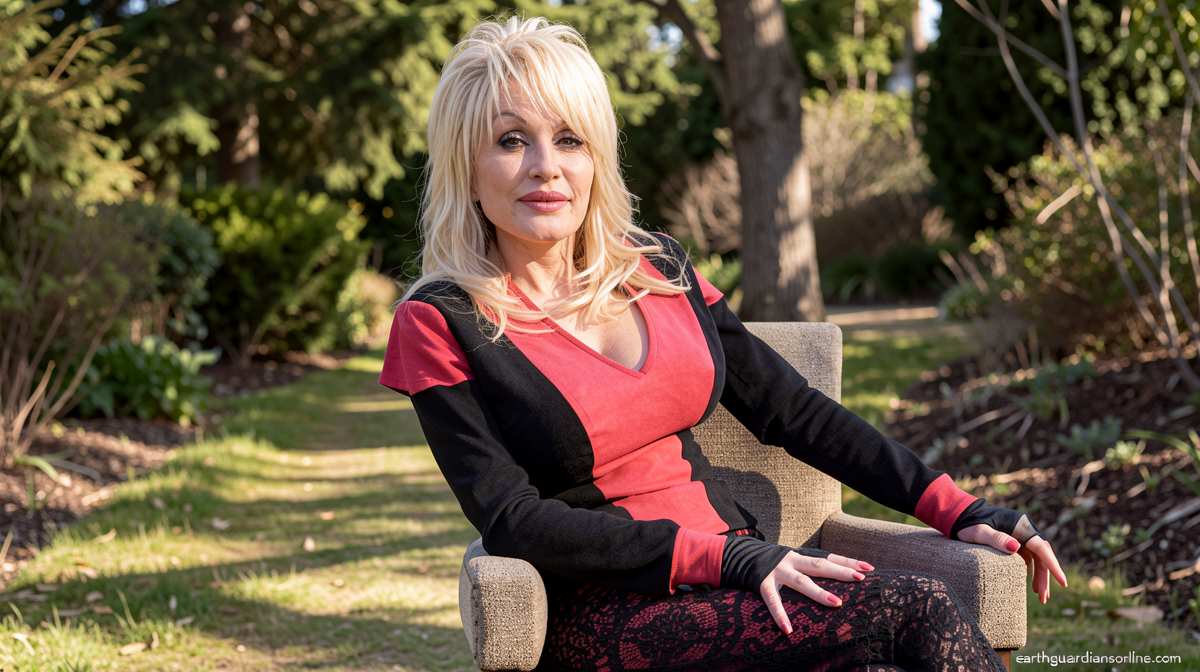
Dolly Parton, queen of country music and humanitarian hero, dead at 80

Daftar Isi
Dolly Parton, the Songwriter Who Built an Empire From a Tennessee Cabin, Has Died
Earthguardiansonline.com – The woman who transformed a rural Appalachian upbringing into one of the most recognizable voices in American popular culture is gone. Dolly Parton passed away on Tuesday at her Nashville residence, surrounded by family, at the age of 80. A statement released by her nephew Bryan Seaver confirmed the death and described it as “peaceful.” The family indicated that a small, private memorial service would be arranged for immediate relatives.
Parton’s final years had been marked by visible struggles with her health, a reality she addressed openly with fans. The loss of her husband of nearly six decades, Carl Dean, in March 2025, compounded those difficulties. Speaking to her audience in a video earlier this year, she offered a candid explanation for her declining condition:
“Back when my husband Carl was very sick — that was for a long time — and then when he passed, I didn’t take care of myself. So I let a lot of things go that I should have been taking care of.”
A Career Measured in Thousands of Songs
Over more than fifty years of professional activity, Parton composed or co-wrote in excess of 3,000 songs, a body of work that spans country, pop, gospel, and children’s music. Her catalog includes tender family portraits such as “Coat of Many Colors,” a quiet tribute to the mother who sewed garments in the family’s isolated Tennessee home. It also encompasses some of the most enduring love songs in the English language, from “Jolene” to “I Will Always Love You,” the latter of which achieved a second, massive life after Whitney Houston’s 1992 cover for the film The Bodyguard.
Her 1980 hit “9 to 5,” the title track of the film in which she starred, transcended genre boundaries and became a rallying anthem for working women across the country. Across her recording career, Parton released 49 studio albums and collected 11 Grammy Awards. She scored repeated crossovers onto the pop charts, most notably with “Islands in the Stream,” a 1983 duet with Kenny Rogers that topped multiple charts simultaneously.
The Song That Changed Everything
Parton frequently recounted the origin of “I Will Always Love You,” a story that encapsulates both her creative instincts and the turning point of her career. The song began not as a love ballad but as a practical plea: she needed to convince her longtime television partner, Porter Wagoner, to release her from their joint variety show so she could pursue a solo path.
“So I went home and wrote that song, took it back the next morning, and said, ‘Sit down, I need you to hear something.’ So I sang it, and he was crying.”
Wagoner, in her telling, had been “wasn’t listening to anything” she attempted to say during their conversations. The song, however, broke through. He relented, and Parton stepped into a solo career that would prove almost without parallel in the breadth and longevity of its commercial and cultural impact.
From a One-Room Cabin to the Nashville Laundromat
Parton was born on January 19, 1946, in a single-room cabin in Sevier County, Tennessee. She was the fourth of twelve children in a household she later described as “dirt poor.” Her father could not read. Music, nonetheless, saturated the family’s daily life, filtered largely through her mother, whose own father had been a preacher who played piano and guitar.
“My people were the ones that sang at funerals and weddings and shindigs and anything around locally.”
An uncle handed her a guitar when she was still a small child. By age seven she was playing and composing simple melodies. Her mother, Parton recalled, was “fascinated with how I could rhyme and write songs about stuff I’d never lived,” though the child was simply absorbing the conversations and hymns of her community.
After finishing high school, she relocated to Nashville to chase a recording career. On her very first day in the city, she encountered a young man named Carl Thomas Dean outside a laundromat. Years later she wrote that she was “surprised and delighted” that he looked at her face while talking — something, she noted, was rare for her. He appeared genuinely curious about who she was and what she wanted to do.
Monument, Wagoner, and the Road to Solo
Parton signed her first recording contract with Monument Records in 1965 and married Dean the following year. By 1967 she had secured regular slots on The Porter Wagoner Show, a nationally televised music variety program that turned her into a household name almost overnight. Her first number-one single, “Joshua,” arrived in 1971; “Coat of Many Colors,” released that same year, peaked at number four.
For roughly seven years she functioned first as Wagoner’s supporting vocalist and then as his duet partner. By 1974, however, she concluded that the arrangement had run its course. Armed with the emotional weight of “I Will Always Love You,” she struck out independently. At the time the move could have seemed reckless, but Parton had already been building institutional infrastructure: at age twenty she had co-founded a publishing company with her uncle and occasional co-writer Bill Owens, giving her a controlling stake in her own catalog from an early stage.
Philanthropy at Scale
In later decades, Parton channeled the enormous wealth generated by her music into large-scale charitable work. Most prominently, she established a library initiative that has distributed more than 300 million books to children worldwide, a figure that places the program among the largest private book-distribution efforts in history. Her humanitarian profile made her one of the most philanthropic figures in American entertainment, a reputation that deepened her public affection well beyond the country-music audience.
Her death closes a chapter in American cultural history that began in a cabin with no electricity and ended with a woman who had written more songs than most nations’ entire pop catalogs. The family’s request for a private service suggests that, for now, the mourning will remain intimate. But the public reckoning with what Parton represented — a songwriter’s work ethic married to a humanitarian’s generosity, both rooted in a place most Americans would never find on a map — is only beginning.
Related Reading
Frequently Asked Questions
What is Dolly Parton queen of country music?
Dolly Parton queen of country music is the main topic of this guide. The article explains the context, practical details, and next steps readers should understand.
Why does Dolly Parton queen of country music matter?
Dolly Parton queen of country music matters because readers are looking for a useful answer, not just a short summary. Good content should match search intent and help them decide what to do next.