
These drag queens have no time for culture wars
These drag queens have no time for culture wars
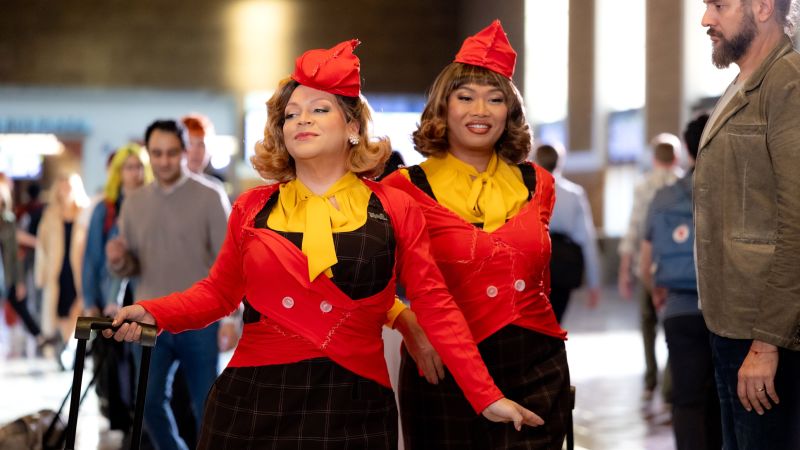
These drag queens have no time – Adam Shankman, the director behind iconic films like Hairspray and A Walk to Remember, embarked on an unusual project: a comedic parody of a disaster movie featuring a diverse ensemble of drag queens. The result is Stop! That! Train!, a film that blends chaotic humor with a surprisingly broad appeal, even as it navigates the often contentious landscape of cultural perceptions surrounding drag. Opening this weekend with an R rating, the movie has sparked both laughter and debate, with its creators insisting it’s a far cry from the politically charged dramas that dominate headlines.
A comedy with no political baggage
Shankman’s latest endeavor, Stop! That! Train!, began as a straightforward attempt to craft a lighthearted disaster comedy. However, the film’s inclusion of drag queens as central characters has led to unexpected discussions about its tone and themes. “I made a kids movie, sort of,” Shankman said, “if it weren’t for the d**k jokes.” While the movie certainly contains risqué humor, its accessibility to mainstream audiences is its most notable feature. Unlike other recent films that have leaned into political satire or social commentary, this comedy focuses on pure absurdity, with a premise that leans heavily on tropes from classic disaster films.
“The movie is, from a humor standpoint, as politically free as you can be, and I did that intentionally,” Shankman added. “I made a comedy-forward movie. The fact that it is populated by these drag artists is the most transgressive part of it.”
The film follows Tess (played by Ginger Minj) and DeeDee (Jujubee), two employees of the Stank Rail commuter service who dream of embarking on a cross-country adventure. As Tess puts it, their goal is “to see the Dakotas—both Fanning and Johnson.” When they lose their jobs, they con their way into positions on the Glamazonian Express, a luxury train with a far more glamorous set of passengers. The duo soon finds themselves in a race against time to survive a runaway train hurtling toward a colossal storm, dubbed a “stormaganza,” while dealing with both catty colleagues and demanding travelers.
Shankman’s decision to star drag queens in his comedy has drawn attention in a time when drag performers are frequently scrutinized for their role in cultural discourse. The film’s humor is intentionally free of divisive topics, with no jokes about race, religion, or even the drag community itself. Instead, it relies on slapstick, puns, and visual gags—elements that have long defined the genre of disaster comedies. The movie’s biggest controversy, so far, has been speculation about whether it used artificial intelligence to create special effects, an accusation Shankman has firmly denied.
A legacy of drag in film
Drag has been a fixture in cinema since its early days, according to Joe E. Jeffreys, a drag historian at New York University’s Tisch School of the Arts. As early as 1901, drag performances were already making their way into film, with Gilbert Sarony starring in a silent short titled The Old Maid Having Her Picture Taken, where he impersonated a female character. However, drag’s role in mainstream films has often been reduced to a comedic device, with male stars crossdressing to navigate tricky situations. This pattern is evident in classics like Some Like It Hot (1959), Tootsie (1982), and Mrs. Doubtfire (1993), where drag serves as a tool for humor rather than a central theme.
More recently, films like The Adventures of Priscilla, Queen of the Desert (1994), To Wong Foo, Thanks for Everything! Julie Newmar (1995), and The Birdcage (1996) have embraced drag as a narrative force, casting predominantly straight, cisgender men in roles that celebrate the art form. These films helped bridge the gap between drag culture and wider audiences, but they often framed drag as a secondary element rather than a defining aspect of the story. Stop! That! Train! marks a shift, placing drag queens at the forefront and allowing their presence to shape the film’s identity.
Despite its comedic roots, the film’s appeal has extended beyond traditional audiences. “We’ve all seen these movies a million times,” said Ginger Minj, one of the lead performers. “But it has this undercurrent of drag that’s just sprinkled there that I think is easily accessible for a lot of people who aren’t familiar with drag.” The blend of familiar disaster movie tropes with drag culture’s irreverent flair has created a unique experience that resonates with viewers regardless of their background in the art form.
Quick production and star-studded cameos
Shot in just 19 days, Stop! That! Train! features a star-studded cast of celebrities, including Sarah Michelle Gellar, Nicole Richie, Jesse Tyler Ferguson, and Raven-Symoné. The film’s rapid production schedule and budget-friendly approach have been praised for allowing the cast and crew to focus on the humor rather than overcomplicating the narrative. The result is a 92-minute spectacle of campy chaos, with each scene designed to maximize laughs and minimize pretension.
Shankman’s creative choices have also been highlighted as a deliberate effort to avoid political controversy. While the film is set against the backdrop of a stormaganza, it never feels like a metaphor for real-world issues. Instead, it’s a celebration of drag’s ability to entertain without needing to make a statement. “I wanted to make a film that’s just fun,” Shankman said. “The drag queens are the stars, and the rest is just spectacle.”
For drag enthusiasts, the film is a joyous throwback to the roots of the art form. For newcomers, it’s an entry point into the world of drag culture, with humor that’s easy to grasp and characters that are as colorful as the film’s visual style. This accessibility has been a key factor in its national release, which is rare for a Hollywood comedy with no existing IP to draw from. “It’s a gamble,” Jeffreys noted, “but one that pays off when the audience is allowed to laugh first and think later.”
The film’s success underscores a broader trend: drag’s ability to transcend cultural divides and find a place in mainstream entertainment. Whether through parody or drama, drag has long been a vehicle for both self-expression and humor. Stop! That! Train! continues this legacy, proving that even in an era of heightened political discourse, drag queens can still claim the spotlight with nothing but a train, a storm, and a willingness to embrace the ridiculous.
