
Exploring Ancient Civilizations and Empires: Key Lessons from History
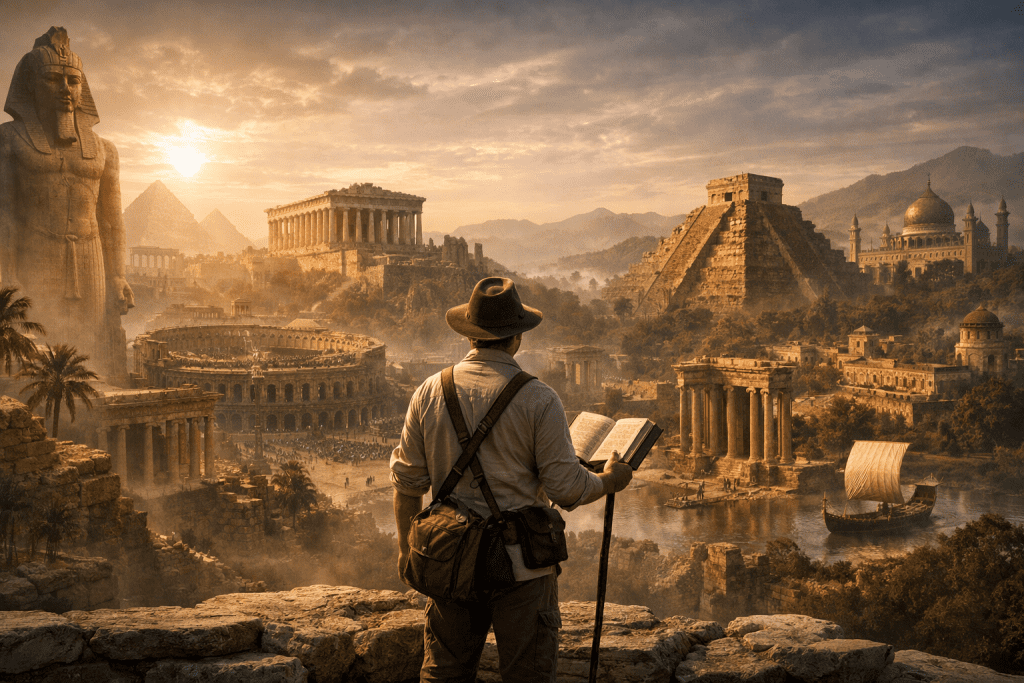
The study of ancient civilizations and empires offers more than stories of kings, wars, and monumental architecture. It provides enduring lessons about leadership, governance, innovation, resilience, and collapse. By examining how early societies rose to power and why many eventually declined, we gain insight into patterns that still shape the modern world. Understanding these historical foundations helps us better navigate political, economic, and social challenges today.
From the fertile valleys of Mesopotamia to the vast territories of Rome and China, ancient societies laid the groundwork for law, infrastructure, culture, and trade. Their achievements were not accidental but the result of strategic organization, adaptability, and human ambition. At the same time, their failures reveal the consequences of inequality, overexpansion, and environmental neglect. Exploring ancient civilizations and empires allows us to see both the triumphs and vulnerabilities of complex societies.
The Foundations of Early Civilizations
Most early civilizations emerged near rivers that provided water, fertile soil, and trade routes. The civilization of Mesopotamia, located between the Tigris and Euphrates rivers, is often called the “cradle of civilization.” Here, the Sumer developed one of the first writing systems, cuneiform, enabling record-keeping, laws, and literature.
Similarly, Ancient Egypt flourished along the Nile River, where predictable flooding supported stable agriculture. The Egyptians built monumental structures such as the Great Pyramid of Giza, demonstrating advanced engineering and centralized authority. These early societies highlight the importance of geography in shaping political power and economic stability.
In East Asia, the Shang Dynasty established early forms of governance and bronze technology. Meanwhile, in South Asia, the Indus Valley Civilization developed sophisticated urban planning with grid-based cities and advanced drainage systems. Across continents, early urban centers showed that organization, innovation, and shared belief systems were critical to societal cohesion.
The key lesson from these early examples is clear: strong institutions and environmental adaptation are essential foundations for long-term survival. Without stable agriculture and administrative systems, civilizations struggled to expand or endure.
Governance, Law, and Social Order
One of the defining features of successful ancient civilizations and empires was their ability to create systems of law and governance. The Babylonian Empire introduced the Code of Hammurabi, one of the earliest written legal codes. It established clear rules and consequences, reinforcing social order and centralized authority.
In the Mediterranean, the Roman Empire developed an extensive legal framework that influenced modern legal systems. Roman law emphasized citizenship, contracts, and property rights, shaping governance models that still resonate today. Their system of roads, taxation, and military organization helped maintain control over vast territories.
In Asia, the Han Dynasty strengthened bureaucratic governance through Confucian principles and merit-based civil service. This emphasis on education and administrative competence reinforced stability across generations. The durability of these systems demonstrates how institutional continuity can outlast individual rulers.
These examples show that law and governance are not merely administrative tools but the backbone of civilizational longevity. When legal systems are fair, adaptable, and respected, societies are more resilient against internal unrest.
Expansion, Trade, and Cultural Exchange
Many ancient civilizations and empires expanded through conquest, diplomacy, and trade. Expansion often brought wealth and cultural diversity but also increased administrative challenges. The Persian Empire, for example, managed a vast multicultural territory by allowing regional autonomy while maintaining centralized authority.
Trade networks such as the Silk Road connected the Roman Empire with the Han Dynasty, facilitating the exchange of goods, ideas, and technologies. This interconnectedness fostered innovation and economic growth. Cultural diffusion spread religions, artistic styles, and scientific knowledge across continents.
In the Americas, the Maya Civilization developed complex trade routes and calendrical systems. Meanwhile, the Inca Empire built extensive road networks across challenging mountainous terrain. These achievements reveal that infrastructure and cooperation are central to sustaining expansive territories.
The lesson here is that openness to exchange strengthens societies. Trade and cultural interaction not only increase prosperity but also encourage intellectual and technological progress.
Causes of Decline and Collapse
Despite remarkable achievements, many ancient civilizations and empires eventually declined. The fall of the Roman Empire illustrates how political corruption, economic instability, military overreach, and external invasions can converge. Internal division weakened Rome’s capacity to defend and govern effectively.
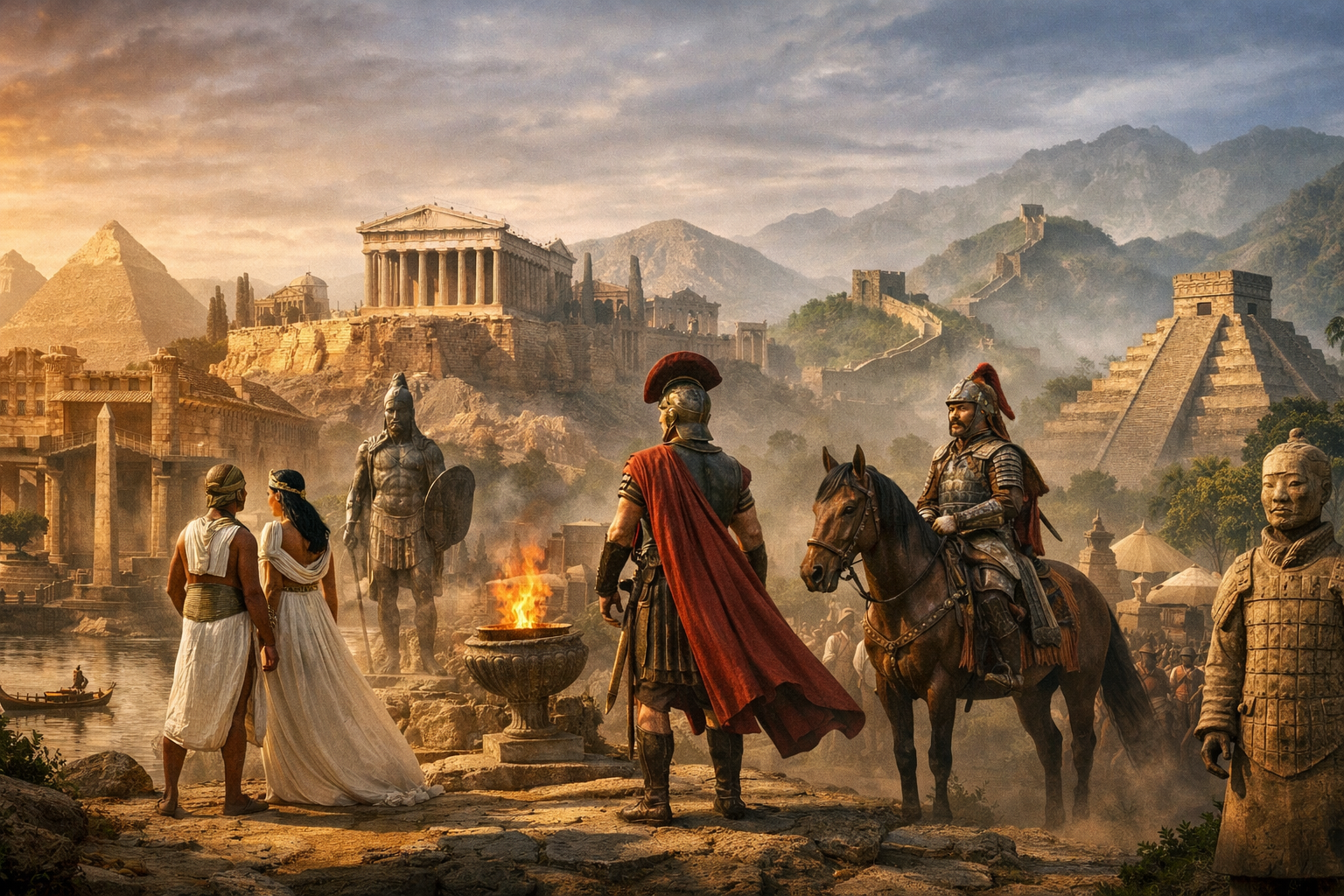
Environmental stress also played a significant role in collapse. Evidence suggests that prolonged droughts affected the Maya Civilization, contributing to urban abandonment. Overuse of land and deforestation strained agricultural systems, revealing the dangers of unsustainable practices.
In some cases, rigid social hierarchies and inequality intensified unrest. When elites concentrated wealth and power, social cohesion weakened. The history of ancient civilizations and empires repeatedly shows that ignoring economic disparity and environmental limits can accelerate decline.
From these patterns, we learn that adaptability and sustainability are essential for survival. Societies that fail to reform institutions or address emerging crises often struggle to endure.
Leadership, Innovation, and Legacy
Leadership profoundly shaped the trajectory of ancient civilizations and empires. Figures like Alexander the Great expanded territories rapidly, spreading Hellenistic culture across regions. His campaigns reshaped political and cultural landscapes, leaving a lasting imprint on multiple continents.
Technological and intellectual innovation also defined enduring legacies. Roman engineering, Chinese papermaking, and Egyptian architectural techniques influenced later generations. The preservation and transmission of knowledge became a cornerstone for future advancements.
Perhaps the most enduring lesson is that civilizations are built not only on conquest but on ideas. Philosophies, religions, and legal traditions established thousands of years ago continue to inform modern governance and ethics. The legacy of ancient civilizations and empires lives on in contemporary institutions, cultural identities, and global systems.
By studying these past societies, we recognize patterns of growth, conflict, cooperation, and renewal. Their stories remind us that progress requires vision, discipline, and collective responsibility.
Conclusion
Exploring ancient civilizations and empires reveals timeless lessons about governance, innovation, trade, sustainability, and human ambition. While their monuments stand as symbols of greatness, their histories also warn against complacency, inequality, and environmental neglect. By understanding both their successes and failures, we gain practical insights that remain relevant in shaping the modern world.
FAQ
Q: Why are ancient civilizations and empires important to study today? A: They provide lessons about governance, economic systems, cultural exchange, and societal resilience that still influence modern institutions and global dynamics.
Q: What caused most ancient civilizations and empires to collapse? A: Common factors include political instability, economic inequality, environmental stress, military overexpansion, and failure to adapt to changing conditions.
Q: How did trade influence ancient civilizations and empires? A: Trade networks promoted economic growth, cultural exchange, and technological innovation, strengthening connections between distant regions.
Q: Which ancient empire had the most lasting legal influence? A: The Roman Empire had a profound impact on modern legal systems, especially in areas related to citizenship, contracts, and property law.
Q: What is the main lesson modern societies can learn from ancient civilizations and empires? A: Sustainable development, strong institutions, and adaptability are essential for long-term stability and prosperity.
