
A professor’s mic went off mute. What she said about Black children reverberated across New York.
A professor’s mic went off mute. What she said about Black children reverberated across New York.
Emergency Meeting Sparks Community Reflection
At a gathering held in the basement of Joan of Arc Junior High School, a small crowd of parents and council members convened, joining virtually via Zoom. The meeting, which followed weeks of controversy, brought together about 20 individuals in person and 150 online. An air of unease hung over the assembly, as two Black students held signs declaring, “Student dignity. Accountability is not optional.”
Condemnation and Calls for Reform
Community Education Council District 3 members concluded the two-hour session by unanimously endorsing a resolution that criticized Allyson Friedman’s remarks and demanded improved guidelines for video conferencing, anti-bias training for parents, and stricter safeguards against future interruptions. “The anti-Black words spoken by an adult have been heard ’round the world,” said council Co-President Jill Rackmill, who opened the meeting by reciting the eighth grader’s speech that had been cut off earlier. “Yet the student who bravely stood in what should have been a secure environment has been overshadowed. Adults let her down.”
Reactions to the Controversial Remarks
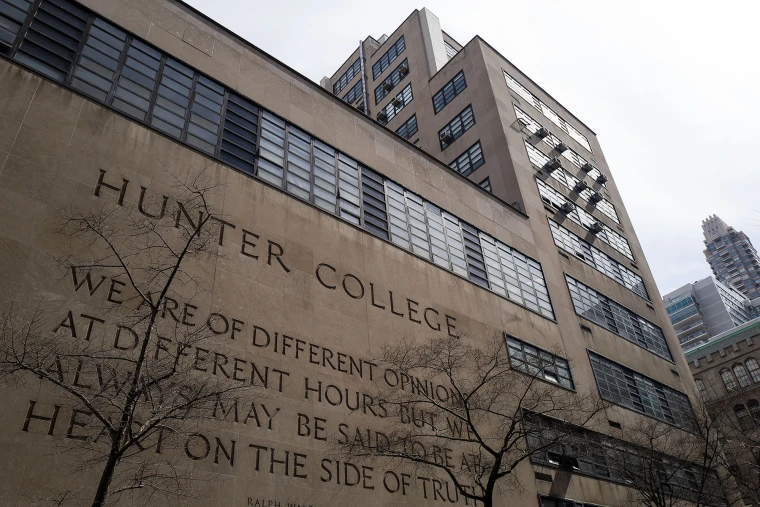
The incident stemmed from a February 10 council meeting where Friedman, a tenured associate professor at Hunter College, remarked over Zoom about Black students: “They’re too dumb to know they’re in a bad school.” The statement came as a Black eighth grader pleaded to save her middle school from potential closure. The recording of the exchange swiftly went viral, thrusting the debate over school closures and equity into national conversation.
New York City Mayor Zohran Mamdani denounced Friedman’s comments as “racist,” and just hours before Thursday’s meeting, Hunter College placed her on leave pending an investigation. Public school parent and CEC District 3 council member Noah Odabashian noted, “On the Upper West Side, they far sooner would smile at your face and do anti-Black things as opposed to say anti-Black things. And so I was a little shocked that they would say the quiet part out loud.”
Proposals and Community Tensions
For months, school officials have proposed relocating or closing at least four middle schools on the Upper West Side, citing factors such as declining enrollment, budget constraints, academic performance, and compliance with a 2022 law requiring class-size reductions by 2028. These plans have sparked heated discussions, as they threaten neighborhood cohesion and could widen racial and economic gaps.
Elizabeth Sofro, a parent attending the meeting, described the proposals as a “push to the wall with what they can handle,” emphasizing that the closures were introduced with minimal time for families to process the impact. “So, stuff comes out. People’s true colors come out, whether it’s good or bad,” she remarked.
Systemic Racism in Educational Decisions
City Council member Rita Joseph, who chairs the higher education committee, argued that the discussion of school closures is inherently racial. According to data from the New York City Department of Education, 27% of students in grades six through eight in the district are Black, compared to 23% citywide. “We cannot talk about school closures, equity, or educational opportunity without addressing the culture and systems that devalue Black students and communities,” Joseph stated in an interview with The New York Times.
Meanwhile, Dominique Ellison, a spokesperson for the New York City Department of Education, clarified in a statement that “no formal proposals have been finalized or circulated” at this time. The ongoing debate reflects deep divisions within the community, with some families fearing disruption to established school networks and cultural ties.
