
They were forced to hand one son over to the Israeli army in return for another. Eight months later he was dead in prison
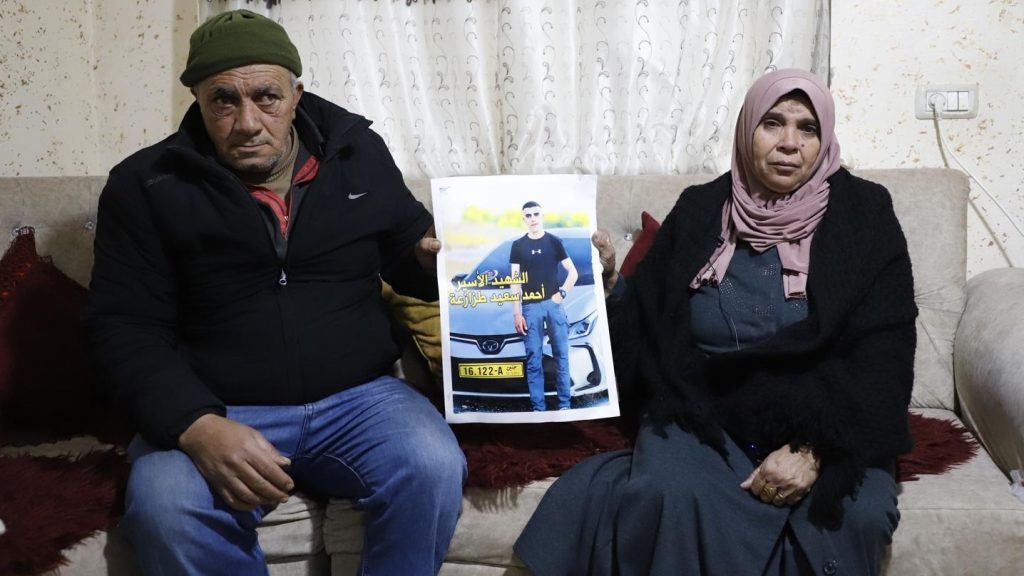
Haunted by sorrow and remorse, Ahmad Tazaza’s family mourns the loss of their youngest son
Ahmad Tazaza, a 20-year-old Palestinian with no prior medical issues, was surrendered to Israeli forces in January 2025 in the occupied West Bank. His parents now live with the anguish of his death eight months later in Megiddo prison, a place infamous for its harsh conditions.
The Detention Process
Despite their confusion, the Tazaza family maintains that they had no clear reason for handing over their youngest son. The situation mirrored countless others, where young Palestinians were detained without formal charges or trials. Ahmad was held as an administrative detainee, a method allowing indefinite imprisonment without due process.
By September 2025, Israeli Prison Service data showed 10,465 Palestinian men were detained as “security prisoners,” with 7,425 from the West Bank and East Jerusalem. The family’s home in Qabatiya, a northern West Bank town, had been repeatedly raided by Israeli security forces seeking Ahmad. Harassment and threats were constant.
“They smashed the house and destroyed everything,” said Najah Abdul Qader, Ahmad’s mother. “He was not at home; he was working at the market and sleeping there that night. They took his brother and father, then released them saying, ‘We want him’.”
Qader recounted how an Israeli soldier had later threatened to bomb their home if Ahmad didn’t turn himself in. He had narrowly avoided capture before by leaping from a vehicle as it was crushed by a bulldozer.
The Exchange at the Checkpoint
After failing to locate Ahmad, Israeli forces detained his brother again. Saeed Tazaza, the father, described the exchange: “They insisted, ‘We won’t let him go until you hand over your other son.’ His brother is married with two children. We told Ahmad we wanted to see him. We caught him and took him.”
The family delivered him to the Salem checkpoint near Jenin. “We handed him over,” Qader recalled. “He looked at us and I knew he would not return. I felt he was not coming back when he turned his face and walked away.”
Initially, the parents believed they had spared him from greater danger. “I handed my son over because I was afraid for him,” his father stated. “I was afraid he would die. We were forced, and we handed him over. What could we do? This is our fate.”
“He said to me, ‘Mum, they torture people in prison,’ ” Qader shared. “I told him, ‘Let them torture you, but not kill you, not shoot you.’ Today in the street they shoot a person who has done nothing.”
Autopsy Findings and Family Dispute
Ahmad Tazaza died at age 21 in Megiddo prison on 3 August 2025, as confirmed by a post-mortem report obtained by Middle East Eye. The report, dated 8 August, was conducted by a physician affiliated with Physicians for Human Rights Israel (PHRI), a group that monitors Palestinian prisoner autopsies when allowed by Israeli authorities.
The report noted Ahmad was “reported to be healthy” at the time of detention. His prison records listed minor ailments like diarrhoea and scabies, as well as a sore throat days before his death. On 2 August, an on-call doctor observed blood stains on his trousers during a clinic visit.
According to the report, Ahmad collapsed after requesting to use the restroom, losing consciousness and vital signs. Resuscitation efforts, including intubation and CPR, were unsuccessful. The autopsy suggested possible signs of severe blood cancer, such as acute leukaemia or aggressive lymphoma, ruling out sudden death causes.
However, the family disputes the findings, unable to see Ahmad’s body due to its retention by Israeli authorities. They relied on accounts from released prisoners and an International Committee of the Red Cross liaison officer, though the ICRChas not been granted access to Palestinian detainees. “I handed my son to my enemy,” Qader said. “But that’s it. We wanted to protect him.”
