‘Decades in Sports’: How Colin Kaepernick taking a knee in 2016 revived athlete activism in sports

Daftar Isi
Nearly a Decade Later, the Knee Still Echoes Through American Sports
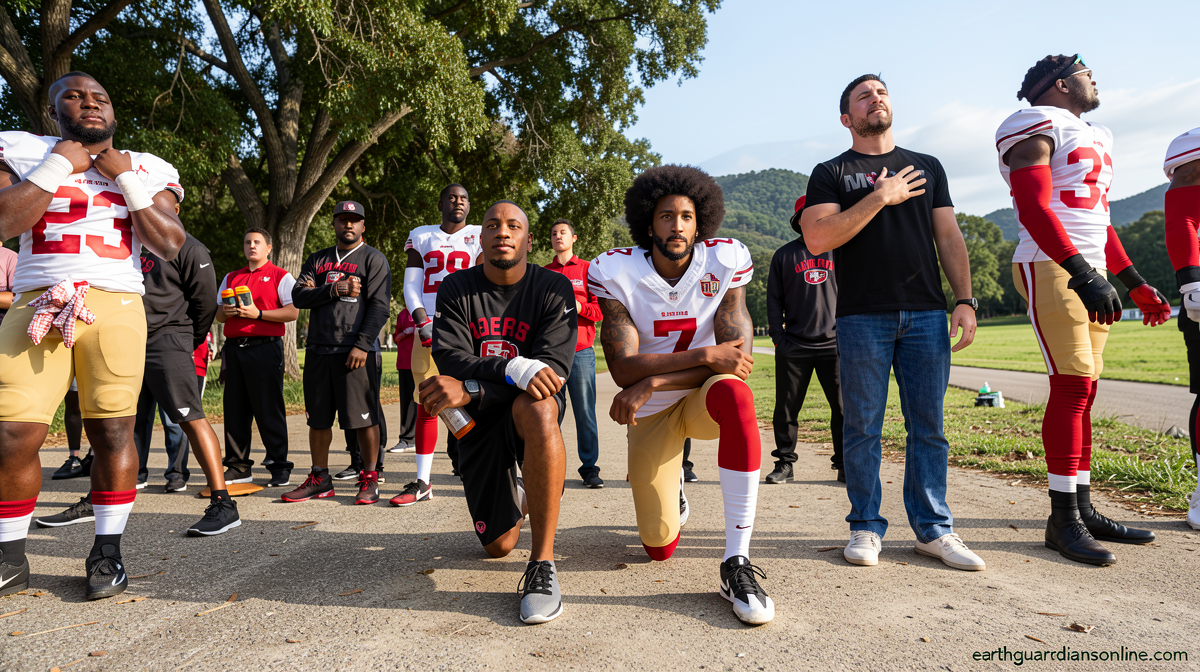
Earthguardiansonline.com – On a September evening in 2016, a quarterback dropped to one knee in the shadow of the national anthem, and the image fractured something in the national conversation that had been building for years. Almost ten years have elapsed since that moment, yet the reverberations of Colin Kaepernick’s silent act of dissent continue to shape how athletes, fans, and institutions navigate the intersection of sport and social justice. What began as a personal gesture of mourning and defiance has calcified into a cultural touchstone — a shorthand for the question of whether athletes owe their audiences silence, spectacle, or solidarity.
From the Bench to the Knee
The protest did not arrive fully formed. Its earliest iteration was quieter, almost invisible. On August 14, 2016, before a preseason matchup with the Houston Texans, Kaepernick chose to remain seated while the anthem played. He repeated the gesture the following week against the Denver Broncos. Because he did not suit up for either contest, the acts passed without public remark. The turning point came on August 26, when Kaepernick returned to uniform for a preseason game against the Green Bay Packers. Once again he sat during the anthem — but this time, cameras were rolling and millions watched. The following week, against the San Diego Chargers on September 1, he escalated the gesture: he knelt, joined by teammate Eric Reid. That image, broadcast to a national audience, became one of the most recognizable photographs of 2010s sports culture.
Kaepernick, then 28 years old, was entering the season carrying the weight of a battered 2015 campaign in which injuries had derailed his year and cost him the starting position. Football, however, had receded in his personal hierarchy of concerns. After the Packers game, he addressed the question of motive with unflinching directness to longtime NFL reporter Steve Wyche:
“I am not going to stand up to show pride in a flag for a country that oppresses Black people and people of color. To me, this is bigger than football and it would be selfish on my part to look the other way. There are bodies in the street and people (are) getting paid leave and getting away with murder.”
The Racial Climate Behind the Gesture
Understanding the protest requires understanding the atmosphere in which it was born. The Black Lives Matter movement had surged into national consciousness in 2013 after George Zimmerman, a 28-year-old neighborhood watch volunteer, was acquitted of killing 17-year-old Trayvon Martin in Sanford, Florida, the prior year. Nearly half a century had elapsed since Martin Luther King Jr. addressed the nation from the Lincoln Memorial steps, yet the dream articulated that day remained, in the eyes of many Americans, unfulfilled. Police killings of Black citizens continued at a pace that fueled sustained protest across multiple cities.
Tensions reached a peak in July 2016. Alton Sterling was shot by officers in Baton Rouge, Louisiana, and just one day later, Philando Castile was killed by police in Falcon, Minnesota. Castile’s death prompted then-Governor Mark Dayton to confront the racial dimension publicly at a press conference:
“Would this have happened if the driver and passenger were white? I don’t think it would have. So I’m forced to confront, and I think all of Minnesota is forced to confront, that this kind of racism exists.”
Kaepernick had been vocal on social media about both deaths, describing Sterling’s killing as a modern-day “lynching” and saying he had been “executed.” After Castile’s death followed within less than 24 hours, Kaepernick declared it was “clear as day” that African Americans across the country were “under attack.” It was against this backdrop of grief and fury that he chose to translate private anguish into a public, visible act during the 2016 NFL preseason.
A Nation Divided by a Silent Act
Renée Graham, Associate Editor and Columnist at The Boston Globe, has noted that although the protest was quiet and non-disruptive, it seized public attention and “took on this sort of life of its own.” When the regular season commenced, Kaepernick continued his silent boycott of the anthem. The response was swift and often vicious: boos rolled through stadiums from coast to coast, death threats accumulated, and sharp public criticism followed. Then-Republican presidential candidate Donald Trump, speaking in an interview with KIRO radio in Seattle, labeled the protest a “terrible thing” and suggested Kaepernick should “find a country that works better for him.”
Sam Farmer, sports journalist at the Los Angeles Times, observed that “the whole country was wrapped up in this controversy.” Yet Kaepernick remained unmoved. It became evident, as Farmer and others noted, that no institutional force — not even the man who would soon become the most powerful leader in the country — could halt the mission he had set for himself.
Legacy and the Reshaping of Athlete Activism
The knee did not exist in a vacuum. It landed in a media landscape already saturated with social-media amplification, where a single broadcast image could ignite a global conversation within hours. In the years since, the gesture has been adopted, adapted, and contested across leagues, nations, and generations of athletes. It has forced teams, sponsors, and broadcasters to reckon with questions of political expression in sporting spaces that had long been treated as apolitical by convention.
For Kaepernick himself, the aftermath was brutal: he spent years without an NFL contract, navigating legal battles and public scrutiny while continuing to advocate for police reform and racial equity. Yet the broader arc of his decision — a single player choosing visibility over comfort in a moment of national fracture — altered the calculus for every athlete who followed. The question the knee posed was never merely about football. It was about whether the platform of professional sport carries an obligation to speak when silence, in the face of injustice, becomes its own form of complicity. Nearly a decade on, American sports has not fully answered that question. The debate, like the anthem itself, continues.
Related Reading
Frequently Asked Questions
What is Decades in Sports?
Decades in Sports is the main topic of this guide. The article explains the context, practical details, and next steps readers should understand.
Why does Decades in Sports matter?
Decades in Sports matters because readers are looking for a useful answer, not just a short summary. Good content should match search intent and help them decide what to do next.