
‘It’s insane’: How climate change is having an impact at Roland Garros
‘It’s Insane’: Climate Change Alters the Game at Roland Garros
It s insane – Elite athletes thrive on precision, discipline, and repetition. Their routines are built on years of preparation, with schedules, nutrition, and training meticulously honed to peak performance. Yet, one unpredictable factor continues to challenge even the most seasoned competitors: the weather. As a relentless heatwave scorches Europe, its effects are intensifying at the French Open, where players are grappling with conditions that defy traditional norms. France’s national weather service has reported daily highs surpassing 32 degrees Celsius (90 degrees Fahrenheit) since Saturday, a phenomenon that has shaken the tennis world. The relentless sun has transformed the tournament into a test of endurance, with players sweating through matches under temperatures that rival the sweltering days of July—the country’s usual hottest month.
Players Battle Against Unprecedented Heat
The heatwave’s grip on Roland Garros is not just a discomfort; it’s a crisis. This week has already broken records, with France’s highest May temperature on record registered. The implications are clear: even the most disciplined athletes are struggling to adapt. During pauses in play, players rush to their benches, where they employ a range of strategies to combat the rising heat. Umbrellas provide temporary shade, portable fans operate at full capacity, and hydration stations buzz with activity as players sip electrolyte-rich drinks. Some have resorted to holding ice packs against their faces and necks, though the cooling effect is fleeting as the ice melts rapidly.
“It was kind of a heatstroke feeling,” Ruud described after his five-set win against Roman Safiullin. “I had experienced something similar some years ago when I played in Washington, DC, and I had to retire in the third set.”
World No. 16 Casper Ruud, who recently secured his first-round victory, echoed this sentiment. “I felt at times really dizzy and walking around like a zombie almost,” he admitted, highlighting the toll of the scorching conditions. Ruud’s experience is shared by others, as the heat dome casting its shadow over the continent intensifies the challenge. This atmospheric anomaly—a persistent high-pressure system that traps warm air—has created an environment where the sun seems to dominate the court as much as the players.
Heat Dome: A Looming Threat to Tournament Dynamics
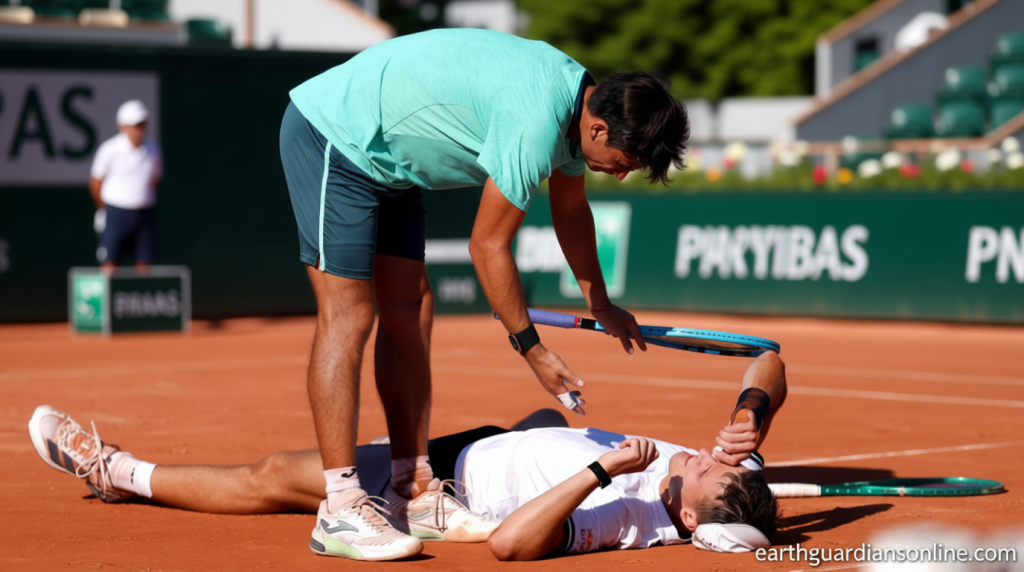
The heat dome, a meteorological phenomenon that acts like a lid over a boiling pot, is amplifying the intensity of the weather. Players like Jakub Menšík have called the conditions “insane,” emphasizing the physical and mental strain of enduring such extreme temperatures. Menšík’s collapse during his five-set victory against Mariano Navone Wednesday was a stark reminder of the stakes. After nearly five hours of play, he staggered onto the clay court, his body seemingly overwhelmed by the heat. First responders provided a wheelchair, but Menšík managed to exit the court unaided, vowing that the situation demands a reevaluation of strict break protocols.
“In this heat and in these conditions, it’s insane,” Menšík reiterated, suggesting a more lenient approach to the tournament’s rigid rules.
Menšík’s comments underscore a growing concern among players about the tournament’s ability to accommodate the heatwave. While the clay surface provides some insulation, the sun’s intensity remains a constant adversary. Players are forced to balance their strategies, adjusting their playstyle to conserve energy while navigating the unforgiving conditions. The extended matches, combined with the sweltering climate, have created a perfect storm for fatigue and dehydration, testing the limits of human resilience.
Climate Change and the Evolution of Tennis Conditions
As the tournament progresses, the effects of climate change are becoming increasingly apparent. The heatwave is not an isolated event but part of a broader pattern of rising global temperatures. Roland Garros, once a bastion of predictable weather, now faces unprecedented challenges. The tournament’s organizers are under pressure to adapt, with players and officials alike advocating for changes such as extended breaks or delayed start times. Yet, for now, the game continues under these extreme conditions, leaving players to fend for themselves against the elements.
Jannik Sinner, the world No. 1, has also felt the heat’s impact. His early exit in the second round, a surprise for many, has sparked discussions about the role of the climate in his performance. Despite taking a commanding lead in the match, Sinner struggled to maintain his rhythm, citing the conditions as a challenge rather than a complete factor. “It was warm but not crazy warm,” he said, though his physical limits were clearly tested. “It was just me today, but it happens.”
“It was a tough spot to be in. But, again, this is the sport.”
Sinner’s remarks reflect a common sentiment among athletes: while the weather is a formidable opponent, it is the ultimate test of their ability to adapt. Yet, even the most resilient players are not immune to the heat’s effects. The tournament’s physical demands are compounded by the rising temperatures, forcing competitors to adjust their tactics and recovery methods. Coaches and medical staff are now more vigilant than ever, monitoring players for signs of heat exhaustion and ensuring they remain hydrated throughout the grueling matches.
Equipment Under Pressure
Outside the players’ physical struggles, the heat is also affecting the gear they rely on. Tournament officials have noticed unusual behavior from some competitors, with players experimenting to protect their equipment. One notable example is Coco Gauff, the defending champion, who has been seen storing spare rackets in a cooler. This strategy aims to stabilize string tension, which can fluctuate with temperature changes. “String tension changes with different weather,” noted former Wimbledon finalist Sabine Lisicki in an Instagram comment. “When it’s hot, tension tends to drop quicker than usual.”
The practical implications of this adjustment are significant. Strings that lose tension can alter a player’s swing mechanics, affecting precision and power. By keeping rackets in a cooler, Gauff is safeguarding her equipment, ensuring it performs optimally even in the harshest conditions. Other players are adopting similar measures, such as using temperature-controlled bags or modifying their playing surfaces. These adaptations highlight how climate change is reshaping the very fabric of the game, pushing athletes and organizers to innovate in the face of rising temperatures.
As the heatwave persists, the tournament becomes a microcosm of the broader challenges posed by climate change. The sweltering conditions at Roland Garros are not just a temporary inconvenience but a harbinger of what to expect in the years to come. Players, coaches, and fans are all adjusting to a new normal, where the sun’s influence on the game is more pronounced than ever. For now, the focus remains on the court, with athletes striving to maintain their composure and performance despite the relentless heat. The question lingers: how long can the game endure before it reshapes its rules to match the changing climate?
