
Beloved British artist David Hockney dies at 88
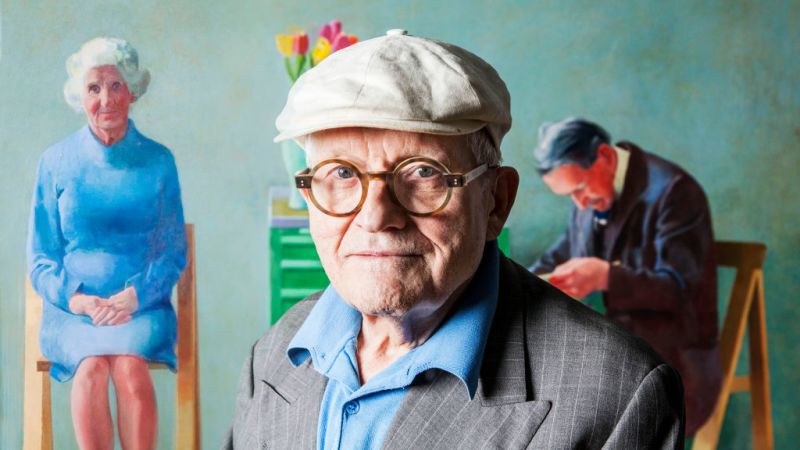
Beloved British Artist David Hockney Dies at 88
Beloved British artist David Hockney dies – David Hockney, the celebrated British painter renowned for his vivid portrayals of everyday life and landscapes, has passed away at the age of 88. His death, described as “peacefully at home” on Thursday, occurred just one month before his 89th birthday, according to a statement shared with CNN by his longtime publicist, Erica Bolton. Hockney’s legacy as one of contemporary art’s most influential figures endures through his prolific body of work, which spans decades of innovation and experimentation across multiple mediums.
Early Life and Career Beginnings
Born in Bradford, England, in 1937, Hockney’s artistic journey began in his hometown, where he attended his local art school. Later, he pursued studies at the Royal College of Art in London, a prestigious institution that helped shape his early talent. By the time he reached his 20s, Hockney had already begun making a name for himself, with his work drawing attention for its bold colors and dynamic compositions. His early success led him to relocate to Los Angeles in the 1960s, a move that would profoundly impact his creative trajectory.
While teaching at various American colleges, Hockney became a central figure in the Pop Art movement, a period marked by its embrace of consumer culture and everyday objects. However, unlike some of his contemporaries who focused on commercialism, he maintained a distinct personal vision. His art often captured intimate scenes of friends, lovers, and the natural world, blending realism with playful, almost whimsical elements.
Artistic Style and Themes
Known for his ability to transform ordinary moments into striking visual narratives, Hockney’s work frequently featured light-filled spaces and intricate details. His iconic swimming pool paintings, for instance, became a symbol of his innovative approach, with their vibrant hues and fluid lines capturing the essence of time and space. These pieces, which seemed to pause a fleeting moment, were not only artistic triumphs but also a reflection of his deep connection to the environment around him.
Throughout his career, Hockney explored a wide range of subjects, from self-portraits to still-life arrangements. His affection for domestic scenes extended to his portrayal of friends and lovers, as well as his beloved dachshunds Stanley and Boodgie. A series of paintings dedicated to these dogs, paired with a published book, showcased his knack for finding beauty in the mundane. His work also delved into themes of sexuality, often depicted through candid, sometimes explicit imagery that highlighted the intimacy of human relationships.
Commercial Success and Personal Philosophy
Despite his commercial acclaim, Hockney remained deeply committed to his artistic process rather than the financial rewards of his creations. His 2018 auction of “Portrait of an Artist (Pool with Two Figures)” set a record for the highest price paid for a living artist’s work, reaching $90.3 million. Yet, this achievement was unexpected, as the piece had been sold for a mere $18,000 in 1972 by his New York dealer. This contrast underscored his belief that the true value of art lies in its ability to capture emotion and perception, not in its market price.
Later in his career, Hockney expanded his artistic practice to include photography, printmaking, and even stage design for ballet and opera. His photocollages of the 1980s, which combined fragmented images into cohesive compositions, demonstrated his continued experimentation with form and perspective. His abstract landscapes, often rendered in bold, geometric strokes, reflected a shift in his style while maintaining the same emotional resonance that had defined his earlier work.
Later Years and Digital Innovation
Even in his later years, Hockney remained as productive as ever. At the age of 80, he told CNN that he still dedicated six or seven hours daily to painting, a habit that kept him grounded in his creative passion. “I feel 30 when I’m in the studio,” he once remarked, illustrating his enduring enthusiasm for the act of making art. By this time, he had also embraced new technologies, beginning to create works using an iPad—a testament to his adaptability and curiosity.
During the pandemic, Hockney spent much of his time in Normandy, France, where he produced a series of digital renderings of the countryside. These pieces, later printed and displayed at venues such as London’s Royal Academy and the de Young Museum in San Francisco, marked a new chapter in his career. His ability to translate the physical world into digital form highlighted his lifelong fascination with capturing reality through varied mediums.
Recognition and Honors
Hockney’s contributions to the art world were widely acknowledged, earning him numerous accolades. Among his many honors, he was invited to join the Royal Academy of Arts and received prestigious awards such as the John Moores Painting Prize and the Japan Art Association’s Praemium Imperiale prize for painting. However, he famously declined a knighthood, choosing instead to accept Queen Elizabeth II’s invitation to the Order of Merit—a group of distinguished public figures limited to just 24 members.
His influence extended beyond the gallery walls, with several major retrospectives dedicated to his career. A 2017 exhibition, for example, toured through Tate Britain, the Pompidou Centre in Paris, and the Metropolitan Museum of Art in New York, drawing global attention to his work. These retrospectives celebrated not only his technical mastery but also his ability to challenge traditional notions of art and creativity.
Enduring Legacy
Hockney’s art continues to inspire new generations of creators, blending technical precision with a sense of joy and spontaneity. His ability to merge personal experience with universal themes ensured that his work resonated with a broad audience. Even as he outlived his peers in the art world, his influence remained undiminished, with his pieces fetching record prices and his innovative techniques reshaping contemporary art practices.
“Hockney taught us about the joy of looking, seeing things the rest of us failed to notice — his witty and sharp observations a constant presence in his work and in person.”
Tate Britain’s director, Alex Farquharson, praised Hockney’s enduring creativity, highlighting his role as an “endlessly inventive artist.” His legacy is not only in the physical works he left behind but also in the way he redefined the possibilities of art. From his early days in Bradford to his later digital experiments in Normandy, Hockney’s career was a testament to his boundless imagination and dedication to his craft. As his studio in California once reflected, he never stopped painting—never stopped seeing the world with fresh eyes.
Hockney’s passing marks the end of an era for art lovers around the globe. His ability to distill the essence of life into visual art, whether through a photograph of a pair of friends or a digital rendering of a French countryside, ensures that his work will continue to be studied and admired. From the bustling streets of London to the sunlit pools of Los Angeles, his art has left an indelible mark on the cultural landscape. The world now mourns the loss of a visionary who transformed the way we perceive and appreciate the beauty of the everyday.
