
Marilyn Monroe through the female gaze
Marilyn Monroe through the Female Gaze
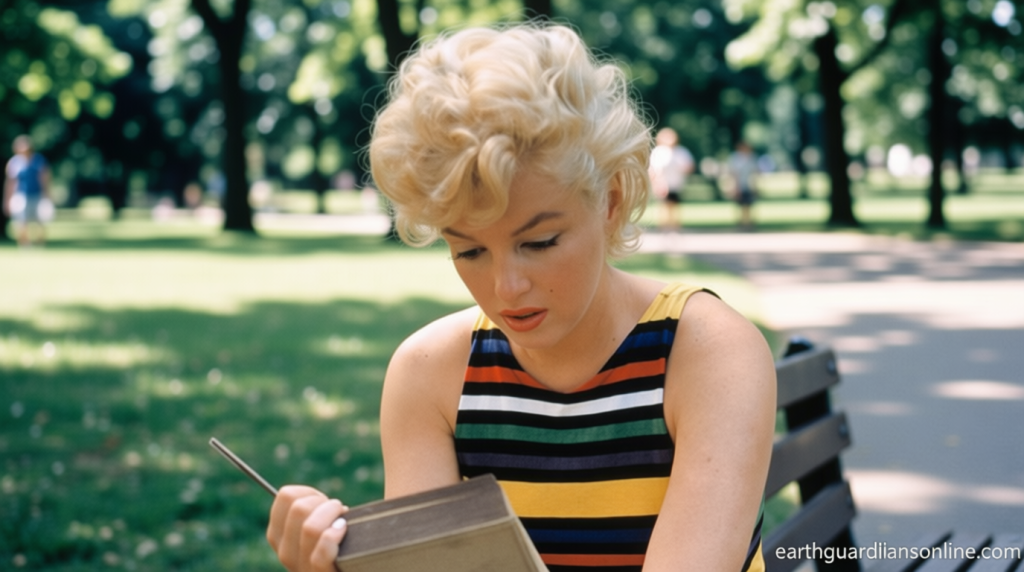
Marilyn Monroe through the female gaze – In the world of visual storytelling, a single image can capture the essence of a person’s identity, challenges, and aspirations. The National Portrait Gallery in London recently unveiled an exhibition that reexamines Marilyn Monroe’s agency in shaping her own image, with one photograph standing out as a symbol of her multifaceted persona. Taken in 1955 on Long Island, New York, the snapshot depicts Monroe perched on playground equipment, her face serene as she reads James Joyce’s Ulysses. The image, stripped of Hollywood glamour and studio polish, reveals a different side of the iconic actress—one that defies the stereotypes she often embodied.
The Unseen Intellectual
At first glance, the photograph seems whimsical: Monroe, clad in a vibrant romper, appears to be a carefree child in a sunlit scene. Yet the heavy book in her arms, Ulysses, challenges this perception. Known for its complex narrative and stream-of-consciousness style, the novel is a far cry from the typical fare associated with Monroe’s public image. This moment, captured by photojournalist Eve Arnold, showcases Monroe’s quiet dedication to literature, a passion that extended beyond mere performance. Her personal library, reportedly containing over 400 volumes, spanned genres from poetry to philosophy, reflecting her desire to engage with ideas beyond the silver screen.
“Eve was just setting up her cameras, and she saw that Monroe got it out and was reading it, waiting for her to get ready,” said Michael Arnold, the photographer’s grandson, during a phone conversation. He emphasized that the book wasn’t a staged prop but a genuine reflection of Monroe’s interests.
Michael Arnold’s insight underscores the authenticity of the moment. The photo, he noted, was a deliberate attempt to subvert the “dumb blonde” archetype that often defined Monroe’s public persona. Instead, it offers a glimpse into her intellectual curiosity, a trait that contrasted with the physical allure she was famously marketed for. The image also hints at the emotional depth Monroe sought to convey, as the summery glow of her exposed limbs seems to mirror the warmth of her inner life.
A Feminist Perspective
Art historians have long debated the layers of meaning within the photograph. Griselda Pollock, a prominent feminist critic, observed that Monroe’s choice to pose with the closing pages of Ulysses was a deliberate act of self-representation. “With her choice to be seen reading the end of Ulysses, Monroe was clearly making a knowing point,” Pollock wrote in a 2016 essay published in the Journal of Visual Culture. The protagonist’s wife in the novel, Molly Bloom, is a figure of unfiltered expression and sexual agency, qualities Pollock suggests Monroe sought to emulate in her own image.
Monroe’s ability to control her visual identity was a rare privilege in the male-dominated film industry. While her on-screen roles were often shaped by directors and studios, her photographs allowed her a unique form of self-expression. Georgia Atienza, assistant curator of the exhibition, highlighted this dynamic. “With photography, I think she felt she was more in control,” Atienza explained. She noted that Monroe had the power to veto images, often scratching out unwanted photos on contact sheets with a hairpin, a subtle but powerful act of curating her own narrative.
From Pinup to Visionary
Monroe’s journey from a pinup girl to a serious artist is central to the exhibition. The 1955 photo, taken months after she had left Hollywood to establish her own film company, marks a turning point in her career. It reflects her growing confidence to assert her identity beyond the confines of the studio. Arnold, who had previously captured the naturalistic style of Marlene Dietrich in a 1952 recording session, became a key figure in Monroe’s evolution. The Dietrich photos, which emphasized authenticity over artifice, resonated with Monroe, who later approached Arnold with a memorable question: “If you can do that well with Marlene, can you imagine what you can do with me?”
Arnold’s work with Monroe spanned a decade, from their early collaborations to the emotionally charged photoshoots during the actress’s time on the set of The Misfits in 1960. That period, marked by marital strife and personal reflection, saw Monroe lean on Arnold’s presence as a source of creative and emotional support. Their bond, forged through shared ambitions and a willingness to break norms, allowed Monroe to explore her identity in ways that were often constrained by Hollywood’s expectations.
The Legacy of a Self-Made Image
Monroe’s relationship with Arnold wasn’t just professional—it was deeply personal. Michael Arnold described how his grandmother, Eve, was initially hesitant to work with the Hollywood star but was drawn to her magnetic presence. “But I think there was something kind of magnetic about her that she kept coming back to,” he said. This mutual respect is evident in the exhibition’s curation, which highlights Monroe’s agency in her own image-making. The collection spans her early years as Norma Jeane Baker of Missouri, through her rise as a cinematic icon, to her final moments on the Santa Monica beach, captured weeks before her death in 1962 at the age of 36.
The photograph’s enduring relevance lies in its ability to bridge Monroe’s public and private selves. While the image may appear simple—a woman reading on a playground—it carries profound symbolism. The choice to feature the final pages of Ulysses suggests Monroe’s desire to be seen as more than a sex symbol. Her gaze, though possibly fixed on the book, invites the viewer to consider the layers of meaning she intended to convey. As the exhibition opens, it serves as a reminder of how a single frame can encapsulate a lifetime of transformation and self-discovery.
Conclusion: A Portrait of Possibility
Monroe’s image in this photograph is a testament to her resilience and artistic ambition. It challenges the notion that she was merely a product of Hollywood’s vision, instead presenting her as an active participant in her own story. The exhibition, which celebrates her 100th birthday this month, offers a broader perspective on how women have historically used photography to assert their voices. Through Arnold’s lens, Monroe’s quiet contemplation becomes a powerful statement of identity, one that resonates with the modern viewer and underscores her legacy as both a cultural icon and a trailblazer in visual storytelling.
