From heated rivalry to frenemies: Inside the cutthroat business of ruling tech in Asia

Daftar Isi
When Rivals Become Partners: How the AI Gold Rush Is Rewriting Asia’s Tech Rivalry
Earthguardiansonline.com – The cavernous server halls stretching across data centers in Virginia, Germany, and beyond now house hundreds of thousands of AI machines, each one a monument to an interdependence that would have seemed absurd a generation ago. Inside every Nvidia-built AI server sits a computing chip fabricated by Taiwan’s TSMC, memory components sourced from South Korea’s SK Hynix or Samsung, and specialized integration technologies that fuse these elements into a single accelerator unit. Taiwanese assembly plants then slot those accelerators into racks fitted with advanced thermal-management systems before the finished machines ship out to power generative-model training runs. The result is a supply chain so tightly braided between two former rivals that neither side can scale alone.
For decades, South Korea and Taiwan waged a grinding contest for dominance over the hardware layers of the digital economy — flat-panel displays, mobile phones, NAND and DRAM memory. Their industrial trajectories mirrored each other almost exactly: both were former Japanese colonies that pivoted toward export-led growth, first shipping labor-intensive textiles in the 1960s, then moving up the value chain into consumer electronics through the 1970s and ’80s. As Asia became the world’s factory floor for electronic components, the two economies collided repeatedly. Taiwanese PC brands Acer and Asus squared off against Samsung and LG; HTC challenged Samsung in the smartphone arena. Yet South Korea’s chaebol model, with Samsung integrating multiple stages of the supply chain under one corporate roof, gave it a structural edge that repeatedly left Taiwan on the losing side.
The Old Rivalry, Documented
Owen Lin, a veteran technology journalist and author of Chip Champion: The Triumph of TSMC and Taiwan, recalls that cooperative ventures between the two economies were “actually very rare” compared with the constant friction of head-to-head competition. The intensity of that friction surfaced in a 2013 profile published in Taiwan’s Business Today magazine, in which Lin described an internal Samsung meeting in 2008 where executives allegedly debated a “Kill Taiwan” strategy aimed at dominating every sector where Taiwanese firms competed. Samsung disputed that any such formal strategy existed and declined further comment when approached for clarification. Sung Soo Eric Kim, a distinguished guest professor at Keio University in Tokyo, urged readers not to over-read the episode: “all companies compete with each other,” he noted, adding that a global firm of Samsung’s scale would naturally field market strategies aimed at rivals across Taiwan, Japan, and the United States.
Even in contract semiconductor manufacturing — the sector TSMC now commands with overwhelming market share — Samsung initially held the upper hand. The explosive rise of the iPhone and Apple’s subsequent dependence on outsourced foundry capacity ultimately tipped the balance toward TSMC, but the competitive scars from earlier decades never fully healed.
Why Necessity Overrode Rivalry
The transformation from adversaries to co-suppliers was not born of goodwill. Tech giants’ insatiable appetite for raw compute to train frontier generative models has triggered an unprecedented global buildout of AI infrastructure. The resulting demand is so vast that no single nation can meet it, stretching thin the production capacity of the few firms capable of supplying accelerators designed by Nvidia and AMD. In that environment, the intertwined supply chain linking Taipei and Seoul became less a vulnerability and more a shared asset.
“We don’t have time to get into this old-fashioned conflict,” said Sung Soo Eric Kim. “There’s so much demand; we have to cooperate and supply first.”
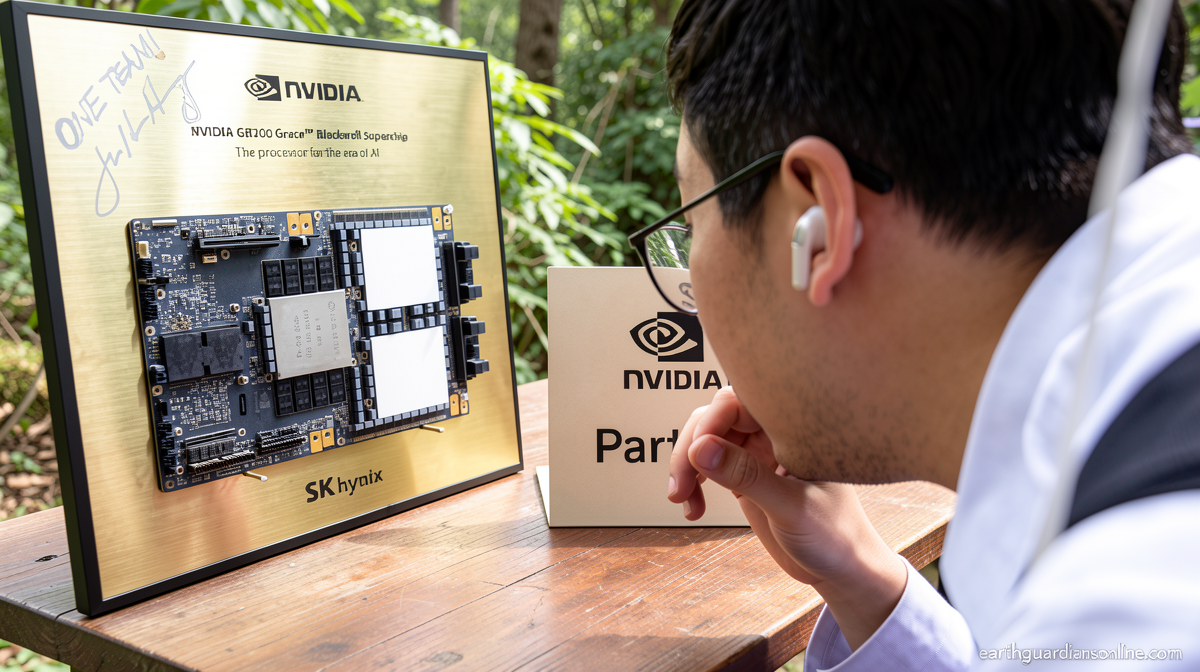
The urgency of the situation was made vividly visible in June, when Nvidia chief executive Jensen Huang took a memory wafer produced by SK Hynix at Taipei’s annual computer show and scrawled a note across its surface: “Please make more.” The gesture, captured on camera and widely shared, underscored how thin the margin between demand and supply has become.
Supply as the New Competitive Weapon
SK Hynix has framed the shift in explicitly commercial terms. A company spokesperson explained that in the current AI era, raw technological superiority is no longer sufficient; the decisive edge belongs to whichever supplier can deliver the required volume at precisely the moment a customer needs it. The firm is accelerating plans to build additional fabrication facilities to close the gap between order books and output.
For readers outside the semiconductor industry, the stakes are easy to grasp. Every time a user doomscrolls on an iPhone, poses a question to ChatGPT, or streams a 4K film through a laptop, the underlying compute that made the experience possible was assembled from components that crossed the Taiwan Strait and the Korean Peninsula multiple times before reaching a data center. The old narrative of two Asian economies locked in zero-sum competition is giving way to something stranger and more consequential: a frenemy relationship in which the same firms that once tried to outmaneuver each other in consumer markets now depend on one another to keep the world’s most powerful machines running. Whether that dependence endures once the current buildout cycle matures remains an open question — but for now, the demand curve has made cooperation the only viable strategy.
Related Reading
Frequently Asked Questions
What is From heated rivalry to frenemies?
From heated rivalry to frenemies is the main topic of this guide. The article explains the context, practical details, and next steps readers should understand.
Why does From heated rivalry to frenemies matter?
From heated rivalry to frenemies matters because readers are looking for a useful answer, not just a short summary. Good content should match search intent and help them decide what to do next.