
How hyper-hot weather is changing Asia’s travel map
Asia’s Travel Landscape Shifts as Temperatures Soar
How hyper hot weather is changing – Benjamin Wong has discovered tranquility at an elevation of 8,530 feet. The Singapore-based high school educator enjoys extended summer holidays, yet consistently battles the challenge of locating destinations that offer relief from the oppressive heat he experiences daily. This season, he has chosen to stay at an upscale mountain retreat in Yunnan, a southwestern Chinese province that has gained considerable popularity among visitors seeking cooler climates. During summer evenings, the well-known destinations of Dali and Lijiang can drop to a refreshing 59 degrees Fahrenheit, which proves decisive for Wong’s travel choices.
“Other than weekend getaways to neighboring Southeast Asian cities, all my other holidays are always to places cooler than Singapore,” says Wong of the humid city-state, where temperatures routinely hover above 80 F.
Wong’s personal preferences reflect a broader global phenomenon. Travel professionals have adopted the term “coolcations” to characterize vacations selected primarily for milder temperatures. The impact extends beyond leisure travelers. According to the World Meteorological Organization, approximately 75 percent of Asian workers face extreme heat conditions, including food vendors and delivery personnel who frequently serve tourists.
European nations have also experienced severe weather patterns. France recently recorded temperatures reaching 104 degrees Fahrenheit beneath a “heat dome” that covered much of the country. Paris authorities made an unusual request to organizers of the annual Fete de la Musique festival, asking them to limit alcohol sales due to concerns about dehydration and heat-related illnesses among participants. Similar conditions affected Spain, the United Kingdom, and Switzerland, where record-breaking temperatures forced numerous outdoor venues to modify their operating schedules.
Asia faces particularly challenging circumstances. The continent is experiencing warming at twice the rate observed globally, according to WMO data. Japan has established new temperature records with remarkable regularity, with two new highs appearing annually. The nation recently reached an unprecedented 107.2 degrees Fahrenheit. Remarkably, all five of Japan’s hottest recorded days occurred during the previous summer. This extreme weather prompted Japanese officials to introduce the term “kokusho-bi,” meaning a cruelly hot day.
While certain travelers have shifted to shoulder seasons, northern hemisphere summer remains the dominant travel period due to educational calendars. Multiple Asian nations provide students with extended breaks spanning June through August. This combination of intense heat and heavy visitor numbers creates difficult conditions for many.
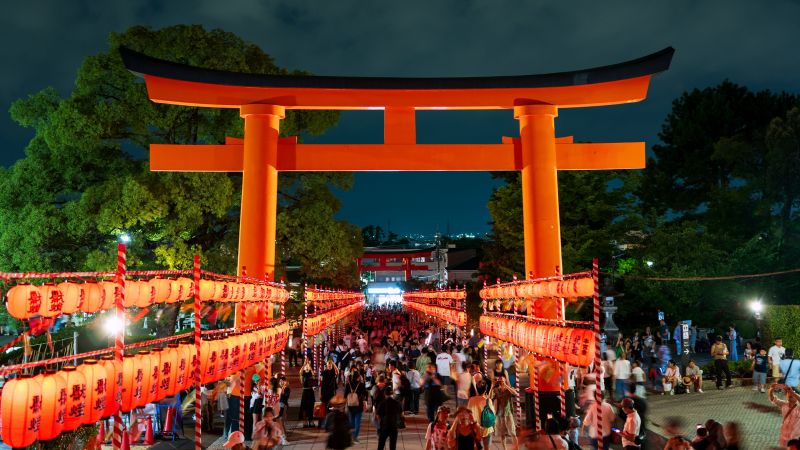
One practical approach involves visiting outdoor attractions during cooler morning or evening hours. Get Your Guide, a travel booking platform, reports adding additional nighttime activities to address this demand. Asian “dusking” experiences now feature nighttime visits to Kyoto’s celebrated Fushimi Inari shrine, sunset cruises along Thailand’s Mekong River, and evening ghost-story tours through Seoul’s historic neighborhoods. The platform reports a 30 percent increase in bookings between 5 and 9 p.m., with Asia showing the strongest growth at 70 percent.
Takao Nishina, who is the Japan and South Korea manager for Get Your Guide, says it’s first-time visitors and the obsessive bucket listers who are most willing to push through extreme heat to cross items off their itinerary.
For travelers who spend considerable time in transit, enduring challenging weather has become part of the journey. Nishina now works on creating solutions that accommodate various preferences, such as relocating cooking demonstrations from open markets to air-conditioned spaces or scheduling sumo stadium tours during peak sunlight hours.
Brian Yung, a Hong Kong marketing professional, believes he has been practicing “coolcations” without recognizing the trend. Over recent years, Yung has vacationed in Finland, Denmark, and Canada. He also visits Japan multiple times annually, preferring smaller mountainous areas over major cities like Tokyo and Osaka.
“I love Yamagata. I went in the winter and it was actually cold. It felt colder there than in Finland, which was wild to me.”
“I’m always thinking about how can I get out of the heat and the humidity,” Yung says. “I feel like subconsciously I’ve been choosing
Yung’s approach demonstrates how travelers are increasingly prioritizing climate comfort alongside traditional destination appeal. As temperatures continue rising across Asia, this pattern is likely to strengthen, reshaping not only where people vacation but also how tourism infrastructure adapts to serve visitors seeking relief from increasingly extreme conditions.
