
The underground tunnel village where Vietnamese people lived for years to hide from war
The underground tunnel village where Vietnamese people lived for years to hide from war
The underground tunnel village where Vietnamese – On the edge of Vịnh Mốc, a cluster of bamboo groves sways gently in the breeze, casting shadows over bustling street food vendors. The village, once a serene coastal settlement, now houses red plastic chairs arranged along sidewalks, where locals prepare sizzling grilled rice and noodle dishes for passing customers. While the scene is familiar to many Vietnamese communities, the tranquility of this place is a stark contrast to its violent past. For nearly a decade, Vịnh Mốc stood as a frontline battleground, enduring relentless aerial assaults by American forces. Over eight years, more than 9,000 tons of bombs rained down, reshaping the landscape and forcing the villagers to adapt in extraordinary ways.
A Shattered Landscape and Strategic Importance
Before the Vietnam War, Vịnh Mốc was a peaceful fishing hamlet nestled along the coast of Quảng Trị province. Its charm lay in the vibrant interplay of natural elements: lush rice paddies, red basalt soil, golden sands of South China Sea beaches, and dense bamboo thickets. But this idyllic setting transformed into a critical military hub after the Geneva Accords of 1954 divided the country into North and South Vietnam, establishing the Demilitarized Zone (DMZ) north of the Bến Hải River. The following year marked the beginning of the Vietnam War, and Vịnh Mốc, situated near the DMZ, became a strategic target for both North Vietnamese and American forces. Its proximity to key supply routes made it a focal point in the conflict, as the village’s fate was tied to the broader war efforts.
From Surface to Subterranean Survival
Amid the chaos, the people of Vịnh Mốc devised a radical solution to endure the violence. “Relocation was not an option due to constant bombardment and the threat of losing land and lives,” explains Văn Ngọc Vũ, a tour guide and director of Annam Tour. Instead, they chose to retreat beneath the earth, creating an underground sanctuary that would sustain them for over six years. This decision was not made lightly, as it required immense effort and ingenuity. The tunnels, designed as a self-sustained village, became a lifeline, offering shelter from the relentless airstrikes and artillery fire.
“Digging underground was both a practical and strategic move,” says Văn Ngọc Vũ. “It allowed us to survive the worst of the war while maintaining our way of life.”
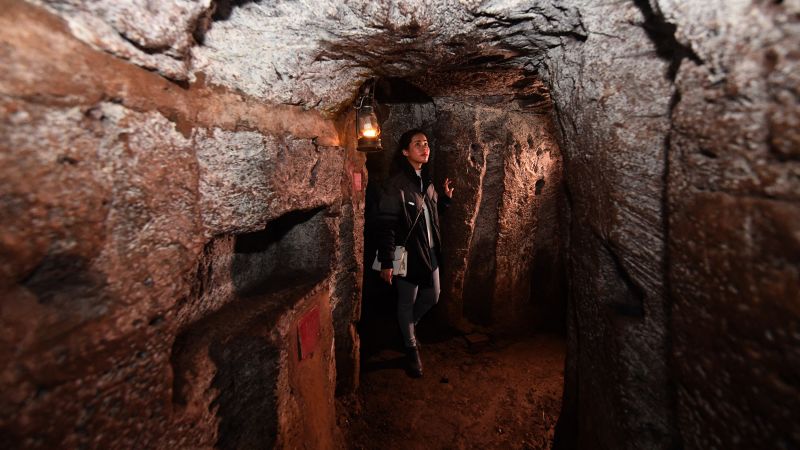
The concept of underground living was not entirely new to the region. Before 1965, residents had already built small shelters to protect against occasional attacks. However, the scale of the war necessitated a more permanent solution. Trần Nam Trung, a senior Communist Party official in South Vietnam, is credited with inspiring the project during a visit to the area in 1963. He envisioned a network of tunnels that could serve as residential and supply hubs, drawing from the successful model of Củ Chi, another tunnel complex near Ho Chi Minh City. While Củ Chi featured narrow crawl tunnels, Vịnh Mốc’s design prioritized space, with main corridors wide enough for people to stand and larger rooms for communal living.
Engineering a Hidden Fortress
The construction of the underground village began in 1965 and spanned two years, led by Lê Xuân Vy, a border police commander. The result was an engineering marvel, with tunnels stretching over a mile and designed to maximize survival. Zigzag paths were carved to deflect blast waves, which travel in straight lines, while arching ceilings and thick walls provided additional protection against shrapnel. Every element of the complex was crafted with the intent of enduring the war’s fury, from wells for fresh water to ventilation systems that kept the air breathable.
“Tunnel exits were vital to the system’s functionality,” says Văn Ngọc Vũ. “They ensured airflow, escape routes, and access to essential resources.”
The underground village was connected to the outside world via thirteen strategically placed exits, linking it to farmland and the sea. These openings enabled quiet supply missions to Cồn Cỏ Island, allowing the community to sustain itself during the war. On the surface, the village’s once-thriving markets and open spaces were now overshadowed by the hidden network beneath. The transition from sunlight to darkness was disorienting, and the cramped conditions forced residents to abandon their traditional way of life. Yet, they adapted, transforming the tunnels into a microcosm of daily survival.
Life Beneath the Earth
Living underground required a redefinition of space and time. Families carved out niches in the tunnel walls for sleeping quarters, while communal rooms housed kitchens and living areas. The complex was organized into three levels, ranging from 50 to 75 feet below ground, creating a layered system that maximized safety. Narrow tunnels gradually widened into spacious chambers, allowing for movement and activity. Despite the damp and confined environment, the villagers managed to grow crops, store food, and even maintain social ties within the tunnels.
For many, the shift to subterranean life was both a necessity and a test of resilience. The tunnels, though dark and humid, offered a refuge from the chaos above. However, the experience was far from comfortable. The lack of natural light, the constant threat of collapse, and the need to navigate low ceilings made daily tasks challenging. “Trading the tropical sun for the darkness and dampness underground was unsettling,” remarks Tran My Hoa, a guide from Connect Travel. “But the tunnels became our home, our protection, and our hope.”
The legacy of Vịnh Mốc’s underground village endures as a testament to human perseverance. Today, visitors can explore the remnants of this hidden world, gaining insight into the sacrifices made during the war. The tunnels, once a place of survival, now serve as a museum and a reminder of the resilience of the Vietnamese people. While the surface of Vịnh Mốc has been restored, the story of its underground refuge continues to inspire, highlighting the ingenuity and courage required to endure one of history’s most brutal conflicts.
