
A chance encounter led to one of the largest T. rexes ever found. Now, it could be ‘lost to science’
A Chance Encounter Led to One of the Largest T. rexes Ever Discovered
A chance encounter led to one of the most significant paleontological finds in recent history. Long before earning his title among history’s greatest hunters, the late Gary “Gus” Licking held a quiet conviction that his South Dakota estate concealed something extraordinary. As a dedicated cattle rancher, he spent decades tending to his land, unaware that beneath the grasslands lay the remains of a colossal creature. Today, that creature is known as Gus, a magnificent Tyrannosaurus rex skeleton poised to potentially shatter records at an upcoming auction in New York City.
The Legacy of the Licking Ranch
The family property spans 6,500 acres within Harding County, resting squarely inside the renowned Hell Creek Formation. This vast geological region, which extends through Montana, Wyoming, and both Dakotas, is celebrated globally as a premier site for dinosaur fossils. It was here, in this ancient sedimentary layer, that the very first T. rex bones were unearthed in 1902, eventually leading to the naming of the species. The area has produced numerous significant finds over the last century, including the famous “Stan” skeleton, which commanded a staggering $31.8 million when sold in 2020.
Licking himself was an avid collector of local artifacts and fossils, often searching his fields for clues about the past. He frequently shared his dreams with neighbors, hoping that one day his diligent efforts would yield a major discovery. His intuition proved correct, setting the stage for a remarkable partnership that would bring his dream to fruition. A chance encounter led to one of the most remarkable discoveries in paleontology.
A Serendipitous Meeting and Excavation
The turning point arrived through a fortuitous meeting with Thomas Heitkamp, a commercial paleontologist who runs Theropoda Expeditions. Heitkamp was already familiar with the Licking estate due to its prime location within the fossil-rich formation. During a casual drive-by, he decided to stop and introduce himself to the rancher, who was inspecting a water trough near the highway.
“I was passing by the ranch randomly one day and Gary was checking a watering trough near the road, so I stopped and introduced myself,” Heitkamp recalled. “The Licking ranch had been on my radar because of its location within the Hell Creek formation. Gary had always been interested in fossils and artifacts, and he had quite a good collection of things he had found in his home.”
Heitkamp recognized Licking’s deep knowledge of his own land and his belief that a thorough search would eventually reveal a specimen. In 2021, Heitkamp’s team began excavating the area Licking had pointed out. Tragically, Licking passed away before the work was finished, never witnessing the full emergence of the giant he had suspected was buried there. His legacy, however, lives on through the skeleton named in his honor. A chance encounter led to one of the most complete T. rex specimens ever found.
Measuring a Monster
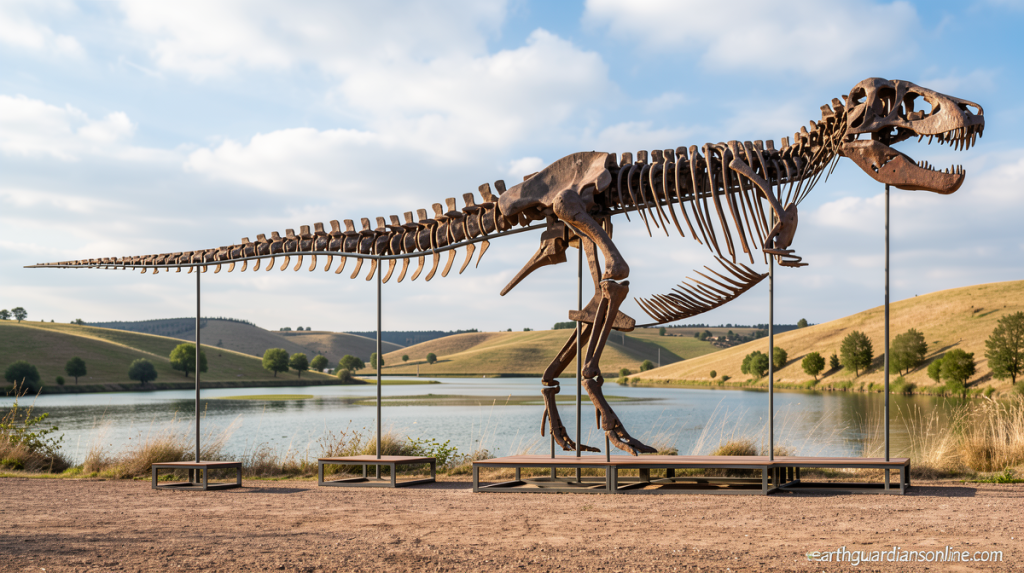
According to Sotheby’s, the auction house handling the sale, Gus is a true giant of the dinosaur world. The skeleton measures 38 feet in length and stands 12.5 feet tall, with a massive skull spanning 54 inches. The collection includes 183 distinct bone elements, resulting in a completeness rating of approximately 61 percent by bone count. When measured by mass, the specimen is even more intact, reaching between 75 and 80 percent completeness.
While impressive, Gus is not quite as complete as its predecessors. The “Stan” skeleton holds a 70 percent completeness rating by bone count, while “Sue,” the first dinosaur ever sold at auction in 1997, boasts an exceptional 90 percent completeness. Despite this, Gus offers unique scientific value, displaying visible bite marks and healed fractures that provide insight into the animal’s life and death.
Science vs. Private Ownership
The upcoming sale has ignited a debate within the paleontological community regarding the stewardship of fossils. Although the transaction is entirely legal since the bones were discovered on private property, many experts worry about the implications for scientific research. Currently, no museum has publicly committed to acquiring Gus, leaving the future of this remarkable specimen uncertain. A chance encounter led to one of the largest T. rexes ever found, but without institutional interest, it could be lost to science forever. The auction is expected to draw international attention, with collectors and institutions alike weighing whether to secure this prehistoric treasure for public display or private collection.
