
Ancient DNA reveals clues about mysterious ‘Golden Man’ and rise of the Scythian elites
Ancient DNA reveals clues about mysterious ‘Golden Man’ and rise of the Scythian elites
Unearthing the Legacy of Scythian Nobility
Ancient DNA reveals clues about mysterious – During the Iron Age, the Scythians—nomadic warriors who traversed the vast Eurasian Steppe on horseback—held a prominent place in history. Their society was marked by a distinct hierarchy, with an elite class exercising significant influence. This group was honored in death through elaborate funerary rites, often interred with an array of treasures. Among the most renowned of these elite individuals is the “Golden Man,” whose tomb, a kurgan, contained iron weapons, bronze objects, a silver bowl, and over 4,000 gold ornaments. Recent genetic research has shed new light on this enigmatic figure, revealing that his elevated status was not solely a product of merit but also hereditary, linking him to a lineage of Scythian power.
Genetic Evidence of Social Stratification
Scientists have now uncovered that Scythian elites, including the Golden Man, shared genetic ties with their kin, creating a structured social system. This discovery challenges earlier assumptions about the Bronze Age, which saw less defined social divisions. By analyzing the DNA of dozens of individuals from various burial sites, researchers identified familial relationships even among groups separated by significant distances. These connections suggest that wealth and authority were not only preserved across generations but also transmitted through bloodlines, solidifying the role of heredity in Scythian societal organization.
The Golden Man’s Identity and Origins
The Golden Man’s burial mound, discovered in 1969 in Kazakhstan, dates back to approximately 400 to 300 BCE. Despite the nickname, which implies a male identity, researchers had long debated whether the youth buried there was male or female. For this study, geneticists focused on DNA markers across the Golden Man’s genome, employing statistical techniques to reconstruct gaps in the data. The results pointed toward a male genetic profile, aligning him with a southern branch of Scythians known as the Saka. This finding not only clarified his identity but also highlighted the genetic diversity within the broader Scythian population.
Connecting Past and Present through Science
“This paper does a fantastic job of integrating genetic, archaeological, and textual findings to support their interpretations of lineage-based status,” said Alicia R. Ventresca-Miller, an associate professor of anthropology at the University of Michigan. She noted that the study’s insights into hereditary power are crucial for understanding how wealth and social standing were sustained across generations. “An elite system rooted in family ties is a very important finding, as wealth was passed down across generations,” Ventresca-Miller explained in an email to CNN. Her comments underscore the significance of the genetic evidence in validating the Scythians’ social structure.
A Bronze Age Metropolis and Its Significance
Archaeologists may have uncovered a Bronze Age metropolis in Kazakhstan’s steppe, a discovery that aligns with the genetic study’s broader implications. The research examined DNA samples from 85 individuals, with 38 originating from elite burials and 47 from non-elite graves. Populations during the Iron Age showed greater genetic diversity compared to the Bronze Age, but the elites’ DNA exhibited unique patterns. These included “runs of homozygosity”—regions of the genome where genetic markers indicated shared ancestry—suggesting a genetic subgroup within the larger population. The study authors emphasized that this genetic homogeneity might have been key to the elites’ ability to maintain cohesion during periods of intense cultural and genetic mixing.
Preserving the Elite: Burial Practices and Symbolism
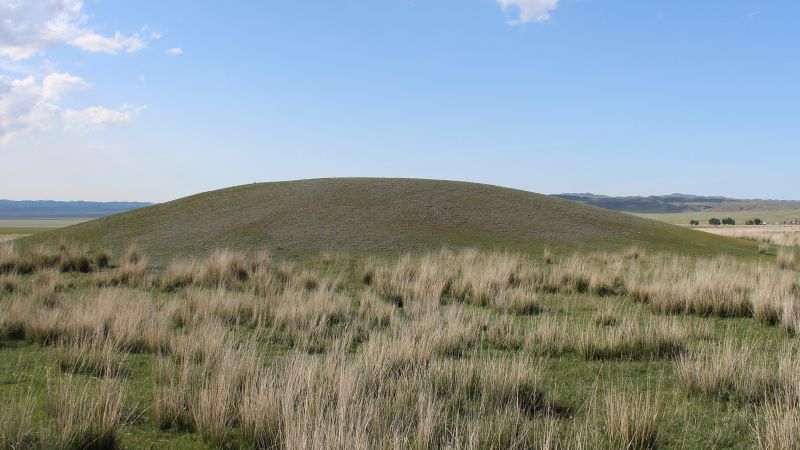
Elite kurgans were monumental structures, often reaching heights of up to 49 feet (15 meters) and spanning diameters of 345 feet (105 meters). These mounds were designed with corridors, catacombs, and side chambers that housed animal remains or relatives. The remains frequently showed signs of mummification or postmortem trepanation, a practice involving drilling a hole in the skull to remove the brain. Ainash Childebayeva, a senior author of the study and assistant professor in the University of Texas at Austin’s anthropology department, explained that such techniques preserved bodies that couldn’t be quickly entombed due to the complexity of their burials. “It would make sense if one had to build a mound to bury this individual, or if they had to be transported to a specific location where they would be buried,” she told CNN.
Dynastic Rule and the Hereditary Nature of Power
One of the study’s most compelling findings was the relationship between an elite man and his grandchildren, discovered at separate cemeteries over 60 miles (nearly 100 kilometers) apart. Their burial sites, rich with artifacts, stood out as an example of dynastic rule, linking close relatives to elite status. Notably, one of the grandchildren was interred as an infant, a detail that Childebayeva viewed as a strong indicator of hereditary power. “If the status was passed down through family lines, it would explain why such young individuals were given elite burials,” she remarked. This example reinforces the idea that social stratification in Scythian society was not just cultural but also biological, with family ties playing a central role in maintaining status and power.
Implications for Scythian History and Archaeology
The study’s findings offer a new perspective on Scythian history, demonstrating how genetic inheritance intertwined with societal structure. By identifying shared ancestry among elites, researchers have provided tangible evidence of a system that prioritized lineage. This challenges previous theories that Scythian power was distributed more evenly or based on individual achievements. The genetic analysis also helps resolve longstanding mysteries about the Golden Man, such as his gender and origins. As the Scythians transitioned from the Bronze Age to the Iron Age, their burial practices and social hierarchies evolved, reflecting a deeper understanding of identity and status.
The research underscores the importance of interdisciplinary approaches in studying ancient societies. Combining genetic data with archaeological discoveries and historical texts allows for a more nuanced interpretation of Scythian life. For instance, the presence of gold ornaments in the Golden Man’s tomb may have been more than decorative—it could symbolize his role in a family that held influence over trade routes and military campaigns. The study also raises questions about how genetic homogeneity among elites was maintained in a region known for its cultural exchanges. As the Scythians expanded their reach across the Eurasian Steppe, their hereditary systems may have helped preserve social order amidst external influences.
Future Directions and Historical Relevance
These findings not only deepen our understanding of the Scythians but also provide a framework for exploring similar social structures in other ancient cultures. The hereditary transmission of status suggests that lineage was a critical factor in maintaining authority, a concept that could have parallels in other nomadic or hierarchical societies. As more DNA data becomes available from Scythian sites, researchers may uncover further evidence of how family networks shaped political and economic power. The Golden Man’s tomb, now reinterpreted through genetic insights, stands as a testament to the enduring legacy of Scythian elites and their role in shaping the region’s history.
For centuries, the Scythians have been shrouded in mystery, their society often described as fluid and merit-based. However, this new study reveals a more structured system, where inheritance was as much a part of social dynamics as it was of wealth. The implications of this research extend beyond the Scythians, offering broader insights into how genetic relationships influenced societal organization in prehistoric times. As we continue to decode the past through modern science, the Golden Man’s story becomes not just a tale of individual glory but a reflection of the collective power of his lineage.
