
China reports reusable rocket breakthrough as it vies to catch up with the US
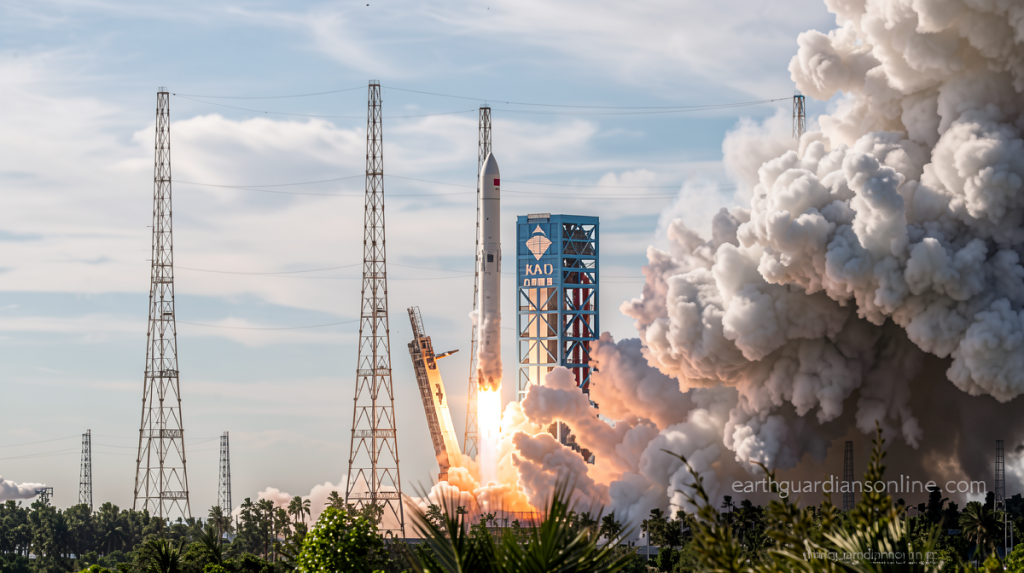
China Achieves Milestone in Reusable Rocket Technology During Orbital Test
A Historic Step Toward Space Dominance
China reports reusable rocket breakthrough as it – State media announced on Friday that China has successfully captured the first stage of its carrier rocket following an orbital launch test, marking a significant advancement for the nation’s space program. This achievement positions China favorably as it competes with American counterparts in the rapidly evolving field of reusable rocket technology. The Long March 10B vehicle lifted off from Hainan island, located in southern China, during the pivotal test mission.
According to footage broadcast by state television network CCTV, approximately six minutes after the separation between the first stage and upper stage occurred, the booster returned precisely to a floating platform positioned below. Video documentation shared through a CCTV-affiliated social media channel reveals the booster descending vertically while emitting smoke from its upper section as it approached the recovery platform. This visual evidence demonstrates the precision required for such operations.
Strategic Implications for Global Space Competition
The successful completion of this test brings China incrementally closer to matching the reusable rocket capabilities demonstrated by American commercial enterprises. Industry experts recognize this technology as fundamental to advancing both space exploration initiatives and commercial space travel, while simultaneously supporting the construction of essential satellite infrastructure networks. The ability to recover and reuse rocket components represents a transformative shift in how nations approach space access.
“This mission … signifies a historic breakthrough in China’s reusable rocket technology and a solid foundation for accelerating the improvement of China’s space access capabilities,” the rocket-maker China Aerospace Science and Technology Corporation stated in a social media announcement.
Beyond the recovery achievement, the mission also accomplished the deployment of a satellite into its designated orbital position, according to official state media reports. This dual success—both landing the booster and placing a satellite in orbit—demonstrates the comprehensive nature of the test program.
Building on Recent Progress and Future Ambitions
The successful landing represents a turning point following several unsuccessful attempts with other rocket systems during recent months. Multiple organizations operating within China’s increasingly crowded commercial space sector have been racing to achieve critical milestones in reusable launch vehicle development. Each successful test brings the nation closer to its broader objectives of establishing itself as a leading aerospace power on the world stage.
Beijing has articulated clear ambitions to become what officials describe as a “strong aerospace nation.” To accomplish this goal, the government has mobilized not only its traditional national space resources but has also encouraged the growth of a vibrant commercial space industry designed to compete effectively against international rivals. This dual approach combines state-backed expertise with private sector innovation.
The development of reusable rocket technology offers substantial economic benefits by significantly reducing both the financial costs and turnaround time associated with rocket launches. When rockets can be recovered and relaunched rather than discarded after single use, the economics of space access change dramatically. This cost reduction enables more frequent missions and opens new possibilities for commercial applications.
Furthermore, reusable rockets provide nations with strategic advantages as space increasingly becomes recognized as a domain connected to military power and defense capabilities on Earth. Control over space infrastructure translates directly into geopolitical influence, making this technological race particularly significant for global powers.
The Long March-10 series, engineered and manufactured by a subsidiary of the state-owned China Aerospace Science and Technology Corporation, holds particular importance for China’s plans to conduct crewed missions to the lunar surface. This vehicle represents a critical component of the nation’s ambitious timeline for returning humans to the moon.
Meanwhile, reusable rockets have proven to be the foundation of success for Elon Musk’s company SpaceX, which developed the capability to land and reuse rocket boosters nearly ten years ago. SpaceX now commands a dominant position in the global launch market, having established itself as the preferred provider for numerous commercial and government missions. American competitor Blue Origin also achieved a notable milestone last November when it completed its first successful landing of the first stage of its New Glenn rocket, demonstrating that the race for reusable rocket supremacy involves multiple players from different nations.
