
Farage and Le Pen make the same defiant pitch: Only the people can judge us
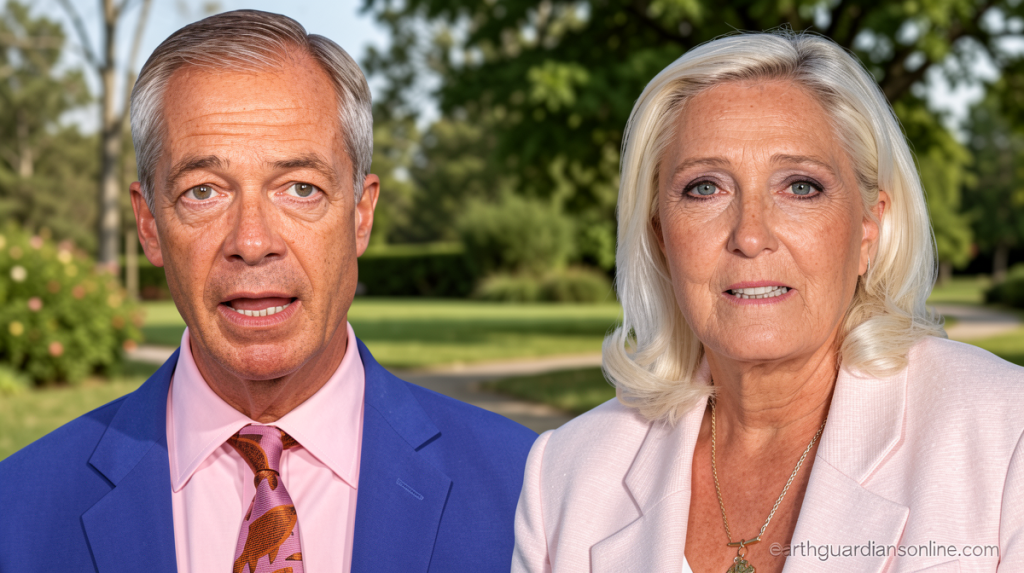
Two Populist Leaders Challenge Their Nations’ Systems in Defiant Moves
A Shared Message: Let the People Decide
Farage and Le Pen make the same – On Tuesday, two of the most recognizable figures in global populism delivered parallel declarations of independence from their respective political establishments. Nigel Farage and Marine Le Pen, separated by the English Channel but united by their confrontational approach, both announced plans to bypass traditional institutional channels and appeal directly to voters. Their coordinated timing underscored a shared belief that mainstream political structures had failed to represent their constituencies.
Le Pen’s announcement came during a televised evening address, where she declared her intention to mount a fourth presidential campaign. This decision followed closely on the heels of a judicial ruling that cleared the legal path for her candidacy. The Paris courthouse, packed with journalists who had spilled into overflow chambers, delivered its verdict shortly after midday. The court examined Le Pen’s appeal against a 2025 criminal conviction that found her, her National Rally party, and eleven senior party members guilty of misappropriating millions of euros in European Union funds designated for party-political workers in France.
While the court reduced the duration of Le Pen’s ban from public office, it maintained both the conviction and the associated sentence. This meant she remained subject to one year of house arrest under electronic monitoring—a restriction she had previously vowed would prevent her from campaigning effectively. Nevertheless, the evening broadcast revealed a politician undeterred. Le Pen, who has dedicated decades to both seizing control of the party founded by her father and transforming its image, announced she would continue her fight. She expressed confidence that a new appeal to France’s supreme court would vindicate her, positioning the electorate as her ultimate arbiters.
Farage’s Parliamentary Exit and Financial Defense
Meanwhile, across the Channel, Farage delivered an equally forceful address. His speech conveyed deep anger toward what he characterized as an orchestrated campaign against him by political elites. The founder of Reform UK, which currently leads national opinion polls much like Le Pen’s party does in France, announced his resignation from parliament. Having credited himself with securing Britain’s exit from the European Union, Farage declared his intention to transform the resulting by-election in his Clacton constituency into a fresh referendum. This time, however, the focus would be on officials currently examining his financial affairs.
This strategic move effectively paused a parliamentary investigation into an undisclosed £5 million gift that The Guardian reported Farage received from a cryptocurrency billionaire based in Thailand. Additionally, the Sunday Times had documented benefits Farage accepted from an individual convicted of fraud in the United States. Farage firmly rejected any allegations of impropriety, asserting on Tuesday that he had violated no laws whatsoever.
Historical Context and International Support
Le Pen’s television appearance, accompanied by a new campaign poster depicting her with arms outstretched in triumph, signaled her belief that her legal challenges could now serve her political ambitions. Since her 2022 defeat to President Emmanuel Macron, who captured 41% of the vote, the veteran far-right leader had been methodically preparing for a 2027 presidential bid. She transferred leadership of the National Rally to her protégé Jordan Bardella, enabling her to concentrate on what she considered the most significant prize in her political career.
Bardella has since delivered substantial results, guiding the party to victory in the 2024 European elections and securing first place in the initial round of subsequent snap parliamentary elections. The organization, once dismissed as unelectable when founded by Jean-Marie Le Pen, now stands as the largest party in the National Assembly and appears poised to win the presidency according to current polling data.
The March 2025 ban on Le Pen’s candidacy arrived like a thunderclap, freezing what she viewed as an inevitable ascent to power. At an immediate rally, she characterized the ruling as a political judgment disguised as legal procedure—a “witch hunt” that violated democratic principles. She emphasized three decades of fighting injustice and refused to be denied the presidency.
International figures quickly rallied to her support. US President Donald Trump condemned the sentence as “lawfare” targeting a political adversary, posting on Truth Social: “FREE MARINE LE PEN.” The Kremlin, Elon Musk, and Hungary’s former Prime Minister Viktor Orbán echoed similar sentiments, arguing that citizens rather than judges should determine political outcomes.
“The people, not the courts, should choose.”
Le Pen made clear on Tuesday evening that she expects to avoid house arrest and believes her legal situation now works to her advantage. Both she and Farage demonstrated that they would not be contained by institutional constraints, instead seeking to fundamentally reshape their respective political systems through direct appeals to popular sovereignty.
