Jon Ossoff’s ‘Travels with Natalie’ shows how candidates win attention in a culture of clips

Daftar Isi
When a Rally Line Becomes a National Story: The Clip Economy Reshapes Campaign Strategy
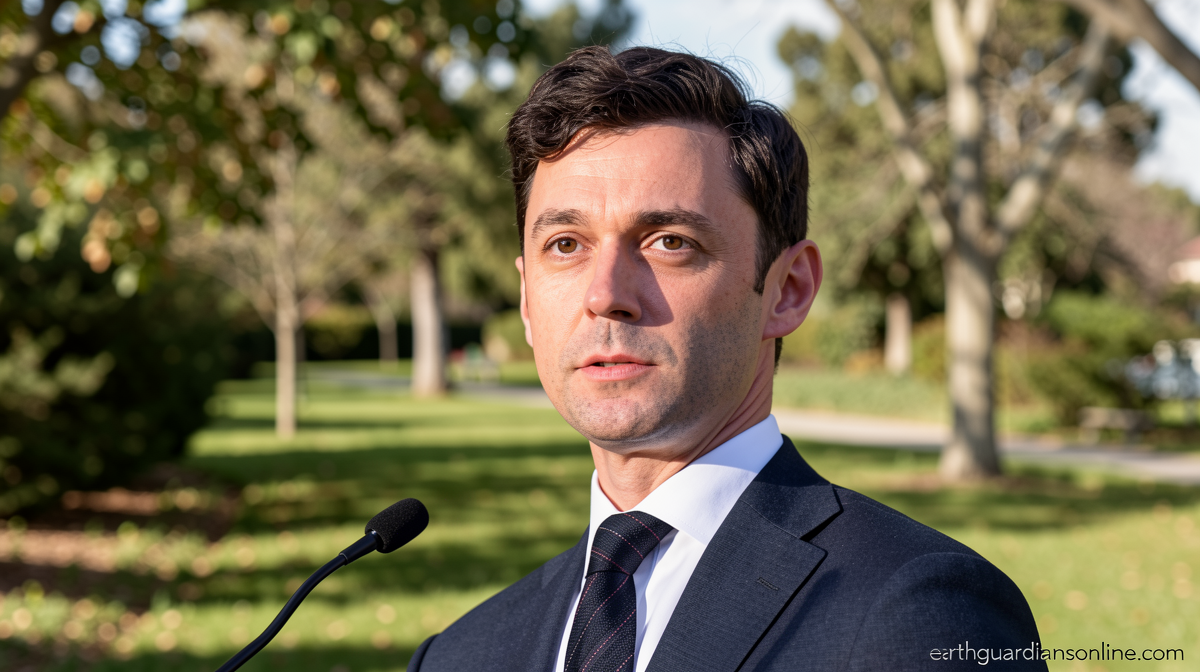
Earthguardiansonline.com – The modern political campaign increasingly lives and dies in fragments — thirty-second bursts of rhetoric engineered to survive the scroll, the share, and the algorithm. A single well-placed phrase, delivered at the right cadence, can outperform weeks of television appearances in raw audience reach. That dynamic was laid bare this week when Georgia Senator Jon Ossoff, 39, turned a routine rally remark into a phenomenon that dominated headlines, search engines, and cable-news segments within hours.
The Line That Broke the Cycle
Speaking at a rally last Sunday, Ossoff — who is seeking re-election in his home state while a growing chorus of Democratic insiders floats his name for a 2028 presidential bid — wove a pointed jab into a broader argument that President Trump has neglected the duties of the office. The full sentence landed like a calculated strike:
“He wants to build his ballroom and travel with Natalie on their apparently defenseless flying palace gifted by the Emir of Qatar.”
The phrase “travel with Natalie” — a deliberate echo of Trump’s own casual references to his executive assistant Natalie Harp, 35 — did exactly what its architect intended. It titillated one audience, provoked another, and enraged a third, all simultaneously. Within a day, Google searches for Harp’s name surged by 5,000 percent. Newsrooms scrambled to fill the vacuum with fresh profiles and background pieces. By Tuesday morning, a story asking simply “Who is Natalie Harp?” had climbed to the top of the most-read rankings on major news sites.
The Cable-News Reaction
The saturation coverage was not accidental. It was, in part, a response to genuine audience curiosity and, in part, a product of the White House’s own aggressive pushback against Ossoff, which handed outlets additional angles and follow-up material. On Fox News that Tuesday afternoon, host Jesse Watters delivered a bemused observation that underscored just how unusual the moment had become:
“This is the first time we have covered Ossoff on this show in six years.”
Watters went further, attempting to deflate the controversy while inadvertently amplifying it. He acknowledged that Trump has long surrounded himself with attractive women, dismissed the notion that the president was genuinely rattled, and noted that he had personally defended far more pointed remarks from the White House in the past. Yet the segment ran its full duration, giving Ossoff’s message another round of national exposure.
Commentary Splits Along Party Lines
Liberal voices celebrated the moment. Tommy Vietor, co-host of the podcast “Pod Save America,” described Ossoff as essentially “winking” at the subject and predicted a wave of follow-up reporting. Conservative commentators, by contrast, seized on the gendered framing, with some accusing the senator of sexism. That accusation, in turn, prompted left-leaning voices to cite Trump’s own history of comments about women, and the cycle of rebuttal and counter-rebuttal spun outward — precisely the kind of algorithmically amplified political bickering that social-media platforms are designed to reward.
A Candidate Built for the Fragment
Ossoff is not a one-off beneficiary of viral luck. His campaign speeches have repeatedly produced short, self-contained moments that travel widely on platforms like X and TikTok, accumulating millions of views. Veteran political journalist Jonathan Martin, now a columnist and show host at Politico, described what he calls “the Ossoff model” earlier this summer: a weekend rally, clips delivered for social media, and a tight focus on corruption. The Harp remark fit that template perfectly, embedding a corruption allegation — the Qatar-linked jet, the ballroom construction — inside a punchy, repeatable phrase.
Amanda Litman, president of Run for Something, an organization dedicated to electing young progressive candidates, told CNN that younger candidates across the spectrum have become fluent in internet-native communication. She characterized Ossoff’s particular strength as delivering speeches “that can be clipped up, because that’s really his strength.” Litman emphasized that winning candidates are shifting their thinking away from individual television hits toward sustained social reach and attention. At rallies, she explained, the calculus is no longer limited to what happens in the room:
“It’s not just what’s happening in the room, it’s what the room can be cut up into for later use.”
The Broader Pattern
The strategy is not confined to one party or one candidate. Democratic Representative Ritchie Torres, speaking about New York City Mayor Zohran Mamdani during last year’s mayoral race, described how Mamdani had mastered what he called the “three threes” — a shorthand for crafting content calibrated to a 30-second social-media window, a three-minute television segment, and a thirty-minute rally address. Each format demands a different rhythm, but all three feed the same ecosystem of clips that now defines how voters encounter their representatives.
For Ossoff, the “travel with Natalie” moment crystallizes a broader shift in American electoral politics. Candidates who once measured success by television ratings and newspaper column inches now measure it in view counts, share rates, and the velocity with which a phrase migrates from a rally stage to a cable-news chyron. The clip economy does not reward nuance; it rewards memorability. And in that economy, a senator’s carefully timed jab about a flying palace and a ballroom can outperform an entire week of policy speeches — not because the policy was absent, but because the packaging made it impossible to ignore.
Related Reading
Frequently Asked Questions
What is Jon Ossoff s Travels with Natalie?
Jon Ossoff s Travels with Natalie is the main topic of this guide. The article explains the context, practical details, and next steps readers should understand.
Why does Jon Ossoff s Travels with Natalie matter?
Jon Ossoff s Travels with Natalie matters because readers are looking for a useful answer, not just a short summary. Good content should match search intent and help them decide what to do next.