Knicks’ Game 5 victory set an NBA ratings record dating back to the 1990s

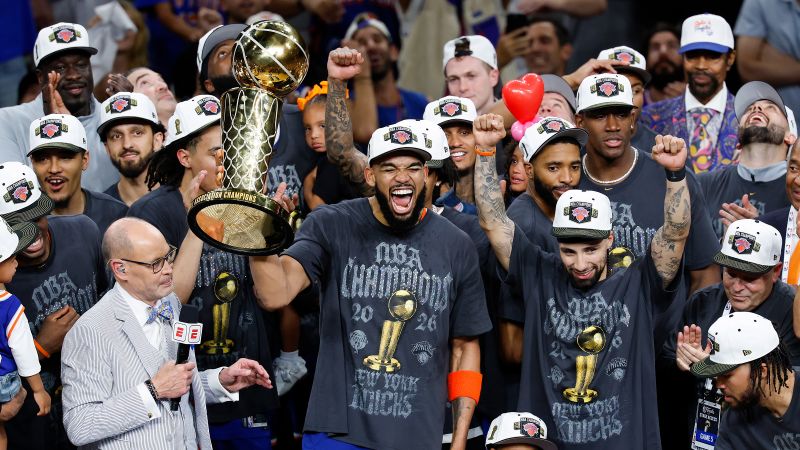
Knicks’ Game 5 Triumph Breaks NBA Finals Ratings Barrier Since 1990s
Knicks Game 5 victory set an NBA – When the New York Knicks secured their first championship since the 1970s, the event sparked a surge in viewership that eclipsed earlier decades. Nielsen data, released Tuesday, confirmed that Saturday night’s Game 5 broadcast averaged 24.5 million viewers, surpassing all previous NBA Finals Game 5 audiences since 1998. This marks a significant moment for the league, as it highlights a rare instance of renewed interest in the postseason’s most anticipated matchups.
A Historic Surge in Audience Numbers
The Knicks’ Game 5 win against the San Antonio Spurs not only clinched the title but also became a catalyst for a record-breaking ratings event. The final quarter of the game saw a peak of 33 million viewers, with the energy of New York’s citywide celebration palpable on screens across the nation. This figure dwarfs last year’s Game 5, which drew only 9.5 million viewers between the Indiana Pacers and Oklahoma City Thunder, underscoring the dramatic shift in audience engagement.
While the Knicks’ victory is a singular story, it also reflects broader changes in the NBA’s visibility. The league’s overall ratings for the five-game finals reached 20.6 million, doubling the previous year’s seven-game series. This growth signals a potential turnaround for a sport that has struggled to maintain viewership in recent years, despite its global appeal and star power.
Comparing the 1998 NBA Finals, which featured the Chicago Bulls and Michael Jordan, to this year’s showdown reveals stark differences in media dynamics. Back then, the league had fewer platforms to compete with, and the Bulls’ dominance made the series a cultural phenomenon. Today, with streaming services and sports leagues vying for attention, the Knicks’ triumph represents a rare triumph in capturing the public’s imagination.
The Knicks’ Journey: A Narrative of Resilience
For decades, the Knicks were synonymous with playoff heartbreak, but their 2026 championship run transformed their narrative. The team’s ability to stage multiple comebacks, including a thrilling late-game rally in Game 5, resonated with fans who had long viewed the franchise as a symbol of underdog spirit. This emotional arc, combined with the high-stakes nature of the Finals, created a storyline that transcended basketball, drawing in viewers from diverse demographics.
Unlike the past few years, where the NBA Finals were often overshadowed by other sports events and media distractions, this year’s series felt electric. The Knicks’ ability to spark spontaneous celebrations in New York’s streets and neighborhoods, despite the rise of digital platforms, proved that traditional television still holds power in moments of collective triumph. Analysts suggest that the team’s relatability—its blend of veteran leadership and young talent—played a key role in amplifying the event’s reach.
Moreover, the Knicks’ success challenged perceptions of the league’s appeal. While critics have long argued that the NBA struggles to match the NFL’s ratings or that its political leanings alienate fans, the 2026 Finals demonstrated a renewed vitality. The series’ popularity, particularly Game 5, suggests that the league’s narrative can still captivate audiences if it aligns with cultural and emotional currents.
Media Evolution and the Role of Nielsen
As the media landscape has evolved, the way we measure audience engagement has changed too. Nielsen ratings, which have tracked viewership for decades, remain a critical metric but may not fully capture the depth of this year’s event. The system, designed for traditional broadcast settings, struggles to account for the spontaneous viewing parties that erupted in New York. These gatherings, where fans crowded bars and living rooms to cheer for the Knicks, were emblematic of a broader cultural phenomenon that traditional data might overlook.
Back in the 1990s, the NBA’s dominance on television was unquestioned. With limited competition from other leagues, the Finals were a weekly spectacle, drawing massive audiences for extended periods. However, the 21st century brought challenges, including the rise of cable networks, the internet, and the NFL’s consistent dominance in viewership. Last year’s Finals, which averaged 9.5 million viewers, highlighted the league’s struggle to maintain momentum in a saturated market.
Despite these hurdles, the Knicks’ Game 5 win reignited enthusiasm for the NBA. The series’ ratings, which doubled from the previous year, indicate that the league can still generate excitement when it delivers compelling narratives. The success of the Knicks’ championship run may also encourage broadcasters to invest more in high-profile matchups, potentially revitalizing the league’s television presence.
A Resurgence for the NBA?
Michael McCarthy, writing for Front Office Sports, hailed the Knicks’ victory as a sign of the NBA’s potential resurgence. “For years, many of the prevailing media narratives about the $14.3 billion league have been negative,” he noted. “The NBA can’t draw TV ratings compared to the mighty NFL. The league is too ‘woke’ politically. ESPN, NBC Sports, and Amazon Prime Video foolishly overpaid for league media rights with their $76 billion, 11-year agreements.”
“The NBA can’t draw TV ratings compared to the mighty NFL. The league is too ‘woke’ politically. ESPN, NBC Sports, and Amazon Prime Video foolishly overpaid for league media rights with their $76 billion, 11-year agreements.”
McCarthy’s critique, while sharp, contrasts with the reality of this year’s Finals. The Knicks’ story, filled with drama and underdog triumph, seemed to cut through the noise, proving that the league can still command attention. The 2026 series may also serve as a template for future events, showing how a combination of storytelling and performance can rekindle public interest.
Looking ahead, the Knicks’ victory could influence how the NBA approaches marketing and scheduling. With a record-breaking Game 5 and overall series ratings, the league might leverage this momentum to expand its global footprint. The success of the Knicks’ journey, marked by resilience and dramatic comebacks, offers a blueprint for turning around the league’s image in an increasingly competitive media environment.
Ultimately, the Knicks’ triumph is more than a statistical anomaly—it’s a testament to the power of storytelling in sports. While Nielsen ratings provide a snapshot of the event’s popularity, they don’t fully encapsulate the emotional impact felt by fans in New York. The city’s collective joy, fueled by the Knicks’ historic win, has already begun to reshape perceptions of the NBA as a league capable of producing moments that unite people across the country.
As the 2026 NBA Finals conclude, their legacy may extend beyond the court. The record-breaking viewership numbers, the media’s renewed focus, and the Knicks’ inspirational journey could signal a new chapter for the league. Whether this marks a long-term trend or a one-time surge remains to be seen, but for now, the Knicks have proven that the NBA can still capture the hearts of fans—and their attention.