
Scientists accidentally discover sea cucumber with ‘tissue immortality’
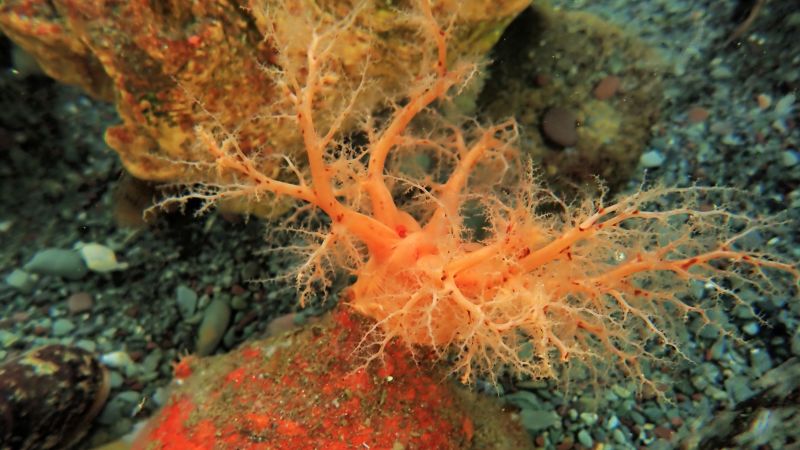
Scientists accidentally discover sea cucumber with ’tissue immortality’
Scientists accidentally discover sea cucumber – What defines life remains a subject of debate, but a recent study has introduced an intriguing twist to the discussion. Researchers investigating a remarkable marine species have observed an unexpected phenomenon: severed tissues from certain sea cucumbers continue to function indefinitely, challenging conventional understandings of biological survival. The findings, published in the journal Science Advances, reveal that fragments of Pseudolus fabricii—a North Atlantic native—exhibit a unique ability to thrive without dying, raising questions about the boundaries between life and death.
Unexpected Regeneration in Lab Experiments
The discovery emerged from routine laboratory experiments. Scientists excised portions of the sea cucumber’s body, including its feet, main trunk, and tentacles, and placed them in untreated seawater to study their regenerative properties. To their surprise, these fragments did not merely decay; instead, they demonstrated sustained cellular activity and self-repair. “These tissues appear to defy the usual rules of mortality,” said Sara Jobson, the study’s lead author, who is a doctoral student specializing in ocean sciences at Memorial University in Newfoundland and Labrador. “They maintain functionality without any signs of degradation, as if they’ve gained a form of immortality.”
Jobson explained that while sea cucumbers are well-known for their robust regenerative abilities, the focus has typically been on the regrowth of lost limbs or appendages. “We assumed that detached tissue would simply perish,” she noted. “But this case shows that the fragments can exist independently, surviving and healing in their natural environment.” The key distinction lies in the fact that these severed parts do not regenerate into full organisms but instead persist as self-sustaining entities. This capability has sparked a deeper inquiry into the nature of biological life itself.
Accidental Observation Sparks Curiosity
The initial discovery was not planned. During routine experiments, researchers noticed that some of the sea cucumber’s tube feet remained attached to the glass walls of the aquarium after being severed. Jobson described this as a “normal” occurrence, as the creatures can detach their feet in the wild to escape threats. However, what initially seemed like a minor detail turned into a major revelation when the tissue fragments were observed surviving for over three years. “They were still there after days, weeks, and months,” she recalled. “They healed, grew, and even moved, all without being connected to the main body.”
Jobson highlighted that these detached tissues thrive in natural seawater, an environment teeming with bacteria and microorganisms. Unlike typical biological processes, the fragments do not rely on the digestive system to absorb nutrients. Instead, they extract amino acids directly from their surroundings, sustaining themselves independently. “This is the first time we’ve seen tissue maintain vitality without a reproductive purpose,” she said. “It’s like watching a part of the organism gain its own life, even though it’s not a complete individual.”
Philosophical Implications for Regeneration
The study’s findings have profound implications for fields such as regenerative biology and aging research. Veronica Hinman, director of the Whitney Laboratory for Marine Bioscience at the University of Florida, emphasized that the work “tests assumptions about what it means to be alive.” Hinman, who was not involved in the study, noted that the research shifts the focus from the whole organism to the autonomous behavior of its components. “These tissues function as independent entities, maintaining cellular activity and immune responses without being part of a living host,” she said. “It’s a breakthrough in understanding how life can persist beyond the traditional confines of the body.”
Jobson likened the phenomenon to a lizard’s tail, which detaches voluntarily but lacks the ability to survive on its own. In contrast, the sea cucumber’s fragments seem to transcend this limitation. “Imagine a lizard tail that not only heals but also explores its surroundings, feeding itself and surviving for years,” she said. “That’s what these tissues do, and it’s completely unexpected.” This analogy underscores the broader significance of the discovery: it suggests that certain tissues may possess properties that allow them to function autonomously, even in the absence of the organism they were originally part of.
Evolutionary Questions and Future Research
While the ability of the sea cucumber’s tissues to survive indefinitely is remarkable, the underlying evolutionary mechanism remains unclear. “Why would these small fragments maintain such resilience without a reproductive function?” Jobson asked. “What evolutionary advantage does this trait offer?” The answer could reshape how scientists view the relationship between regeneration and survival. The tissues do not reproduce, yet they continue to produce new cells and respond to stimuli, indicating a complex interplay between cellular processes and environmental adaptation.
The study’s accidental nature adds to its intrigue. Jobson explained that the research team keeps live sea cucumbers in their lab, often removing them for experiments. However, some animals form strong attachments to their habitat, making it difficult to extract them without leaving behind parts. “The severed tube feet were stuck to the glass, and we didn’t realize they were still alive until months later,” she said. “It was a slow realization that these fragments could survive independently, even in the wild.”
This accidental observation has opened new avenues for exploration. If tissues can maintain functionality without the whole organism, it may lead to breakthroughs in medical science, such as advanced tissue engineering or therapies for chronic wounds. “Understanding how these fragments sustain themselves could help us develop new approaches to healing and tissue preservation,” Hinman said. “It’s a glimpse into the potential of biological systems to operate beyond their original boundaries.”
As the study progresses, scientists hope to uncover more about the cellular mechanisms enabling this phenomenon. The findings challenge long-held beliefs about the necessity of an intact organism for life and survival, suggesting that certain biological processes may be more autonomous than previously thought. For now, the sea cucumber’s tissues stand as a testament to nature’s capacity to surprise, offering a unique perspective on the complexities of life itself.
