US Air Force flight to Antarctica turns back after space activity warning

Daftar Isi
Antarctic Supply Run Scrubbed After Russian Missile Launch Warning Over Pacific Airspace
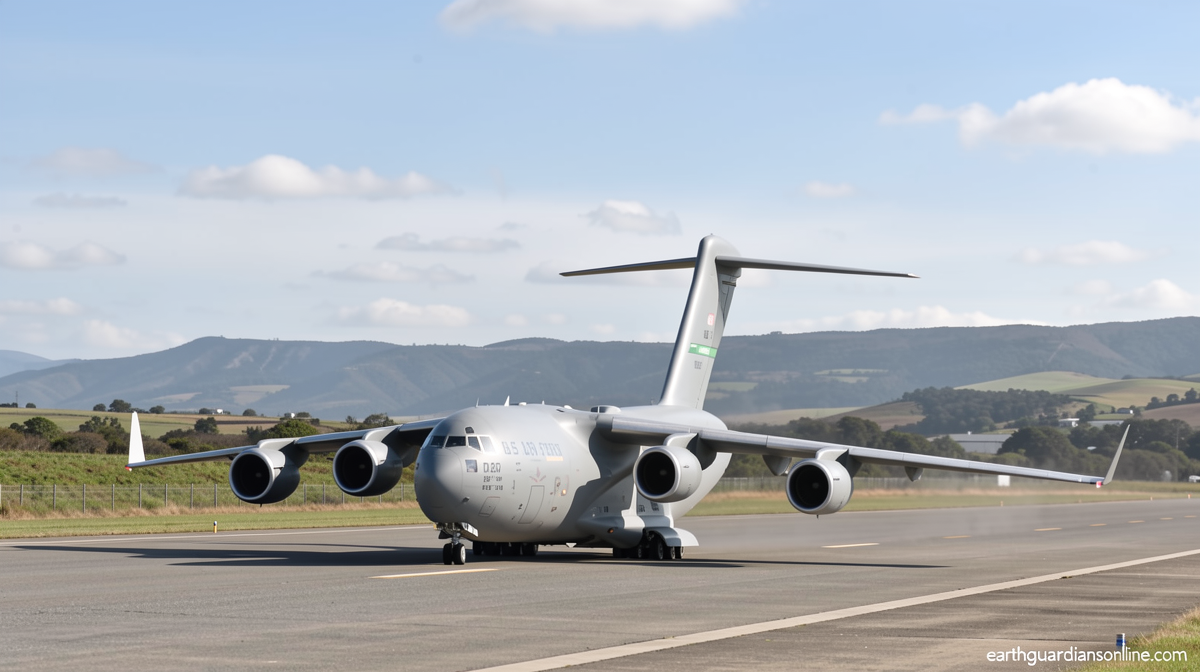
Earthguardiansonline.com – A military cargo plane carrying personnel and equipment toward the icy continent made an unplanned U-turn over the Southern Ocean when New Zealand’s aviation regulator flagged a space-related hazard in its flight corridor. The aircraft, a C-17 Globemaster III operating under the call sign ICE28, lifted off from Christchurch Airport at approximately 9 a.m. local time on Tuesday and was heading south toward the continent when the turn-around order took effect. It touched back down at Christchurch just before 11:30 a.m., having spent roughly 150 minutes airborne.
The interruption came during what is arguably the most critical logistical window of the Antarctic calendar: the annual Winter Fly-in, or WINFLY. Each year, as the austral winter gives way to the research season, a concentrated burst of flights shuttles scientists, technicians, replacement parts, fuel, and construction materials between Christchurch and two major stations on the continent — the United States’ McMurdo Station and New Zealand’s Scott Base. Missing even a single sortie during this compressed window can cascade delays across an entire season of fieldwork, laboratory operations, and overwinter staffing rotations.
What Triggered the Turn-Around
New Zealand’s Civil Aviation Authority (CAA) confirmed it had issued a NOTAM — a Notice to Airmen, the standard instrument used worldwide to alert pilots to temporary hazards in their planned routes. The trigger was a notification received from Russia’s State Air Traffic Management Corporation, which advised the agency of a planned missile launch and the associated risk to international airspace falling within New Zealand’s Oceanic Flight Information Region.
The Oceanic FIR spans roughly 30 million square kilometres of Pacific and Tasman Sea airspace, making it one of the largest contiguous airspaces administered by any single authority on Earth. Much of that volume sits over open ocean, far from any coastline, where no national government exercises direct sovereignty over activities taking place below the flight level. The CAA acknowledged this structural limitation in a follow-up statement released Wednesday.
“We put in place a danger area and issued a NOTAM to alert aircraft operators to the potential hazard. This does not prevent aircraft from flying through the area, operators make their decisions based on the information available,” the CAA said.
The authority added that its jurisdiction over the vast oceanic corridor is inherently constrained: “Much of our Oceanic FIR is over international waters, where we have limited control over activities.” In practical terms, this means the CAA can flag a hazard and advise pilots, but it cannot order a foreign launch to be postponed or rerouted. The decision to continue or turn back rests with the flight crew and their mission commander, weighing fuel margins, weather windows, and the urgency of the cargo against the stated risk.
Flight Details and Tracking
Public flight-tracking data from Flightradar24 corroborated the sequence. The C-17, a four-engine strategic airlifter routinely used by the US Air Force for long-range cargo and personnel movement, departed Christchurch on Tuesday morning and tracked southward before reversing course. The total airborne time of approximately two and a half hours placed the aircraft well into the southern Pacific before the return began, suggesting the crew had already committed to the outbound leg before the NOTAM reached them or before they elected to act on it.
The US Air Force, the US Antarctic Program, and Russia’s State Air Traffic Management Corporation were all contacted for comment. As of publication, none had issued a public statement detailing the specifics of the launch parameters, the exact altitude band of the hazard, or whether the mission would be rescheduled.
Why Space Activity and Aviation Keep Colliding
The incident underscores a growing friction point in global infrastructure: the increasing frequency of rocket launches, satellite deployments, and re-entry events, set against an aviation network that treats the upper atmosphere as a shared, continuously occupied resource. A missile launch from a coastal pad can send spent stages, debris, or exhaust plumes across thousands of kilometres of oceanic airspace, sometimes at altitudes that intersect with cruise-level flight corridors.
For polar logistics in particular, the geometry compounds the problem. The shortest great-circle routes from New Zealand to Antarctica thread through the same southern Pacific corridors where intercontinental ballistic trajectories and suborbital test flights are most likely to intersect. There is no alternate “highway” around the continent; the flight path is essentially fixed by geography, which means a single launch event can effectively close the only viable corridor for a window of time.
The CAA’s role in such scenarios is advisory rather than prohibitive. Pilots receive the NOTAM, assess the stated parameters — altitude, duration, geographic footprint — and decide whether to proceed, hold, or divert. In this case, the ICE28 crew elected to return. The consequence is a lost sortie during WINFLY, a period when every available flight hour is already allocated to keep the continent’s research infrastructure staffed and supplied ahead of the coming summer. How quickly the mission can be re-flown will depend on whether the launch window recurs, whether weather permits an alternate date, and whether the next available aircraft and crew can be re-tasked without cascading further delays down the supply chain.
For the scientists and support personnel awaiting transport to McMurdo or Scott Base, the turn-around translates into days or weeks of additional waiting — a reminder that the most remote research stations on Earth remain dependent on a narrow, weather- and geopolitics-sensitive corridor of air traffic, and that a single notification from a foreign space agency can reshape that corridor overnight.
Related Reading
Frequently Asked Questions
What is US Air Force flight to Antarctica?
US Air Force flight to Antarctica is the main topic of this guide. The article explains the context, practical details, and next steps readers should understand.
Why does US Air Force flight to Antarctica matter?
US Air Force flight to Antarctica matters because readers are looking for a useful answer, not just a short summary. Good content should match search intent and help them decide what to do next.