This ‘perfect invader’ is spreading across the world. It’s costing economies billions

Daftar Isi
The Silent Destroyer: How a Tiny Beetle Is Toppling South Africa’s Ancient Oaks
Earthguardiansonline.com – Stellenbosch has long been celebrated as a picturesque town nestled against the dramatic Western Cape mountains, its landscape dotted with vineyards heavy with grapes. For nearly three and a half centuries, this historic settlement earned the distinguished nickname “City of Oaks.” Yet that proud designation now hangs by a thread. Countless majestic English oaks and other urban trees that once graced the streets and estates have vanished. Those remaining stand marked for their eventual demise, their fate inscribed in tiny perforations beneath the bark—holes no wider than a pen dot left by a ballpoint.
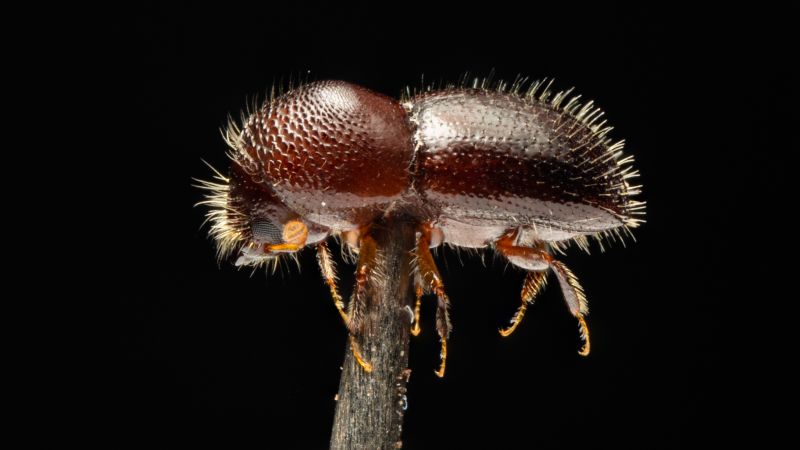
These microscopic wounds serve as calling cards from the polyphagous shot-hole borer, an invasive beetle currently waging war on tree populations throughout South Africa and beyond. Despite being smaller than a sesame seed, this creature’s ecological and economic footprint is enormous and expanding worldwide. The damage spans millions of trees and billions of dollars in losses.
A Global Conqueror in Miniature
Originally hailing from southeast Asia, this beetle has successfully colonized every continent except Antarctica. Research published in the Journal of Pest Science in June revealed how the insect hitchhikes across borders within wood products, live plants, and packaging materials. A July review in the Forests journal documented that approximately 680 tree and woody plant species have fallen victim to this pest so far.
South Africa has experienced the beetle’s devastation more acutely than most nations. Initially spotted in the eastern KwaZulu-Natal province in 2012, the first official documentation occurred in 2017. Today, the insect has been confirmed in eight of South Africa’s nine provinces. Scientists suspect it may already inhabit Limpopo as well—simply awaiting discovery.
Francois Roets, a professor of conservation ecology and entomology at Stellenbosch University, has witnessed this threat firsthand. He characterizes the beetle as “the perfect invader.” His assessment carries weight given his academic expertise.
“I used to have a course for undergraduates where we asked students to design an invasive species based on all the kinds of characteristics that they have,” Roets explained. “This little beetle has all of those things rolled into one.”
The Deadly Partnership
While the beetle alone does not directly kill trees, it arrives with a biological accomplice. The polyphagous shot-hole borer excavates tunnels within host trees to establish breeding galleries. Carried in pouches behind its mandibles are fungal spores that release as the insect chews through wood.
This fungus establishes a symbiotic relationship that ultimately harms the tree. In exchange for transportation to an optimal nursery, the fungus provides the beetle with nourishment and shelter. The fungus feeds both the adult insect and its larvae while simultaneously blocking the tree’s vascular tissue. This obstruction prevents the tree’s natural defense mechanisms from reaching the invading beetle.
The consequences prove devastating. The blocked vascular system disrupts water and nutrient flow, triggering a condition called fusarium dieback. Trees exhibit drought-like symptoms that frequently culminate in severe damage or death. Survival duration varies by species—oaks typically perish within four years, whereas box elders rarely endure beyond twelve months.
Reproductive Superpowers
Remarkably, a single beetle can initiate an epidemic. Unlike most insects, the polyphagous shot-hole borer does not require a male partner to reproduce. Virgin females produce unfertilized eggs that develop into males, which they then mate with to establish new colonies. This reproductive method, known as haplodiploidy, accelerates population growth significantly.
Although males lack wings and females can only fly short distances, this reproductive efficiency—combined with the insect’s diminutive size and preference for concealing itself within wood—has enabled rapid expansion across South Africa.
Economic Consequences Mount
By 2022, satellite imagery captured the alarming disappearance of tree-lined suburban streets in Johannesburg. This visual evidence underscored the primary response strategy: removing infected or dead trees before beetles can transfer to healthy hosts. Unfortunately, this approach proves expensive.
A comprehensive 2022 study conducted by economists and ecologists from Stellenbosch and Pretoria universities calculated the potential economic burden. They estimated the beetle could inflict 275 billion rand—approximately $18.5 billion at the time—over the following decade. This figure represents roughly 0.66 percent of South Africa’s total gross domestic product.
Beyond urban tree loss, the financial implications extend to agricultural sectors, forestry operations, and municipal budgets worldwide. As the beetle continues its relentless advance, communities must balance immediate removal costs against long-term ecological preservation. The fight against this microscopic menace requires coordinated international efforts, enhanced monitoring systems, and innovative treatment methods to protect both natural landscapes and economic stability.
Related Reading
Frequently Asked Questions
What is This perfect invader is spreading across?
This perfect invader is spreading across is the main topic of this guide. The article explains the context, practical details, and next steps readers should understand.
Why does This perfect invader is spreading across matter?
This perfect invader is spreading across matters because readers are looking for a useful answer, not just a short summary. Good content should match search intent and help them decide what to do next.