Looming rock collapse threatens Swiss village as thawing permafrost destabilizes the Alps

Daftar Isi
Alpine Village Watches a Mountain That May Not Hold
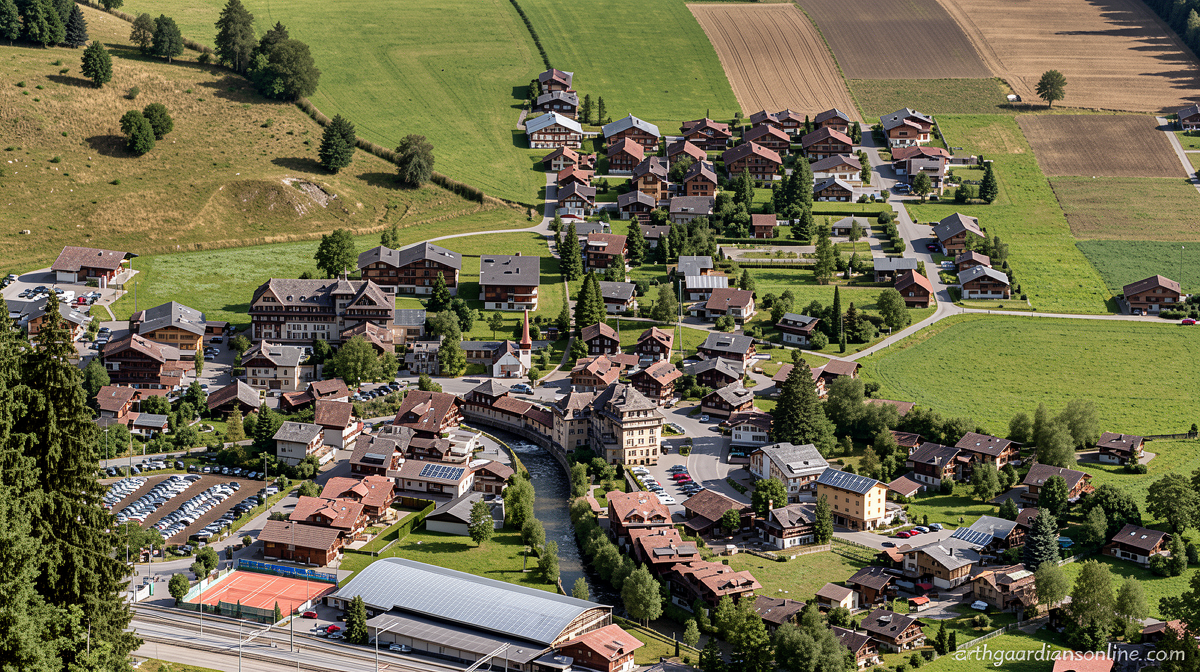
Earthguardiansonline.com – Above the quiet Bernese village of Kandersteg, a vast slab of fractured rock called Spitze Stei hangs over the valley floor like a held breath. Roughly 15 to 20 million cubic meters of unstable material sit on that slope, and geologists warn that a full collapse would unleash a landslide of a magnitude comparable to the catastrophe that buried the neighboring hamlet of Blatten in May 2025. For the 1,300 people who call Kandersteg home, the daily soundtrack of cowbells and glacial meltwater now carries an undercurrent of dread that no evacuation order has yet formalized — but that no one can ignore.
The Blatten Precedent
Less than a year ago, a towering mass of rock and ice sheared free from a glacier face in the Loetschental valley. Plumes of pulverized stone erupted skyward as the debris thundered downslope, smothering nearly every structure in Blatten with a thick blanket of mud. Residents had been moved out beforehand as a precaution, and the event became a stark, televised demonstration of what happens when frozen mountain architecture finally gives way. Scientists traced the trigger to the progressive weakening of permafrost — the ancient, ice-cemented soil and sediment that has for millennia acted as structural glue binding Alpine slopes together.
That mechanism is now accelerating across the Swiss Alps. Warmer air temperatures, driven by decades of greenhouse-gas accumulation, are thawing both surface glaciers and the deeper permafrost layers beneath them. As the ice component melts out, the cohesive strength of the surrounding debris drops sharply, leaving slopes that once stood stable for centuries suddenly prone to progressive failure.
Life Under the Overhang
Kandersteg sits amid a landscape of serrated ridgelines, white ice fields, and steep green couloirs — the kind of postcard Alpine scenery that draws hikers and skiers year-round. Yet the village’s most prominent feature, in the eyes of its inhabitants, is the darkened scar of Spitze Stei looming on the northern flank. No evacuation has been ordered, and authorities maintain that the village is not under immediate danger. Contingency plans for a full withdrawal, however, are drafted and rehearsed.
“You are aware that it’s happening, but not afraid,” Brigitte Jüni, a Kandersteg resident, told visitors. “But then it’s nature. It’s nature and you never know.”
Jüni noted that local officials have taken every precaution within their power. The sentiment captures a particular Alpine psychology: acceptance of geological risk as an inescapable condition of mountain life, tempered by the knowledge that modern monitoring can buy time.
Expert Assessment: Gradual Failure More Likely Than Sudden Catastrophe
Markus Stoffel, a professor of climate change and natural hazards at the University of Geneva, frames the problem in thermodynamic terms. Permafrost, he explains, is not merely frozen dirt; it is a load-bearing component of the slope itself.
“In the mountains and in the unconsolidated debris, there is lots of ice,” Stoffel said. “Once this ice is melting, it acts like a cement. These mountain slopes will become increasingly unstable.”
Continuous geodetic surveys, ground-penetrating radar, and drone photogrammetry track the Spitze Stei mass around the clock. Specialists assess that the most probable failure mode is incremental — a series of smaller rockfalls and debris flows over years or decades — rather than a single, monolithic detachment. Still, the volume at stake means even partial failure could generate a debris avalanche capable of burying valley-floor infrastructure.
Local Voices: A Different Kind of Risk
Residents distinguish their situation from Blatten’s. Rudolf Isler, another Kandersteg inhabitant, pointed out that small stones have been dropping from the Spitze Stei face for years without triggering a major event.
“This isn’t the same case as in Blatten. It’s a different situation,” Isler said. “We are not afraid of the Spitze Stei rock. It’s been many years seeing stones falling from up there. The problem here is about global warming and rising temperatures.”
The distinction matters: Blatten’s disaster involved a glacier-ice interface failing catastrophically in a single event. Spitze Stei, by contrast, is a rock-dominated slope whose instability is governed more by thermal expansion of meltwater in fractures than by the sudden release of a glacier tongue. The risk profile is slower, more measurable, and arguably more manageable — though no less consequential.
Broader Implications for Alpine Settlement
The Kandersteg scenario is not an isolated curiosity. Across the European Alps, dozens of villages sit beneath slopes whose long-term stability was calibrated to a colder climate. As mean annual temperatures climb, the permafrost fraction within those slopes shrinks, reducing shear strength and increasing pore-water pressure. Landslides, rockfalls, and debris flows that occurred once per century may now recur on decadal timescales.
Nathan Solothurnmann, a climate and energy specialist with Greenpeace Switzerland, warns that the cumulative effect could force difficult decisions about where communities can safely remain.
“Maybe even one day we will have to abandon certain valleys or certain villages because it’s becoming impossible to live there,” Solothurnmann said. “Or the measure you will need to take to protect infrastructure is so expensive, the efforts are so big, that it’s not worthwhile anymore living there.”
For now, Kandersteg’s residents go about their routines — school runs, farm chores, weekend hikes — with the knowledge that sensors on the mountainside are watching, that evacuation routes are mapped, and that the geological clock, though ticking, has not yet run out. The question for Bern, for the cantonal authorities, and for the village itself is how much time remains before the slope’s margin of safety narrows beyond what engineering can restore.
Related Reading
Frequently Asked Questions
What is Looming rock collapse threatens Swiss village?
Looming rock collapse threatens Swiss village is the main topic of this guide. The article explains the context, practical details, and next steps readers should understand.
Why does Looming rock collapse threatens Swiss village matter?
Looming rock collapse threatens Swiss village matters because readers are looking for a useful answer, not just a short summary. Good content should match search intent and help them decide what to do next.