Trump is squeezing Iran’s economy and oil sales. It may still have the upper hand in Hormuz

Daftar Isi
The Hormuz Standoff: Economic Squeeze Meets Maritime Leverage
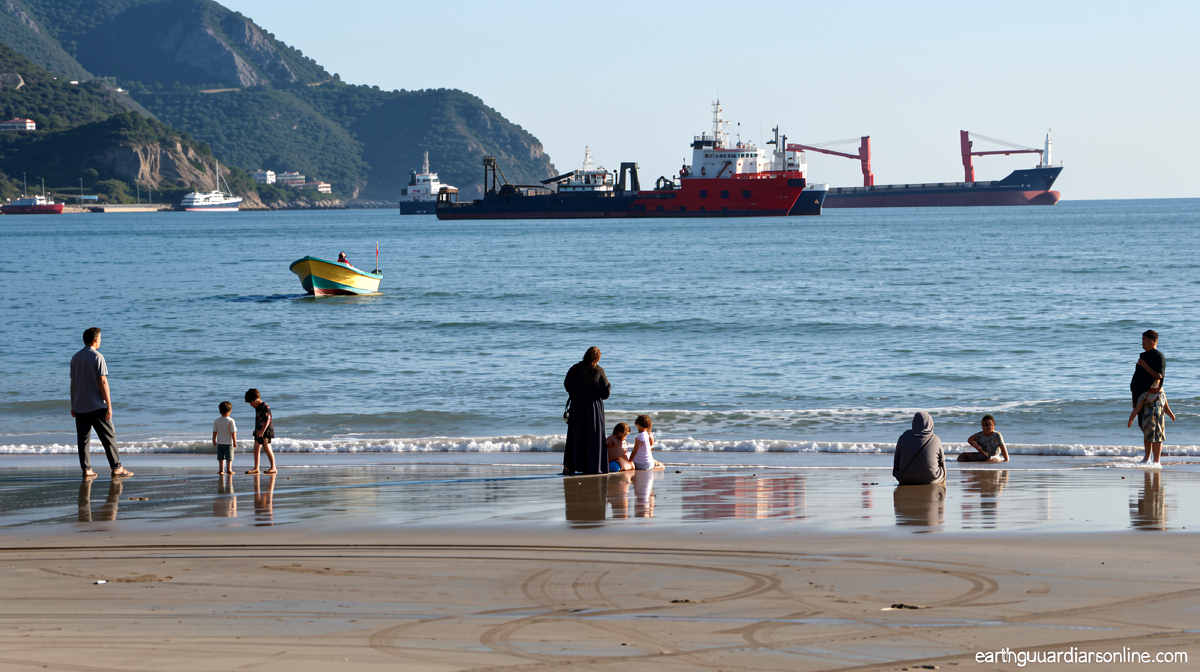
Earthguardiansonline.com – The confrontation between Washington and Tehran over the Strait of Hormuz has entered a phase where neither side can claim outright dominance, yet both continue to project confidence. Shipping through the narrow waterway — the chokepoint through which roughly a fifth of the world’s traded crude passes — has collapsed to a shadow of its pre-war volume. Before hostilities began, more than 130 vessels crossed the strait on an average day. Today, that figure often struggles to reach double digits, a testament to how many shipowners have simply decided the risk of an Iranian strike is not worth the freight rate.
The numbers behind the disruption are stark. Satellite and transponder tracking data compiled by Kpler shows that since July 7, only two to three Very Large Crude Carriers have made the passage each day on average, compared with approximately eight VLCCs per day in the months before the conflict erupted. Fewer tankers are transiting, yet the barrels themselves have not vanished. Increasing volumes of Persian Gulf crude are now moving through alternative routes, riding under the protection of American naval escorts, or being shifted via ship-to-ship transfers in open water to obscure their origin. This porous enforcement blunts what Tehran hoped would become a decisive energy weapon, while simultaneously easing some of the upward pressure on crude benchmarks and, by extension, pump prices in the United States.
Economic Pain as Policy Lever
President Donald Trump’s strategy toward Iran rests on a straightforward premise: sustained economic strangulation will compel the regime to negotiate from weakness. The United States has tightened its grip by effectively choking off Iranian oil exports through a blockade of the country’s ports. Loadings onto Iranian tankers have plummeted to a fraction of what was observed between February and April, according to shipping data. The administration is betting that the cumulative weight of lost revenue, currency collapse, and supply shortages will fracture domestic support for the government.
The damage to Iran’s economy has been severe. The International Monetary Fund projects a contraction of more than five percent for the current year — the worst shrinkage in nearly four decades. Inflation hovers near eighty percent, and the rial has slid to record lows against the dollar, pushing ordinary Iranians into credit just to purchase staples. Yet the regime has shown no visible signs of capitulation. No mass demonstrations have erupted against the leadership, which appears, if anything, emboldened by the external confrontation.
“For Iran, the leadership is prepared to absorb a lot more economic pain,” said Gregory Brew, a senior analyst at Eurasia Group, a political risk consultancy. Iran has “absorbed years of US sanctions, and now a long war, and has not backed down.”
That resilience complicates Washington’s calculus. Jorge Leon, head of geopolitical analysis at energy consultancy Rystad, framed the dilemma plainly:
“It’s now a matter of who blinks first, if anyone. There’s this dichotomy… economic pain is higher for Iran than for the US at the moment, but, importantly, political pressure on Iran is much lower.”
The Oil Clock and Four Months of Revenue
Even with ports blockaded, Tehran retains a meaningful buffer. Roughly eighty million barrels of Iranian crude are already at sea outside the blockade zone, the majority of which is committed to Chinese buyers. At prevailing market prices, those cargoes represent approximately $1.5 billion in monthly revenue, according to Homayoun Falakshahi, head of crude oil analysis at Kpler. But the runway is finite. At a discharge rate of 650,000 barrels per day, that floating inventory translates to roughly four months of export income before the taps run dry.
“It’s a bit like a slow death rather than falling off a cliff,” Falakshahi described the trajectory.
For now, as many as fifteen million barrels of oil continue to flow out of the Gulf through whatever channels remain open, meaning the blockade has not achieved total isolation. The partial leakage keeps global supply from tightening catastrophically and gives Tehran a lifeline while it waits out the standoff.
Domestic Politics in Washington
The American side of the ledger tells a different story. The US economy has been comparatively insulated from the direct disruptions of the war, but gasoline prices have climbed above four dollars per gallon on average, a figure that stings consumers and tests political patience. With midterm elections scheduled for November, the administration faces a narrow window in which economic discomfort must not translate into electoral punishment.
Dan Alamariu, chief geopolitical strategist at Alpine Macro, an Oxford Economics company, captured the tension in a note circulated last week:
“The unpopular war and higher gasoline prices cost (Trump), but a chaotic Middle East retreat would be worse. American voters don’t like presidents that lose wars.”
That calculation explains why the administration has continued to tout its capacity to escort commercial vessels through the strait, projecting strength even as the operational picture remains contested.
Who Actually Controls the Waterway?
Several maritime analysts who spoke with reporters this week pushed back on the notion that American naval presence has neutralized Iranian influence over Hormuz. Dimitris Maniatis, CEO of Marisks, a Greek-based maritime security firm, was blunt in his assessment:
“Iran exerts near-full control of the Strait of Hormuz,” enforced through “the threat of attack.”
The distinction matters. A strait where transit volumes have fallen by more than ninety percent, where shipowners price in a premium for Iranian hostility, and where Tehran retains the option to escalate at will is not a waterway under effective American management. It is a waterway under Iranian deterrence, with the United States absorbing the cost of keeping the lanes nominally open.
The result is a stalemate with no clear exit. Iran’s economy is bleeding, but slowly enough that the regime can endure. American voters are feeling the pinch at the pump, but not yet enough to force a policy reversal. The strait remains a theater of influence rather than a settled corridor. Until one side’s tolerance for continued pressure breaks — whether through a diplomatic breakthrough, a domestic political shock, or an escalation neither side planned — the standoff will persist, with both capitals talking tough and both economies absorbing costs they would prefer to avoid.
Related Reading
Frequently Asked Questions
What is Trump is squeezing Iran s economy?
Trump is squeezing Iran s economy is the main topic of this guide. The article explains the context, practical details, and next steps readers should understand.
Why does Trump is squeezing Iran s economy matter?
Trump is squeezing Iran s economy matters because readers are looking for a useful answer, not just a short summary. Good content should match search intent and help them decide what to do next.