A Qing Dynasty vase 200 years ahead of its time

Daftar Isi
A Glass Vase from the Qing Court That Looks Like It Belongs in a 1960s Living Room
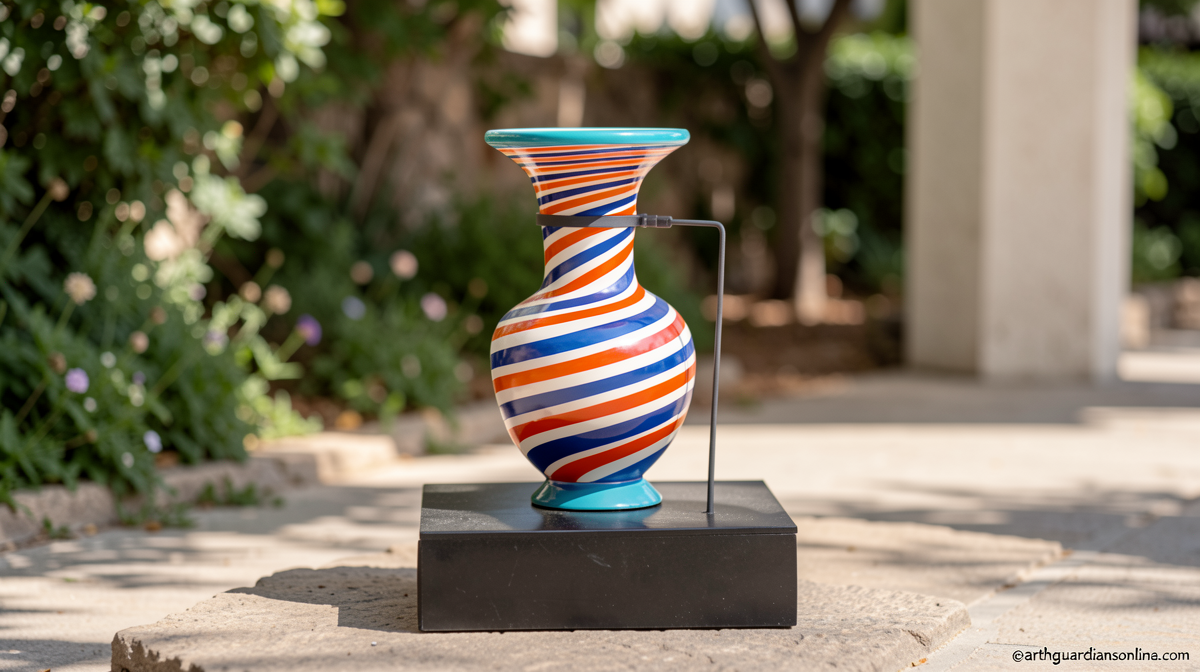
Earthguardiansonline.com – Among the hundreds of thousands of imperial treasures housed in China’s Forbidden City collections, one small object stands apart from everything else on display. It is not porcelain. It is not cloisonné enamel. It is not jade or lacquer. It is blown glass — a material that, in the eighteenth-century Chinese imperial context, carried the unmistakable fingerprint of European workshop traditions. Standing just over eight inches tall, the vase twists with ribbons of red, white, and blue glass set against an emerald-green base and rim. The effect is startlingly modern: a spinning barbershop pole rendered in molten silica, the kind of decorative object that would sit incongruously on a mid-century coffee table.
Yet the piece carries the reign mark of the Qianlong Emperor, whose six-decade rule in the eighteenth century produced an extraordinary volume of commissioned art. The characters stamped or inscribed on the vase’s body place it firmly within the output of one of history’s most prolific imperial patrons.
An Emperor Who Believed More Was Always More
Daisy Wang, Deputy Director and Chief Curator at the Hong Kong Palace Museum, which displayed the vase on loan from the Beijing Palace Museum through August of this year, describes Qianlong’s aesthetic appetite in terms that sound almost contemporary in their excess.
“He loved the profusion of colors, and textures, and all kinds of fine things,” Wang said. “He always thought, ‘more is more.'” Under his six-decade rule, art production flourished.
The glass vase, with its busy swirl of color and its refusal to leave any surface plain, would have fit that appetite perfectly. Marco Almeida, Senior Vice President at Christie’s Asia Pacific and the house’s Head of Chinese Ceramics and Works of Art, notes that compared with the decorative porcelain of the same period — where, as he puts it, “little white space would be left” — the glass piece represents a deliberate departure from restraint.
Where the Glass Came From
China had been working with glass since the Western Zhou period, more than two millennia before Qianlong took the throne. But by the eighteenth century, European glassmaking had advanced well beyond what Chinese workshops could replicate domestically. Other glass vessels produced in the Qing court tended to be small, plain, and single-toned. This vase broke that pattern entirely.
“Suddenly, you have this vase with multiple colors, and a style of decoration that was alien,” Almeida said. “I think the emperor must have been quite taken by it and quite pleased.”
The most likely explanation, according to Wang, is that the piece was either crafted directly by a European missionary or produced using techniques and raw materials introduced by missionaries who ended up employed within the imperial workshops. A precedent existed: during the Kangxi emperor’s reign, the German Jesuit Kilian Stumpf had already begun overseeing glass production inside the court system. The Qianlong court, much like the Mughal court in India, drew artisans from across China and from abroad into its service.
“Putting myself in Qianlong’s shoes, he would consider the vase to be really beautiful, different and novel. That was the value,” Wang said.
The Craft Behind the Swirl
The Hong Kong Palace Museum describes the manufacturing process in terms that evoke a confectioner’s bench. Artisans pulled hot colored glass into thin strands, adhered those strands to the vessel’s body, and rolled the piece repeatedly while it cycled through heating and cooling, allowing the interlocking pattern to set. The technique Almeida identifies as analogous to the “latticino” method long practiced in Venetian glassmaking.
What makes the object a cultural hybrid rather than a mere import is its silhouette. The form of the vase — its proportions, its mouth, its foot — is Chinese. The reign mark is Chinese. Only the decorative technique and the multicolored glass itself carry European provenance.
“It’s the perfect, and clear-cut marriage of what is Chinese and what is Western,” Almeida said.
Rarity and the Question of Value
The Beijing Palace Museum holds more than 300,000 porcelain pieces spanning thousands of years of Chinese ceramic history. Against that backdrop, the number of glass vases in the collection is, in Wang’s word, a “handful.” Scarcity of this kind pushes the object into a category where conventional auction pricing breaks down.
“Borderline priceless,” Almeida called it.
The Workshop Behind the Emperor
The zaobanchu — the network of imperial workshops scattered across the Forbidden City complex and provincial sites — operated during Qianlong’s reign with nearly one thousand artisans under its banner. These workshops contained dozens of specialized departments covering painting, textile production, wood carving, material science, and every other discipline required to execute the emperor’s commissions. Wang, who is curating a forthcoming exhibition on imperial workshops at the Hong Kong Palace Museum opening in September, characterizes Qianlong’s management style in language that would feel at home in a modern corporate critique.
“He was a micromanager in today’s company culture.”
He documented objects meticulously, issued specific instructions on design, proportion, and scale, and enforced compliance through penalties that could include the forfeiture of an entire year’s salary. The artisans worked under that pressure, producing work of extraordinary technical ambition — including, apparently, a glass vase that looks like it wandered in from a different century entirely.
The object’s existence complicates any simple narrative of cultural isolation in eighteenth-century China. It shows a court that absorbed foreign technology selectively, married it to indigenous form, and stamped the result with imperial authority. The swirling glass ribbons are not a concession to Western taste; they are a demonstration of imperial capacity to command every material, every technique, every color available anywhere on earth, and bend it to the emperor’s will.
Related Reading
Frequently Asked Questions
What is A Qing Dynasty vase 200 years?
A Qing Dynasty vase 200 years is the main topic of this guide. The article explains the context, practical details, and next steps readers should understand.
Why does A Qing Dynasty vase 200 years matter?
A Qing Dynasty vase 200 years matters because readers are looking for a useful answer, not just a short summary. Good content should match search intent and help them decide what to do next.