Trump administration threatens to demolish Kennedy Center if renovations aren’t allowed

Daftar Isi
Kennedy Center Lawyers Float Demolition Scenario as Renovation Fight Escalates in Federal Court
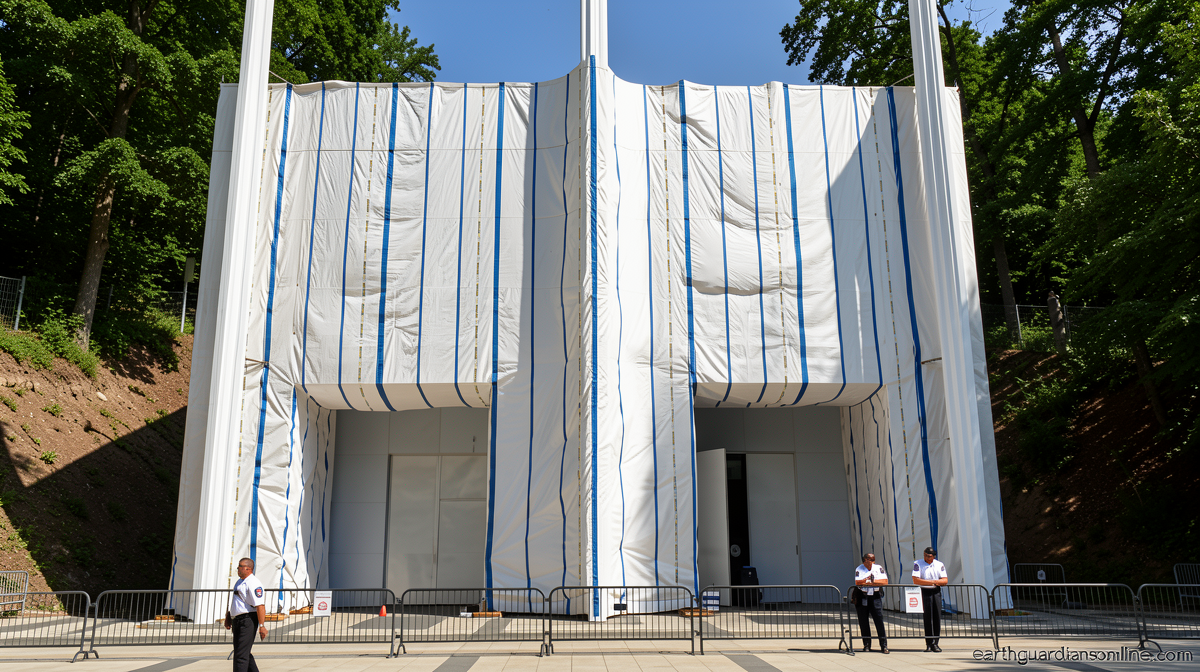
Earthguardiansonline.com – The iconic mid-century modernist complex along Washington’s Potomac waterfront could face complete teardown, according to court filings submitted Monday by attorneys representing the Kennedy Center. If the landmark performance-arts institution cannot carry out the sweeping structural overhauls its leadership has demanded, the lawyers warned the building will continue to decay until it must be razed entirely. In that scenario, they suggested, the site might be reimagined as a large-scale outdoor amphitheater facing the river — a concept that has circulated in planning circles for years but has never gained formal traction.
“will deteriorate further into an unsafe, decrepit structure that will be required to be taken down.”
The filing, lodged before a federal judge, frames the renovation as an existential necessity rather than a discretionary upgrade. The lawyers tied the urgency directly to President Donald Trump’s push to close the venue for what they described as a multi-year rehabilitation project. Without that work, they argued, the center’s aging infrastructure will cross a threshold from merely worn to genuinely hazardous, leaving demolition as the only responsible option.
“on what to build on the site, such as a large outdoor amphitheater overlooking the Potomac River that has been proposed, by some, for many years.”
A Board Aligned With the White House, and a Judge Who Said No
The Monday papers arrived just days after the center’s governing board — now populated heavily by Trump loyalists — voted once more to shutter the facility for the proposed renovations. That vote, and earlier ones, have drawn sustained judicial scrutiny. Earlier this year, a federal judge intervened to halt the closure plan, ruling that the board had acted unlawfully in authorizing the shutdown. The institution’s leadership has continued pressing its agenda despite that ruling, and the latest filing reads as an attempt to pressure the court by raising the stakes: cooperate with the renovation timeline, or face the prospect of a demolished landmark.
The Kennedy Center, opened in 1971 and named for President John F. Kennedy, has long served as one of Washington’s principal stages for opera, ballet, theater, and concert music. Its Brutalist-and-modernist architecture, designed by Edward Durell Stone, has drawn both admiration and criticism since its debut. The building’s concrete shell, mechanical systems, and acoustic infrastructure have aged over five decades, and periodic maintenance debates have surfaced before. What distinguishes the current episode is the political velocity behind the renovation mandate and the willingness of counsel to invoke demolition as leverage in an ongoing litigation.
The Naming Fight: Beatty Challenges Trump’s Name on the Facade
Running parallel to the renovation dispute is a second legal battle over the center’s identity. The board has voted, again, to inscribe Trump’s name on the building’s front facade and in other areas under the center’s control. US District Judge Casey Cooper is scheduled to hold a hearing Thursday on a motion filed by Democratic Representative Joyce Beatty of Ohio, who seeks to block the inscription.
Beatty contends that adding the sitting president’s name to the structure would contravene federal naming statutes and would also run afoul of a prior ruling by Cooper himself. That earlier decision held the center could not be renamed in a way that honored both Trump and the 35th president simultaneously — a constraint rooted in the original dedication and in federal rules governing the naming of public buildings. The congresswoman’s position is that the facade already carries Kennedy’s name, and that grafting a second presidential name onto the same structure creates a legal and symbolic conflict the court has already flagged.
Notably, the Monday filing does not confirm whether the demolition-and-replacement scenario was actually tabled at a board meeting held earlier this month. It surfaces instead in the context of arguments defending the board’s authority to proceed with the naming change, suggesting the lawyers are using the demolition language as rhetorical reinforcement for their broader institutional-control narrative.
Why the Dispute Matters Beyond One Building
The Kennedy Center sits at the intersection of federal patronage, presidential politics, and the governance of a quasi-public cultural institution. Its board, though technically independent, has become a vehicle for executive-branch preferences in recent months. The renovation question — whether the building can be closed for years, who decides that closure, and what happens if the work stalls — is entangled with questions about whether a sitting president’s name may be permanently affixed to a federally supported arts venue.
For audiences, artists, and the surrounding D.C. arts ecosystem, the practical stakes are immediate: a multi-year closure would eliminate one of the capital’s largest performance spaces, disrupt touring seasons, and upend contracts for hundreds of performers and technicians. The demolition scenario, while presented as a worst-case contingency, introduces a further layer of uncertainty into an already volatile institutional environment.
Judge Cooper’s Thursday hearing on the naming motion will be watched closely as a bellwether for how much latitude the court will grant the board in reshaping the center’s public identity. Whatever the outcome, the filings make clear that the Kennedy Center’s next chapter — whether written in concrete, in steel, or in court orders — will be decided under intense political pressure and with the Potomac amphitheater idea lingering as a ghost in the margins of the argument.
Related Reading
Frequently Asked Questions
What is Trump administration threatens to demolish Kennedy?
Trump administration threatens to demolish Kennedy is the main topic of this guide. The article explains the context, practical details, and next steps readers should understand.
Why does Trump administration threatens to demolish Kennedy matter?
Trump administration threatens to demolish Kennedy matters because readers are looking for a useful answer, not just a short summary. Good content should match search intent and help them decide what to do next.