An encounter with NASA’s game-changing ‘starglasses’

Daftar Isi
- A New Eye Opens on the Cosmos: Inside the Technology Behind NASA’s Roman Telescope
- Ghost Ancestors and the Missing Links in Human Evolution
- When Science Funding Runs Dry: Marmots Meet OnlyFans
- August’s Full Moon and a Partial Lunar Eclipse
- The Ganges Shark: A River Predator Never Seen Alive
- Related Reading
- Frequently Asked Questions
A New Eye Opens on the Cosmos: Inside the Technology Behind NASA’s Roman Telescope
Earthguardiansonline.com – The Nancy Grace Roman Space Telescope stands on the edge of launch, potentially lifting off as early as this weekend from Cape Canaveral. If the countdown proceeds without interruption, humanity’s most ambitious next-generation observatory will begin its journey into deep space, carrying instruments designed to peer at phenomena no ground-based or previous orbital telescope has been built to observe directly.
The telescope bears the name of NASA’s pioneering chief of astronomy, a scientist who championed the idea that space-based observatories were indispensable to modern astrophysics. Roman is intended to complement — not replace — the landmark discoveries already delivered by the Hubble Space Telescope and the James Webb Space Telescope. Where those earlier missions mapped the visible and infrared universe with unprecedented clarity, Roman is engineered to probe the invisible scaffolding of the cosmos: dark matter, dark energy, and the large-scale structure that binds galaxies into filaments and voids.
“Roman will investigate dark matter, dark energy and the structure of the universe itself, and accelerate the future of discovery of potentially habitable planets outside our solar system,” said NASA Administrator Jared Isaacman when the completed telescope was unveiled in April.
The “Starglasses” Coronagraph
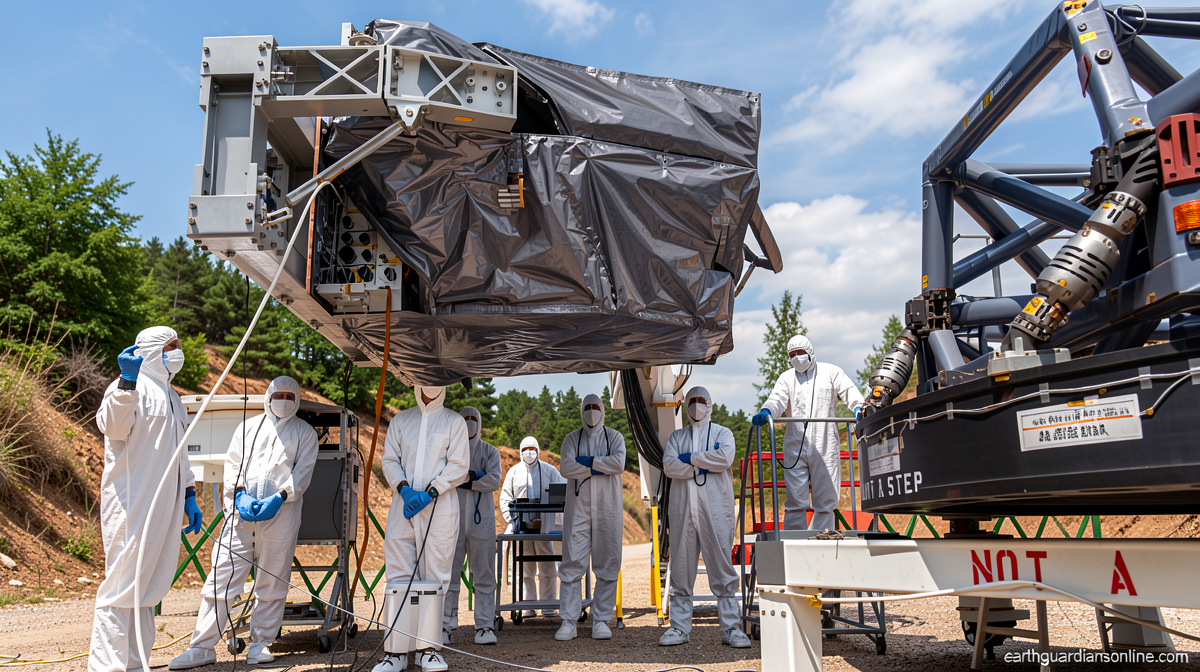
Among the instruments aboard Roman is an experimental coronagraph, informally nicknamed “starglasses,” whose purpose is to suppress the overwhelming glare of nearby stars so that fainter objects orbiting them can be imaged. The device employs flexible mirrors capable of adjusting their shape in real time, maintaining nanometer-scale precision even as the telescope tracks across the sky. In principle, this technology would allow Roman to detect faint, Jupiter-mass planets circling other stars and, under favorable conditions, to identify atmospheric features such as cloud bands on those distant worlds.
The coronagraph’s ultimate ambition goes further: if it performs as modeled, the instrument could one day be pointed at nearby star systems to search for small, rocky, Earth-analog planets and assess whether conditions exist that might sustain life. That prospect is what drew the author of this account into a blindingly white clean room at NASA’s Jet Propulsion Laboratory in Pasadena, California, three years ago.
Every visitor to that facility must don a full-body white “bunny suit” that covers everything except the eyes. The coronagraph’s optical surfaces are so vulnerable to particulate contamination that the team enforces a strict no-entry list: no makeup, no lotion, no scented products of any kind may be present on a person’s skin. To give visitors a sense of the instrument’s internal architecture without risking contamination, the team provides a pair of virtual-reality glasses that render every component and its spatial relationship to neighboring parts. This VR-assisted walkthrough is a standard early step in assembling instruments of comparable complexity.
Spending time with the engineers who spent years developing the coronagraph — and hearing their hopes for what it might reveal — makes clear the scale of dedication required to build a single space mission. Each mirror, each actuator, each thermal control loop represents thousands of hours of design, fabrication, and testing before the instrument ever leaves the laboratory.
Ghost Ancestors and the Missing Links in Human Evolution
In a separate thread of modern biology, researchers studying contemporary human DNA have identified two previously unrecognized ancestral lineages — so-called “ghost” populations — that left no recoverable fossils but did leave identifiable signatures in present-day genomes. Neanderthals and Denisovans, by contrast, are anchored by both skeletal remains and ancient DNA extracted from those remains, giving scientists a direct molecular bridge between the fossil record and modern genetic variation.
The two newly inferred lineages lack that bridge. No ancient DNA has yet been recovered from them, so their connection to the genetic marks they deposited in our genomes remains inferential. Scientists have now developed a refined computational method to reconstruct these lost branches of the human family tree with greater resolution. One of the two lineages appears to have interbred with Homo sapiens in Africa more than 50,000 years ago. The second carries a far more tenuous and enigmatic genetic signature, its precise relationship to known populations still unresolved.
When Science Funding Runs Dry: Marmots Meet OnlyFans
Not every scientific challenge involves dark matter or ancient genomes. A team at the University of California, Los Angeles, lost federal funding for a decades-long behavioral study of yellow-bellied marmots and turned to an unlikely revenue stream: the subscription platform OnlyFans. Under the banner “OnlyMarms,” the scientists share footage of scurrying, roly-poly rodents — occasionally punctuated by PG-rated scuffles between the animals — as a safe-for-work alternative to the racier content typical of the site. The arrangement keeps the long-running ecological observations funded while giving the public a small window into alpine mammal behavior.
August’s Full Moon and a Partial Lunar Eclipse
Look up this weekend and you will find August’s full moon hanging in the night sky. The silvery disc’s full illumination also set the stage for a partial lunar eclipse that peaked just after midnight on Friday. Earth’s shadow swept across portions of the Moon’s visible face, dimming the surface in a slow, moody progression. Observers across North and South America captured images of the event as the shadow crept over the lunar terrain.
The Ganges Shark: A River Predator Never Seen Alive
Among the planet’s most elusive vertebrates, the critically endangered Ganges shark has never been photographed alive. It is one of only three shark species known to inhabit freshwater rivers. Scientists track its dwindling populations in parts of Pakistan, India, Bangladesh, Malaysia, and Myanmar primarily because the animal surfaces as fishing bycatch — an incidental catch that confirms presence without ever yielding a clear image of the animal in its natural habitat. Its continued rarity underscores how little is known about riverine elasmobranch ecology and how quickly such populations can vanish once river systems are altered by dams, pollution, and overfishing.
Related Reading
Frequently Asked Questions
What is An encounter with NASA s game?
An encounter with NASA s game is the main topic of this guide. The article explains the context, practical details, and next steps readers should understand.
Why does An encounter with NASA s game matter?
An encounter with NASA s game matters because readers are looking for a useful answer, not just a short summary. Good content should match search intent and help them decide what to do next.