Roger Federer tells CNN Sports he’s prepared for happy tears at Hall of Fame induction

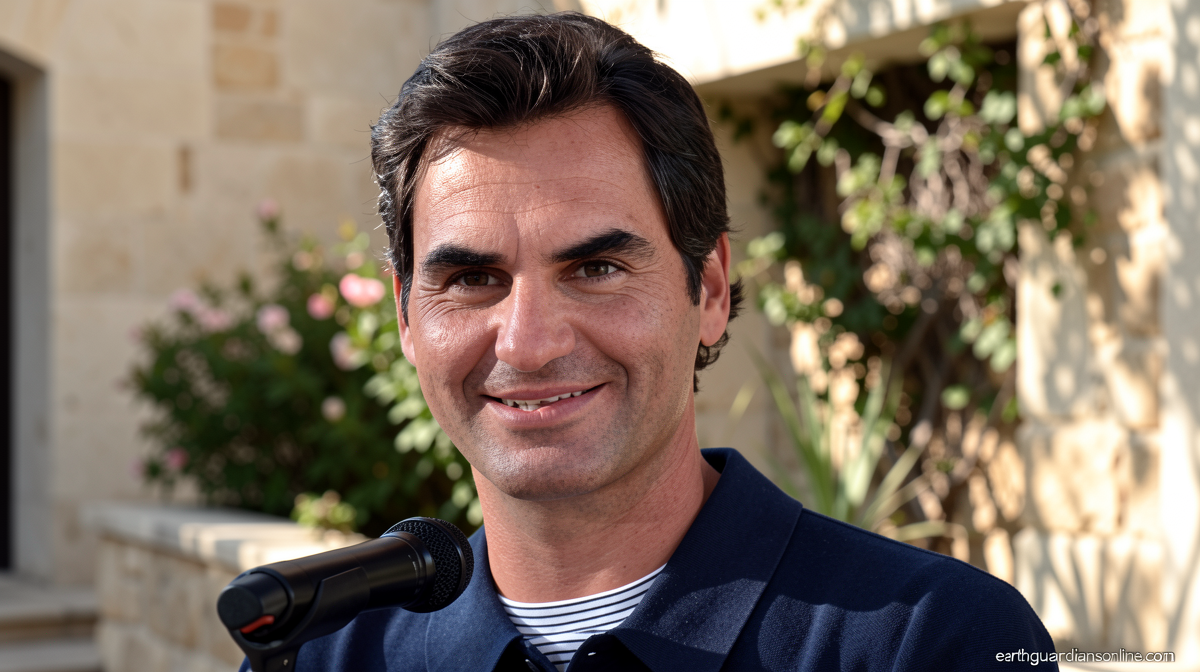
Federer’s Hall of Fame Tears: CNN Sports Interview
Earthguardiansonline.com – This weekend in Newport, Rhode Island, the International Tennis Hall of Fame will induct a player whose induction speech may end in more emotion than the institution has ever hosted. Roger Federer tells CNN Sports that he expects tears — not a single polite wipe, but the full, unscripted kind. With his parents, wife, four children, coaching staff, and physiotherapists all expected in the audience, the Swiss legend concedes the moment could become something far more personal than a rehearsed thank-you.
“If I’m speaking about the game and all the gratitude that I have, and having my entire family there – from my parents to my wife to my four children and my whole team from coaching staff and physios, etc. I think it could hit home very hard.”
Asked what happens if the dam actually breaks mid-address, he answers with a shrug and a coin-toss metaphor: “We’ll see.” The self-awareness is characteristic. He has spent two decades being the most visibly emotional figure in professional sport, and he no longer pretends otherwise.
Where the Tears Began
The template was set on a single afternoon in July 2001. Federer had just beaten Pete Sampras on Centre Court at Wimbledon — his first match on that surface — and the release was instantaneous. He dropped to his knees, shook his hero’s hand, and felt emotions flood him in a way that startled even himself.
“I go to my knees, (then) I shake hands with Pete and he’s my hero … and these emotions came all over me. And I was like, ‘What is going on?’ This is not who I am normally.”
From that moment forward, trophy ceremonies, farewell addresses, and post-match interviews carried a recurring motif: visible, unapologetic tears. By any reasonable metric, no player in the Open Era has cried as publicly or as often. The release was never weakness; it was the cost of holding a standard that left no room for ordinary frustration.
Peak Years and the Record Books
The path to Hall of Fame consideration was sealed in 2004, when he claimed three of four grand slam singles titles and seized the world number-one ranking. That summit was held for 237 consecutive weeks — a streak that still stands as the all-time record in men’s tennis. The following year produced a win rate above 95 percent.
2006 remains the season most cited as his absolute peak: three major championships, twelve titles overall, and a 92-5 record translating to a 94.8-percent win rate. Few players have sustained comparable output across an entire calendar year. By 2009 the question was no longer whether he could surpass Pete Sampras’ long-standing benchmark of 14 grand slam titles. He did so at Wimbledon that summer and ultimately reached 20 majors before Rafael Nadal and Novak Djokovic each pushed past that mark. For a generation that watched his rise, the greatest-of-all-time debate was, for them, already settled.
The Illusion of Effortlessness
A persistent narrative held that his playing style was almost casual — a light touch, a relaxed posture, a ball drifting off the racket with minimal visible force. He has pushed back against that reading for years.
“It looked like I wasn’t actually hitting the ball so hard. But it was kind of flying off of my racket with a lot of power. People always thought, like, ‘It’s so simple for you,’ because it looked like elastic. But it wasn’t the case. There was a lot of work and effort put into it.”
The double bind was maddening, he recalls. Defeat drew criticism for not trying harder; victory drew the comment that everything was effortless. He suggests the emotional toll of carrying that expectation — the “massive sacrifice” and internalized pressure — explains why so many post-match moments ended in tears.
Life After the Last Serve
Since his farewell in 2022, he has settled into a rhythm that suits him. Fatherhood, philanthropy through the Roger Federer Foundation, investment ventures, and occasional business commitments fill his calendar without demanding the sustained competitive pressure that defined his playing years. He describes everyday life at a slower pace as something he genuinely enjoys. Travel, however, remains. “I’ve always been a guy who loves being on the road,” he notes — a line that underscores how deeply the touring lifestyle was woven into his identity beyond the court.
FAQ
When and where is the Hall of Fame induction? The ceremony takes place this weekend in Newport, Rhode Island, at the International Tennis Hall of Fame.
How many grand slam titles does Federer hold? Twenty, a total he reached after surpassing the previous record of 14 set by Pete Sampras.
What was his longest reign at world number one? 237 consecutive weeks, still the all-time record in men’s tennis.
Did he compete after 2022? No. His final professional match came in 2022, after which he transitioned to family life, philanthropy, and business.