Trump’s triumphal arch will cause a slew of ‘adverse’ effects, administration admits — but its plans are staying

Trump’s Arch: Administration Admits Historic Damage
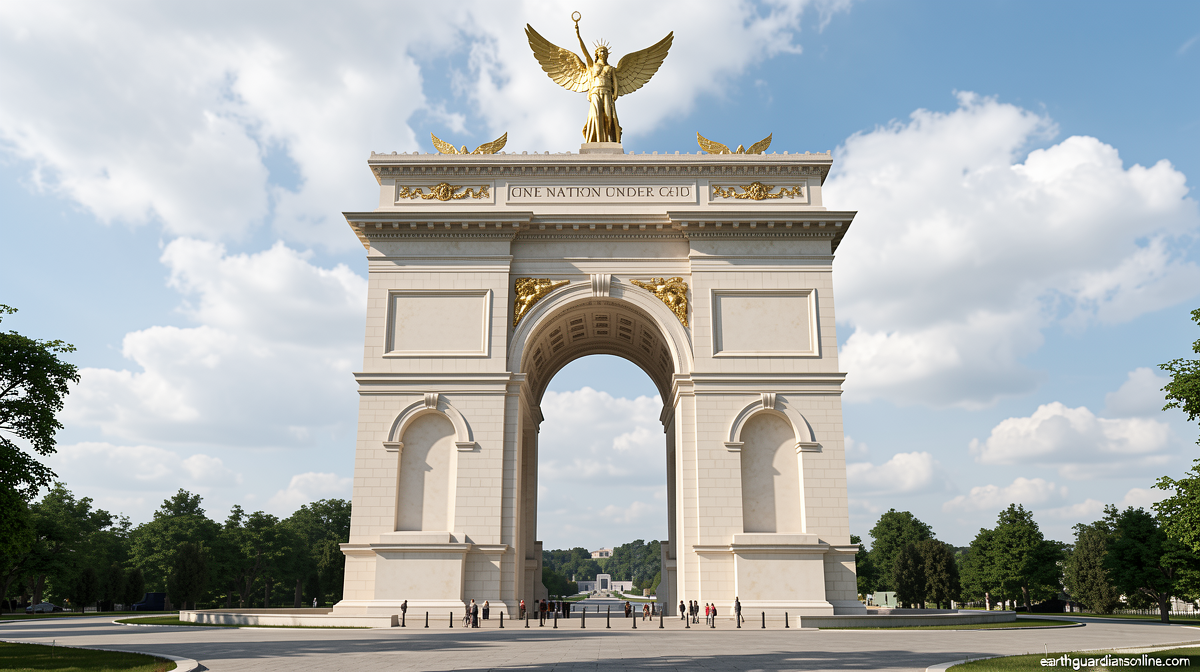
Earthguardiansonline.com – The National Park Service has formally conceded that Trump’s triumphal arch will inflict measurable harm on at least three dozen historic landmarks along the Potomac River corridor. The 133-page report, released Friday, confirms that the proposed 250-foot structure at Memorial Circle — the traffic island between the Lincoln Memorial and Arlington National Cemetery — would disrupt the design continuity of some of the nation’s most iconic ceremonial settings and permanently alter sightlines to surrounding monuments.
Yet the same bureau within the Department of Interior that manages the parcel of land where construction is contemplated declared the project “inherently location dependent” and “not interchangeable” with any other placement. In practical terms, the agency closed the door on relocation as a viable alternative while simultaneously documenting the damage the structure would cause.
What the Report Found
The most concentrated adverse effects fall on six landmarks in the immediate vicinity of the proposed site. These include Arlington National Cemetery itself, the Lincoln Memorial corridor, and Arlington House — the restored home where General Robert E. Lee lived before departing to command the Confederate army, now preserved as a memorial. Once completed, the arch would be visible from as far away as the U.S. Capitol, the Georgetown waterfront, and the Pentagon, inserting a massive new silhouette into vistas that have remained unchanged for generations.
The Park Service acknowledged an uncomfortable paradox: the very qualities that make Memorial Circle fragile from a preservation standpoint are, in its view, what render it the historically fitting location for a commemorative gateway between the capital and the cemetery. Avoiding the project’s effects entirely, the agency argued, would require either moving the structure away from the historically identified site or stripping away its principal commemorative feature — steps it deemed incompatible with the undertaking’s stated purpose.
Alternatives Weighed and Rejected
The report disclosed that the agency examined several alternatives before settling on the current design. Options included scaling the arch down, relocating it to an entirely different site, proceeding with no construction at all, and removing the proposed statues that would crown the structure’s apex. None were adopted. Each rejected option, the agency concluded, would either produce “greater impacts to historic properties” or fail to satisfy what it called the “location-dependent purpose of the undertaking.”
In lieu of avoiding the damage outright, the report proposed a catalogue of mitigation steps, including a meadow management program for the adjacent Lady Bird Johnson Park and an interpretive program along the Lincoln-to-Arlington House corridor. The agency nonetheless conceded, in language that drew sharp criticism, that post-hoc documentation or compensation does not erase the adverse-effect finding itself.
“Mitigation measures that document, interpret, or compensate for adverse effects after they occur do not negate an adverse effect finding.”
Critics Call for Congressional Action
The report lands amid ongoing legal disputes over whether the president possesses the authority to commission such a structure on federal land without congressional authorization. Veterans’ organizations, historic-preservation specialists, and a vocal public campaign have all pressed objections, citing preservation law, landscape integrity, and questions of executive overreach.
Ed Stierli of the National Parks Conservation Association framed the finding as confirmation of what preservationists have long warned: the more closely the site is examined, the more historic places the arch would obscure.
“Every time the Park Service looks harder at this site — the ceremonial gateway between Washington and Arlington National Cemetery — it finds more historic places this arch would stand in front of,” Stierli said. “Widening that assessment is the right thing to do, and it makes it that much harder to justify a 250-foot arch.”
Frequently Asked Questions
Where exactly is the arch planned? Memorial Circle, a traffic island on the Potomac River between the Lincoln Memorial in Washington, D.C. and Arlington National Cemetery in Virginia.
How many historic sites would be affected? The report identifies adverse effects on at least three dozen landmarks, with the most concentrated impacts falling on six sites in the immediate vicinity.
Can the arch be moved? The Park Service concluded the project is “inherently location dependent” and ruled that alternative locations outside Memorial Circle are “not reasonable avoidance alternatives.”
What mitigation measures were proposed? A meadow management program for Lady Bird Johnson Park and an interpretive program along the Lincoln-to-Arlington House corridor, among other steps.
Does the report authorize construction? No. It documents adverse effects and weighs alternatives. The question of presidential authority to commission the structure without congressional authorization remains under legal dispute.