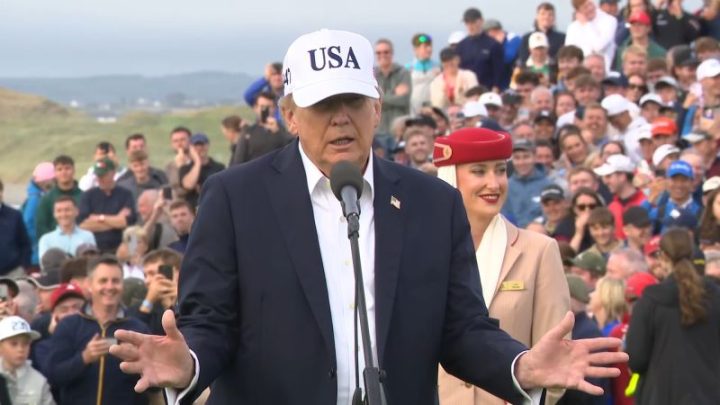
Trump says US reaches deal with Venezuela to control 65 billion barrels of country’s oil reserves

Daftar Isi
A 65-Billion-Barrel Gamble: Washington Locks In Majority Control of Venezuela’s Oil Wealth
Earthguardiansonline.com – With gasoline prices hovering above four dollars per gallon and midterm elections roughly two months away, President Donald Trump announced Friday night that the United States has finalized a sweeping oil arrangement with Venezuela — one he characterized as more than doubling the nation’s proven petroleum reserves. The deal, negotiated through Secretary of State Marco Rubio and Secretary of War Pete Hegseth alongside Venezuela’s interim leader Delcy Rodríguez, grants Washington majority control over more than 65 billion barrels of proven reserves, all at no direct expense to American taxpayers.
“At my direction, Secretary of State Marco Rubio, and Secretary of War Pete Hegseth, working closely with Highly Respected Interim President of Venezuela, Delcy Rodriguez, and, through a partnership with private business, have secured majority U.S. control of more than 65 BILLION BARRELS of proven Oil Reserves in Venezuela, at no cost to the American Taxpayer.”
The announcement lands at a moment of acute energy-market stress. A prolonged conflict with Iran has knocked roughly one-fifth of global oil supply offline for half a year, and commercial stockpiles have thinned dramatically in recent weeks. The United States’ own emergency petroleum reserves have not been this depleted since the early 1980s, leaving both bond-market investors and ordinary voters increasingly impatient with sustained high pump prices.
What the Agreement Actually Grants
A White House official described the structure in detail: the negotiated arrangement gives the United States 55 percent of the effective output from a newly created private joint venture — a company that, by reserves alone, would rank as the second-largest private oil enterprise on Earth. Under the framework, Rodríguez has authorized a private operator to hold 100-year concessions across Venezuelan oil fields, with the venture structured as a joint project between the US government and that private operator.
The official elaborated that Washington has secured more than half the total value of the new oil giant, divided between direct equity ownership and a guaranteed at-cost off-take arrangement. As production scales up, the resulting steady flow of low-cost crude within the Western Hemisphere would be directed toward replenishing the US Strategic Petroleum Reserve and meeting the fuel requirements of the American military.
“This Historic Transaction MORE THAN DOUBLES American Oil Reserves, greatly increases our Oil Supply, and will substantially lower Gas Prices for all Americans, long into the future, while helping to continue to set Venezuela on a course toward Tremendous Success and Great Prosperity.”
The Political Road to This Moment
The deal did not emerge in a vacuum. Earlier this year, US forces executed a large-scale military operation that captured Venezuelan President Nicolás Maduro, transporting him and his wife to New York to face criminal charges. In the aftermath, Trump publicly pledged that American firms would be mobilized to rebuild Venezuela’s battered petroleum sector.
By January, the Venezuelan legislature — with Rodríguez’s backing — passed a legislative amendment lowering barriers for foreign companies to participate in the country’s oil industry. That legal groundwork made the current concession structure possible. Venezuela, which sits atop the largest proven oil reserves of any nation on the planet, had long kept its hydrocarbon sector under tight state control; the shift toward long-term foreign concessions marks a fundamental reorientation of its energy governance.
Market and Strategic Implications
The timing of the announcement is difficult to separate from domestic political calculus. With the national average gas price above four dollars and midterm voters watching their wallets, a headline that promises “substantially lower gas prices” carries obvious electoral weight. The Iran conflict’s disruption of global supply has made the prospect of a new, hemispheric source of at-cost crude particularly attractive to Washington’s energy planners.
For global markets, the entry of a US-controlled entity into Venezuela’s oil fields could reshape supply dynamics over the coming decade. Venezuela’s reserves, while enormous, have been underproduced for years due to infrastructure decay, sanctions, and state-sector inefficiency. Unlocking even a fraction of that capacity through a well-capitalized joint venture would add meaningful barrels to a market already strained by the Middle East disruption.
Caracas’s Framing
Rodríguez issued her own statement Friday night, casting the arrangement in developmental rather than extractive terms. She emphasized that the objective was to consolidate Venezuela’s standing as a major energy-producing nation and to channel the country’s vast reserves toward domestic priorities.
“Our goal is to move toward consolidating our position as an energy-producing power, putting our immense reserves at the service of national development, job creation, increased income for our workers, and the well-being of our people.”
Rubio, speaking shortly after Trump’s social-media post, framed the deal as a mutual benefit, projecting nearly $100 billion in private investment into the Venezuelan economy and thousands of high-paying jobs tied to reconstruction of the oil sector.
“For the Venezuelan people, this deal will bring nearly $100 billion in private investment, support thousands of high-paying jobs, and drive the reconstruction of Venezuela’s economy.”
Open Questions
The announcement raises several questions that will shape implementation over the coming months. How will the 100-year concessions be monitored and enforced? What share of revenue will flow to the Venezuelan state versus the private operator? And how will the arrangement interact with existing international sanctions frameworks and the ongoing criminal proceedings against Maduro in New York? Until those mechanics are clarified, the deal remains a political declaration more than an operational reality — though the scale of reserves involved makes it one of the most consequential energy transactions in decades.
Related Reading
Frequently Asked Questions
What is Trump says US reaches deal?
Trump says US reaches deal is the main topic of this guide. The article explains the context, practical details, and next steps readers should understand.
Why does Trump says US reaches deal matter?
Trump says US reaches deal matters because readers are looking for a useful answer, not just a short summary. Good content should match search intent and help them decide what to do next.