A fire devastates the Eagle’s Nest retreat built for Hitler in Germany. A suspect is detained

Daftar Isi
Fire Damages Eagle’s Nest, Historic Nazi-Era Site in the Bavarian Alps
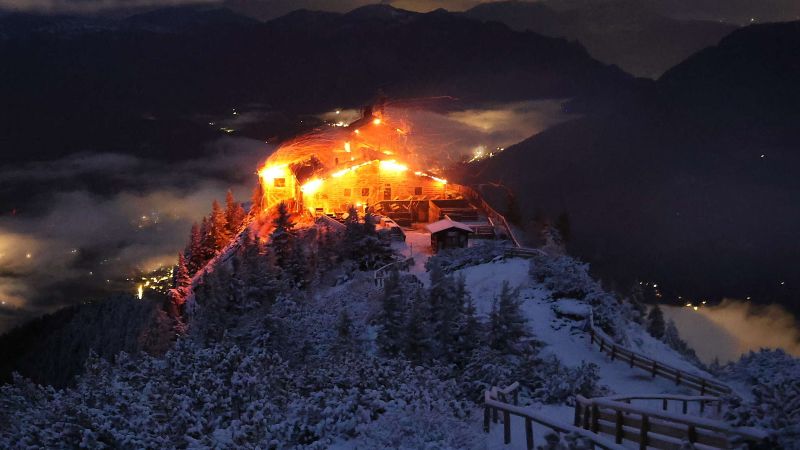
Earthguardiansonline.com – A major fire has damaged the Eagle’s Nest, the mountaintop complex constructed for Adolf Hitler in southeastern Germany, after emergency crews faced snow, rain and powerful winds while trying to contain the blaze.
Authorities in the Berchtesgaden district were alerted by a fire alarm at roughly 9:15 p.m. Friday. The site sits high in the Bavarian Alps, at the end of a narrow mountain route that passes through tunnels before reaching the cliffside building.
Firefighters and police heading uphill could already see flames in the distance. On the same road, they encountered a motorcyclist traveling down the mountain and detained him. Prosecutors said the man, a 33-year-old German citizen with connections to the Berchtesgaden area, is suspected of arson.
The suspect does not presently live in the district. He was questioned after his arrest, and prosecutors said he displayed signs of mental illness. Plans were being made to place him in psychiatric care. Investigators will also examine whether the history of the building could point to a political motive.
Police said there was no indication at the time that other people were involved.
Severe Weather Complicates Emergency Response
The fire created an unusually difficult operation because of both the location and the weather. Rain later changed into the first substantial snowfall of the season, while strong winds swept across the mountain. Those conditions made the already challenging access route more hazardous for responding crews.
After working for several hours, firefighters had to withdraw during the night. Officials said the danger of falling debris prevented crews from entering the building. Firefighters hoped to complete their work on Saturday, once it could be done safely.
No injuries were reported in connection with the fire.
The building is formally called the Kehlsteinhaus in German. It stands on a cliff 1,834 meters, or 6,017 feet, above sea level. Visitors normally reach it from the mountain road by using an elevator built into the rock. The road itself is not open to ordinary public traffic, though buses carry visitors there during daytime operations.
A Site With a Difficult Historical Legacy
Built during the Nazi era, the Eagle’s Nest is closely associated with Hitler, although he used it only rarely. Its dramatic position above Berchtesgaden has made it one of the most recognizable surviving structures connected to the Nazi leadership, while also placing the site within the broader historical landscape of Obersalzberg.
That landscape includes the former Berghof, Hitler’s better-known residence in the same region. The ruins of the Berghof were destroyed in 1952. The Eagle’s Nest, by contrast, remained standing and has operated as a café and restaurant since 1952. It also includes an exhibition explaining its past.
Farther down the mountain, the Obersalzberg Documentation Center contains the area’s principal historical exhibition. That center was not affected by the fire.
The continued use of the Kehlsteinhaus has long involved more than tourism. Its location and history make it a place where visitors encounter evidence of the Nazi period alongside efforts to explain the regime’s legacy and the importance of remembrance. Bavaria’s state government owns the building.
Officials Signal Intent to Restore the Building
Officials indicated that the Eagle’s Nest is expected to be restored, though no detailed plan had been established so soon after the blaze. Decisions about repairs and the building’s future appearance are expected to involve local authorities, historians, preservation specialists and other participants.
“We’re not going to leave a ruin there,” Bavaria’s interior minister, Joachim Herrmann, told reporters in Berchtesgaden.
Herrmann said discussions would be needed before determining what the site should look like in the future. He expressed confidence that participants could reach an appropriate outcome.
“I think we will be able to find a sensible solution,” Herrmann added.
The minister also emphasized the continuing responsibility attached to the location’s history.
“It is important that we continue to do the work of remembrance.”
The investigation into the fire remains focused on determining its cause and the suspected arson case. At the same time, the damage has renewed attention on a building that combines a spectacular Alpine setting with one of Germany’s most difficult historical inheritances. Any reconstruction will have to address both the practical task of repairing a damaged mountain structure and the wider question of how the site continues to present its past to future visitors.
Related Reading
Frequently Asked Questions
What is A fire devastates the Eagle s Nest?
A fire devastates the Eagle s Nest is the main topic of this guide. The article explains the context, practical details, and next steps readers should understand.
Why does A fire devastates the Eagle s Nest matter?
A fire devastates the Eagle s Nest matters because readers are looking for a useful answer, not just a short summary. Good content should match search intent and help them decide what to do next.