
Timmy, the stranded humpback whale, found dead off Danish coast
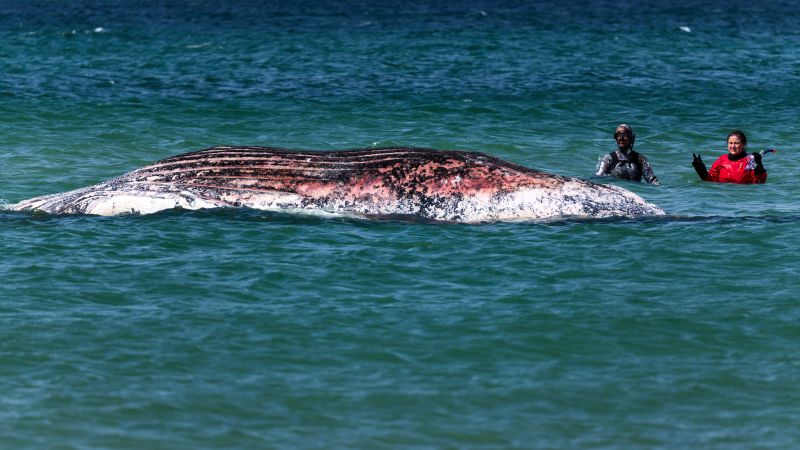
Timmy, the Stranded Humpback Whale, Found Dead Off Danish Coast
Timmy the stranded humpback whale found – Timmy, a young humpback whale that had spent several weeks in shallow waters, was discovered lifeless near the Danish coast, as reported by the Danish Environmental Protection Agency. The incident occurred just weeks after a contentious rescue operation successfully returned the creature to the sea. This event has reignited discussions about the ethical implications of intervening in nature, with contrasting opinions emerging from experts and the public alike.
A Controversial Rescue Effort
The whale, named after the German coastal town where he became stranded, had been the center of global attention after a dramatic attempt to save him. According to Jane Hansen, head of the division at the Danish Environmental Protection Agency, the same individual who had been previously trapped in German waters was identified near Anholt, an island in the Kattegat Strait between Denmark and Sweden. The confirmation came after a staff member located and recovered a malfunctioning tracking device affixed during the rescue.
“The position and appearance of the device confirm that this is the same whale that had previously been observed and handled in German waters,” Hansen stated to CNN on Saturday.
Timmy’s journey began in early March when he was spotted in Wismar harbor, Germany, entangled in fishing gear. Emergency services quickly intervened, cutting him free from the net. However, his luck ran out shortly after, as he once again became stranded near Timmendorfer Strand, a town on Germany’s northern coast, where he earned his nickname. This second incident prompted a large-scale rescue mission, with the whale’s condition being broadcast live online, capturing the world’s imagination.
Despite initial optimism, the rescue team faced significant challenges. Timmy exhibited signs of severe weakness, moving sluggishly and struggling to maintain regular breathing patterns. His skin showed signs of deterioration due to prolonged exposure to the low-salinity waters of the Baltic Sea, a factor that further complicated his recovery. As days passed, concerns grew about the whale’s ability to survive, leading to a decision to halt the rescue efforts.
Private Initiative Sparks Debate
In a bid to give Timmy a second chance, a privately funded team took matters into their own hands. They devised a plan to guide the whale into a barge, intending to transport him out to open waters. This alternative strategy, however, drew criticism from marine biologists who warned that the whale’s fragile state might not support such an action.
“I believe the whale will die very soon now,” Thilo Maack, a Greenpeace marine biologist, told the Associated Press in April. “And I would also like to raise the question: What is actually so bad about that? … Yes, animals live, animals die. This animal is really, really very, very, very sick. And it has decided to seek rest.”
While some viewed the private rescue as a bold move to maximize the whale’s chances of survival, others argued it caused unnecessary stress. The province’s environment minister, Till Backhaus, who approved the operation, defended the action as a necessary response to a life-threatening situation.
“To use even the smallest chance when a life is at stake,” Backhaus explained to the Associated Press, “is a normal response.”
The incident underscored the delicate balance between human intervention and natural processes. Timmy’s condition during his time on land was a stark reminder of the challenges faced by marine life in unfamiliar environments. The tracking device, which had been part of the original rescue effort, provided critical evidence linking the dead whale to the earlier events, solidifying the narrative of his journey from stranding to release and eventual demise.
Aftermath and Public Response
The Danish Environmental Protection Agency has decided against removing Timmy’s body, stating that it “is not currently considered to pose a problem in the area.” The agency has urged people to maintain a safe distance, citing health concerns and the possibility of the carcass exploding due to decomposition.
Timmy’s story has become a symbol of both human compassion and the complexities of wildlife conservation. While some applaud the rescue attempts as heroic efforts to save a creature from certain death, others question the ethics of prolonging his suffering. The whale’s final moments, documented through live streams and media coverage, have left a lasting impression on viewers worldwide.
Experts continue to debate the merits of such interventions. The fact that Timmy spent days barely moving, battling irregular breathing and a skin condition exacerbated by the Baltic Sea’s conditions, highlights the fragility of his situation. The decision to pursue the private rescue, despite scientific reservations, reflects the emotional weight of the moment and the public’s desire to see the whale thrive.
As Timmy’s body lies in the shallows, the event serves as a poignant reminder of the challenges faced by marine mammals in changing environments. It also raises important questions about the role of humans in rescuing wildlife. Whether seen as a triumph or a tragedy, Timmy’s story will undoubtedly shape discussions about conservation strategies in the future.
The Kattegat Strait, where Timmy’s remains were found, is a crucial migratory route for many marine species. His death near this location adds a layer of significance to the incident, as it occurs in an area where human activity and natural habitats intersect. The proximity of his stranding to where he was released also emphasizes the distance he traveled, both physically and metaphorically, in his brief time on land.
Timmy’s journey from entanglement to rescue to death has captured the hearts of many. While his death marks the end of a difficult chapter, it also highlights the resilience and vulnerability of these majestic creatures. The Danish Environmental Protection Agency’s decision to leave the carcass in place is a practical one, but it has also sparked conversations about how to honor the whale’s life in the aftermath of his passing.
For those who witnessed Timmy’s ordeal, the sight of him on the shore was a powerful moment. Yet, the eventual decision to let him go without further intervention has left some wondering if the whale’s suffering was worth the effort. As the whale’s body remains, it stands as a testament to the natural cycle of life and death, even in the face of human attempts to alter it.
The debate over Timmy’s rescue will likely continue for years, with each perspective carrying valid arguments. Some may view the private effort as a courageous attempt to save a life, while others see it as a gamble that added to the whale’s distress. Regardless of the outcome, Timmy’s story will remain a landmark in the history of marine conservation, offering lessons about the intersection of science, emotion, and action in protecting our oceans’ inhabitants.
