
Amy Sherald finds her people
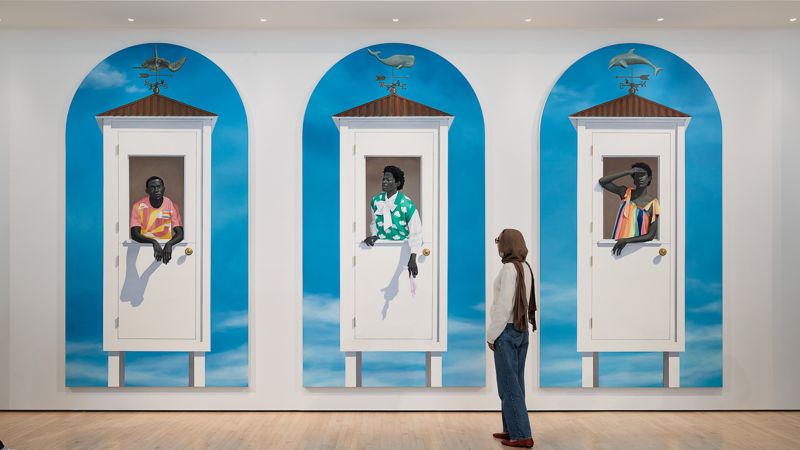
Amy Sherald Finds Her People: A Journey Through Art and Identity
Amy Sherald finds her people, a phrase that encapsulates her artistic mission of centering Black experiences in American visual culture. Her work, often characterized by a bold blend of realism and surrealism, has become a beacon for those who see themselves reflected in her paintings. The former first lady Michelle Obama’s portrait, a standout in Sherald’s oeuvre, exemplifies this ethos. Diana Beasley, a museumgoer who encountered Sherald’s art during a school project, described the piece as “a celebration of everyday Black life,” which resonates with the artist’s broader vision of redefining national narratives. Her ability to capture the essence of her subjects through grayscale tones and whimsical details has earned her critical acclaim, making her a pivotal voice in contemporary art.
The Power of Portraiture in Sherald’s Work
Amy Sherald finds her people through her striking portraits, which often challenge traditional representations of identity. The Michelle Obama piece, now a centerpiece of the “American Sublime” exhibit, showcases this approach. The former first lady’s gaze is both commanding and contemplative, her attire a vibrant contrast to the grayscale background. This visual strategy not only highlights her dignity but also invites viewers to engage with her story on a deeper level. Diana Beasley, who admires the work for its ability to “bridge the gap between the personal and the political,” noted that Sherald’s art feels “like a mirror reflecting both the struggles and triumphs of Black America.”
While the “American Sublime” exhibit was initially showcased at the Smithsonian’s National Portrait Gallery, its relocation to the Baltimore Museum of Art has sparked renewed interest. The exhibit, which began its 17-month national tour in San Francisco, includes a range of Sherald’s works, from intimate family portraits to powerful social commentaries. Her painting “Trans Forming Liberty,” which features a Black transgender woman in the Statue of Liberty’s iconic pose, has become a symbol of resistance. Sherald’s decision to withdraw the exhibit from the Smithsonian was a bold statement, emphasizing her belief that “American Sublime” should be a space for authentic storytelling, not political oversight.
From Smithsonian to Baltimore: A Shift in Cultural Narratives
The move of the “American Sublime” exhibit from the Smithsonian to the Baltimore Museum of Art underscores a growing tension between institutional narratives and personal expression. Amy Sherald finds her people through her refusal to let external forces dictate the context of her work. The Smithsonian’s pairing of “Trans Forming Liberty” with a documentary about public reactions was intended to broaden the audience’s understanding, but Sherald viewed it as an attempt to control the meaning of her art. This decision reflects her commitment to artistic freedom, ensuring that her work remains a true reflection of the communities it represents.
Robyn Palmore-Amos, a visitor to the High Museum’s opening of the exhibit, highlighted the emotional impact of Sherald’s portraits. “When I saw the paintings, it felt like the subjects could be my own family,” she said, emphasizing the universal themes within her art. The reimagined “V-J Day in Times Square” piece, which replaces white figures with a Black couple, resonates with viewers as a testament to the often-overlooked contributions of Black Americans during pivotal moments in history. Amy Sherald finds her people by giving voice to those whose stories have been marginalized, creating a space where identity is not only seen but celebrated.
Sherald’s work continues to evolve, with each piece reinforcing her mission to reclaim representation. The “American Sublime” exhibit, now on display in Atlanta, offers a glimpse into her broader exploration of American identity. Through her art, she challenges viewers to reconsider who is included in the nation’s narrative, ensuring that Black experiences are not just acknowledged but elevated. As Diana Beasley aptly put it, “Her work feels like a gift to those who have long been overlooked.” This sentiment is echoed throughout the exhibit, where every brushstroke contributes to a larger story of resilience and pride.
