
Rescuers race to reach 7 villagers trapped for a week in flooded Laos cave
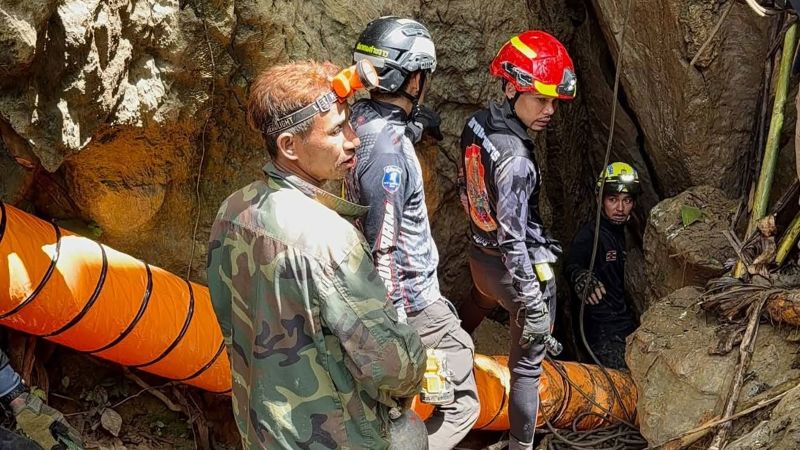
Rescuers Race to Reach Seven Villagers Trapped in Laos Cave
Rescuers race to reach 7 villagers – In a high-stakes operation, cave divers are navigating tight, waterlogged passages to locate seven villagers who have been stranded underground in a cave near the central Laotian province of Xaisomboun for nearly a week. The group entered the cave last Wednesday in search of gold, but torrential rains triggered flash flooding, sealing the exit and leaving them cut off from the surface. The Associated Press reported that both Laos and Thai rescue teams are working in tandem to coordinate the effort, which has drawn international attention due to its complexity.
The Trapped Villagers
According to the Lao News Agency, the villagers are believed to be positioned on an elevated ledge deep within the cave, which offers a steady supply of fresh air. This discovery has raised hopes that they may still be alive, despite the perilous conditions. A Thai diver, Kengkad Bongkawong, shared his assessment on Tuesday, stating that the location is “the safest spot” in the cave system. “We think they should survive,” he said, emphasizing the critical importance of the air flow to their survival.
“We think they should survive,” Thai diver Kengkad Bongkawong told CNN on Tuesday, explaining that the location of the men inside the cave is the “safest spot.”
The rescue mission has been complicated by the cave’s treacherous terrain. The divers must traverse a 340-meter tunnel, part of which is only 60 centimeters wide, requiring them to crawl on their stomachs to pass through. The Metta Tham Kalasin (MTK) Command and Control Center described the challenge, noting that the narrow corridors make movement slow and laborious. Additionally, the team is using cables and ropes to guide their way through the flooded lower sections, as captured in images shared on social media.
Rescue Challenges
Compounding the difficulties, the cave’s layout demands precise coordination among rescuers. With limited space, divers cannot cross paths, forcing them to take turns in single file. Helmets, breathing masks, and gas monitors are essential tools, helping to track oxygen levels and detect toxic gases. To sustain the operation, an “airline” system is being deployed to pump fresh air into the cave, ensuring the trapped individuals remain in a breathable environment.
Outside the cave, teams are exploring alternative routes by rappelling down four shafts discovered on the mountain above. These shafts, which connect to the underground system, are being assessed for potential access points. The rope team’s efforts are part of a broader strategy to locate the villagers and establish a viable path for extraction. “It is so narrow that you have to tilt sideways, duck low, and crawl flat on your stomach to get through,” Bongkawong described, highlighting the physical demands of the task.
“It is so narrow that you have to tilt sideways, duck low, and crawl flat on your stomach to get through,” the seasoned diver explained.
The mission’s risks are underscored by the fact that the villagers were caught off guard by the sudden flooding. A member of the group managed to escape before the exit was blocked, alerting authorities to the crisis. Bounkham Luanglath, leader of Laos’ Rescue Volunteer for People, noted that the escaped individual used a technique known locally as “boo out,” which involves wading through water to force an exit. This method, familiar only to locals, is critical for survival in such environments.
A Historic Parallel
Bongkawong, who has experience from the 2018 cave rescue of 12 boys and their soccer coach in northern Thailand, drew a comparison between the two operations. “Tham Luang was difficult to search; this cave is difficult to access,” he remarked, reflecting on the unique challenges of each scenario. The 2018 mission, which spanned two weeks, required international collaboration and cutting-edge equipment. In contrast, the current effort relies heavily on local expertise and the knowledge of the cave’s specific features.
Despite the differences, both operations share a common goal: rescuing people trapped in confined spaces. The Tham Luang cave, where the 2018 drama unfolded, was a deep, labyrinthine system that posed significant risks. Now, the team faces a different set of obstacles, including the elevated ledge’s position and the need to maintain continuous airflow for the trapped villagers. “That’s why I believe, given the geography and the living conditions of the victims, if they are in that specific area, their chances of survival are very high—very high,” Bongkawong added, underscoring the strategic advantage of the ledge.
“That’s why I believe, given the geography and the living conditions of the victims, if they are in that specific area, their chances of survival are very high—very high,” he said.
Villagers and Safety Warnings
The villagers’ decision to enter the cave for gold mining highlights a recurring issue in the region. Authorities have repeatedly warned about the dangers, but the community continues to visit the site. Bounkham Luanglath, who leads the rescue efforts, explained that the escape of one villager was vital in triggering the response. “They had to wade through the water and effectively force their way out,” he said, revealing the local term for this survival tactic.
Meanwhile, the government’s role in managing the situation is notable. As a one-party communist state, Laos maintains tight control over information dissemination. The Ministry of Foreign Affairs has been contacted by CNN for additional comments, indicating the significance of the event on the national stage. The rescue operation, therefore, carries not only the weight of saving lives but also the expectation of setting a precedent for future cave emergencies.
Technical and Logistical Efforts
Technical preparations are ongoing to optimize the rescue. A detailed map of the cave, which Bongkawong described as highly accurate, is guiding the divers through the complex network. The map’s precision is crucial for identifying the safest routes and avoiding further complications. “The environment is so challenging that even minor errors could lead to delays or hazards,” the diver noted.
Logistically, the operation is being supported by multiple teams working in tandem. Pumping water from the tunnels is a priority, as it reduces the risk of submerging the elevated ledge. Video footage shared by a Thai rescuer on Facebook captures the dark, water-filled caverns and the tireless work of the divers. These visuals provide a glimpse into the harsh conditions and the determination of the rescue team.
As the mission continues, the focus remains on ensuring the safety of both the trapped villagers and the rescuers. The combination of natural challenges and human expertise is making this rescue possible. With each step forward, the team hopes to bring the villagers to the surface, marking a significant moment in Laos’ ongoing efforts to manage such crises. The outcome of this operation may also influence future safety protocols for cave exploration in the region.
Conclusion
The rescue in Xaisomboun province is a testament to the resilience of both the divers and the local community. While the villagers face uncertain conditions, the coordinated efforts of international and national teams are pushing the boundaries of what is possible in such an environment. As the operation unfolds in a mountainous area known for its rich mineral deposits, the success of this mission could have far-reaching implications for cave rescue strategies in Southeast Asia.
