
‘The thing I do best in life is build’: How Trump has made construction his second job as president
Trump’s Construction Obsession: Building as a Presidential Priority
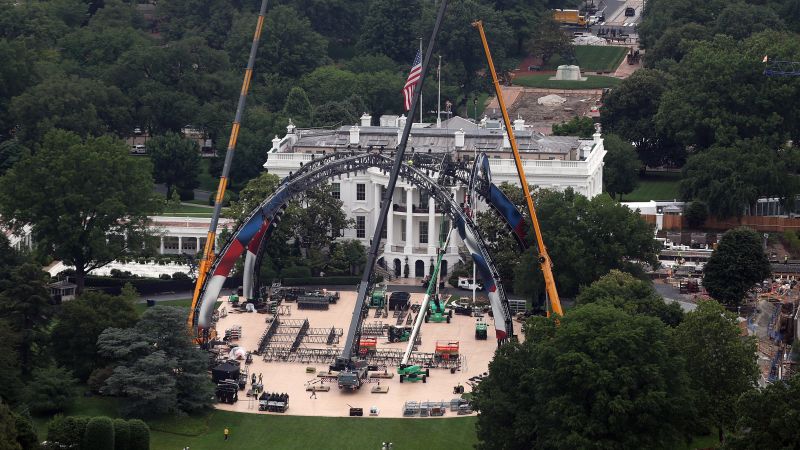
The thing I do best in life – President Donald Trump, known for his flair for the dramatic, has turned construction into an integral part of his presidential responsibilities. While the White House remains his primary workplace, his dedication to architectural projects has grown to the point where it rivals the attention given to policy decisions. This week, the South Lawn of the White House is dominated by a temporary arena for an upcoming UFC event, a project that has taken precedence over other administrative tasks. The massive structure, visible from the North Lawn, is a testament to Trump’s belief that physical transformation is as vital as political strategy.
The East Wing Ballroom: A Constant Focus
Earlier this month, as he exited the Oval Office, Trump engaged an associate in a detailed discussion about the East Wing ballroom. He insisted certain elements were absent from the latest renderings, questioning the placement of columns and their aesthetic impact. This exchange, occurring on the same day the U.S. engaged in negotiations to resolve the Iran war, underscored how deeply he intertwines his personal ambitions with the presidency. The ballroom, a centerpiece of his redesign plans, has become a recurring topic in his meetings, with Trump often referencing it as his most significant undertaking.
Trump’s approach to construction is marked by his hands-on involvement, a contrast to his predecessors who often delegated such tasks to specialized teams. While past leaders focused on streamlining decision-making and limiting staff access to the Oval Office, Trump sees design as an extension of his leadership. His presence in meetings is notable, not just for his opinions but for the tangible materials he brings—fabric swatches, tile samples, and images—that suggest a level of detail rarely seen in high-level discussions. One source described this as “a display of meticulousness that surprises even those who work closely with him.”
From Oval Office to World War II Memorial: Aesthetic Reforms
Trump’s influence on the White House’s appearance began subtly. His initial proposal to gild the Oval Office—a design choice he proudly labels as “real gold leaf, not the fake stuff”—spilled into the Roosevelt Room. This trend continued with his vision for the East Wing, which now boasts a grand ballroom designed to rival his Mar-a-Lago estate. The transformation isn’t limited to interior spaces; he has also directed changes to the exterior, including the installation of new flagpoles and a helipad on the lawn. His ambition extends to the World War II Memorial, where he plans to repaint the fountain’s base, a move reminiscent of his efforts to alter the Reflecting Pool.
These projects reflect a broader strategy: to rebrand the White House as a symbol of his personal brand. During a recent Cabinet meeting, he elaborated on his vision, suggesting that the ballroom’s design should be the tallest arch in the world. Sources noted that his enthusiasm for these details often overshadows other discussions, with his insistence on specific finishes and layouts creating a ripple effect throughout the administration. “He feels like he’s the mastermind behind every detail,” one anonymous official remarked, highlighting how his involvement has reshaped the planning process.
Public Reaction and Political Calculus
Despite his fervor, Trump’s construction initiatives have not been universally welcomed. A source close to the president hinted that these projects were strategically timed for his second term, allowing him to focus on them without the pressure of an impending election. “It’s politically toxic, any way you slice it,” the individual said, adding that the constant scrutiny of the White House’s transformation has drawn criticism from the public. Yet, Trump remains undeterred, framing construction as the bedrock of his legacy. “I’m a really good builder. The thing I do best in life is build,” he told reporters last week, his voice echoing over the noise of ongoing renovations.
His dedication to building is so profound that it has become a secondary job. “I have two jobs,” he recently stated, “one is politics, and the other is construction—which is like relaxation for me because I’ve been doing it all my life.” This perspective underscores his view that physical projects are not merely decorative but essential to his political identity. The former real estate mogul’s insistence on technical specifics, from marble flooring to onyx countertops, has led to a unique blend of luxury and functionality in the White House. Even the Lincoln Bedroom bathroom, a historic space, has undergone a redesign to match his vision of grandeur.
Expansion Beyond the White House: A City-Wide Vision
Trump’s influence doesn’t stop at the White House gates. His plans have reached across the city, with the K (assuming the article was cut off here) serving as a focal point for his broader ambitions. The same meticulous attention he applies to the White House is evident in his projects elsewhere, such as the redesign of the Rose Garden to mirror the layout of his Mar-a-Lago patio. This city-wide effort includes the installation of a “Presidential Walk of Fame,” where biographies are written in his characteristic tone, and the addition of granite pavers to the West Colonnade.
His involvement in these projects is not limited to conceptual approval. Trump personally shops for materials, visiting South Florida stone showrooms to select marble and onyx for various installations. He even dictates the image of an auto-pen used to represent former President Joe Biden, ensuring every detail aligns with his personal style. This level of control has led to a sense of urgency in the construction timeline, with sources noting that he often prioritizes projects over traditional diplomatic engagements.
Despite the criticism, Trump maintains that his efforts are a necessary investment in the nation’s image. “We’re not just building a space; we’re building a legacy,” he argues, emphasizing how each project contributes to a larger narrative of American reinvention. The temporary arena for the UFC event, for instance, is not only a logistical necessity but also a stage for his public persona, blending entertainment with presidential symbolism. As the White House continues to undergo his signature transformation, it’s clear that for Trump, construction is not a diversion—it’s the cornerstone of his political career.
His relentless focus has also impacted the White House’s daily operations. During a Memorial Day visit to Arlington National Cemetery, he dedicated six minutes to inspecting columns on the North Portico, a detail that reflects his obsession with precision. This habit has led to a constant state of flux in the executive mansion, with staff navigating the tension between Trump’s vision and the need for efficiency. Yet, for the president, the chaos is part of the process. “When I decide something, I want it done immediately,” sources said, capturing the urgency that defines his approach to construction.
As the summer progresses, Trump’s projects remain a defining feature of the White House. Whether it’s the renovation of the Rose Garden, the strategic placement of flagpoles, or the ongoing debate over the East Wing ballroom’s design, his influence is unmistakable. While some question the political cost of his attention to these projects, others see them as a bold statement of his leadership style. In Trump’s eyes, the act of building is not just a professional endeavor—it’s a personal mission, one that he believes will resonate with the American public for years to come.
